

Hall Pass - January 28, 2026

Welcome to Hall Pass, a newsletter written to keep you plugged into the conversations driving school board governance, the politics surrounding it, and education policy.
In today’s edition, you’ll find:
- On the issues: The debate over the Texas Education Agency’s Required Literary Works List
- School board filing deadlines, election results, and recall certifications
- Five states have formally opted into the federal school choice tax credit
- Thirty-one states have released official AI guidance for K-12 public schools
- Extracurricular: education news from around the web
- Candidate Connection survey
Reply to this email to share reactions or story ideas!
On the issues: The debate over the Texas Education Agency’s Required Literary Works List
In this section, we curate reporting, analysis, and commentary on the issues school board members deliberate when they set out to offer the best education possible in their district. Missed an issue? Click here to see the previous education debates we’ve covered.
This week, the Texas State Board of Education (SBOE) will vote on a list of mandatory literary readings for all K-12 public school students. According to the Texas Education Agency (TEA), which released the proposed list on Jan. 9, “[t]here is an academic need to ensure students read a common literary canon that increases in difficulty over time.”
In Texas, SBOE members are elected. Republicans hold 10 of the seats and Democrats hold five. Texas is one of eight states in which voters will elect new state board of education members in 2026.
The Literary Works List would make Texas the only state with mandated literary readings for all grade levels. HB 1605, which Gov. Greg Abbott (R) signed in 2023, requires the SBOE to select “at least one literary work to be taught in each grade level.”
Readings include Beatrix Potter’s “The Tale of Peter Rabbit” in first grade, C.S. Lewis’ “The Lion the Witch and the Wardrobe” in fifth grade, Anne Frank’s diary in eighth grade, and everything from Booker T. Washington’s “Up From Slavery” to Jane Austen’s “Pride and Prejudice” in high school. The list also includes 11 readings from the Bible. Click here to see the full list.
Here’s how education analysts are responding to the proposed list.
Retired public school English teacher and education commentator Peter Green, who writes the blog Curmudgucation, says the Literary Works List forecloses debate over which books schools should teach and leaves no room for teachers’ expertise and judgement. Green argues politics played a role in the selection of the list, which he says features an insufficient number of authors of color or women. Green says the TEA should instead create a broad reading list and allow educators to use their discernment when assigning books.
Texas Public Policy Foundation Education Director Matthew McCormick, a former high school English teacher, says the Literary Works List will provide students with an age-appropriate and well-rounded immersion in important works of literature. McCormick argues the current approach to reading education is too decentralized and has allowed schools to expose students to ideologically driven texts and de-emphasize reading whole books. McCormick says the readings will not only educate but also inculcate virtues.
TX: State Mandated Canon | Peter Greene, Curmudgucation blog
“Should teachers just pick whatever-the-hell list of works they feel like? Absolutely not. But neither should they be locked into a list set by state officials (particularly when those officials seem at least if not more concerned about political concerns rather than literary or pedagogical ones). Set up some guardrails, create a broad and varied list, and give schools and local English departments the ability to choose from a set list. Let professional educators use some of the judgment that you hire them to use.”
Important changes coming to Texas students’ required reading list | Matthew McCormick, Texas Public Policy Foundation
“C.S. Lewis said, ‘Since it is so likely that children will meet cruel enemies, let them at least have heard of brave knights and heroic courage.’ English education should promote literacy and literary understanding, but, as art has the power to shape hearts, the stories students read should impart in them powerful lessons and morals, not grievance or narcissistic navel-gazing. This new literature list ensures that every public school student in Texas leaves school literate and worldly.”
School board update: filing deadlines, election results, and recall certifications
In 2025, Ballotpedia will cover elections for more than 30,000 school board seats. We’re expanding our coverage each year with our eye on covering the country’s more than 80,000 school board seats.
Below is a look at the upcoming elections in the first part of this year.
Upcoming school board elections
Oklahoma
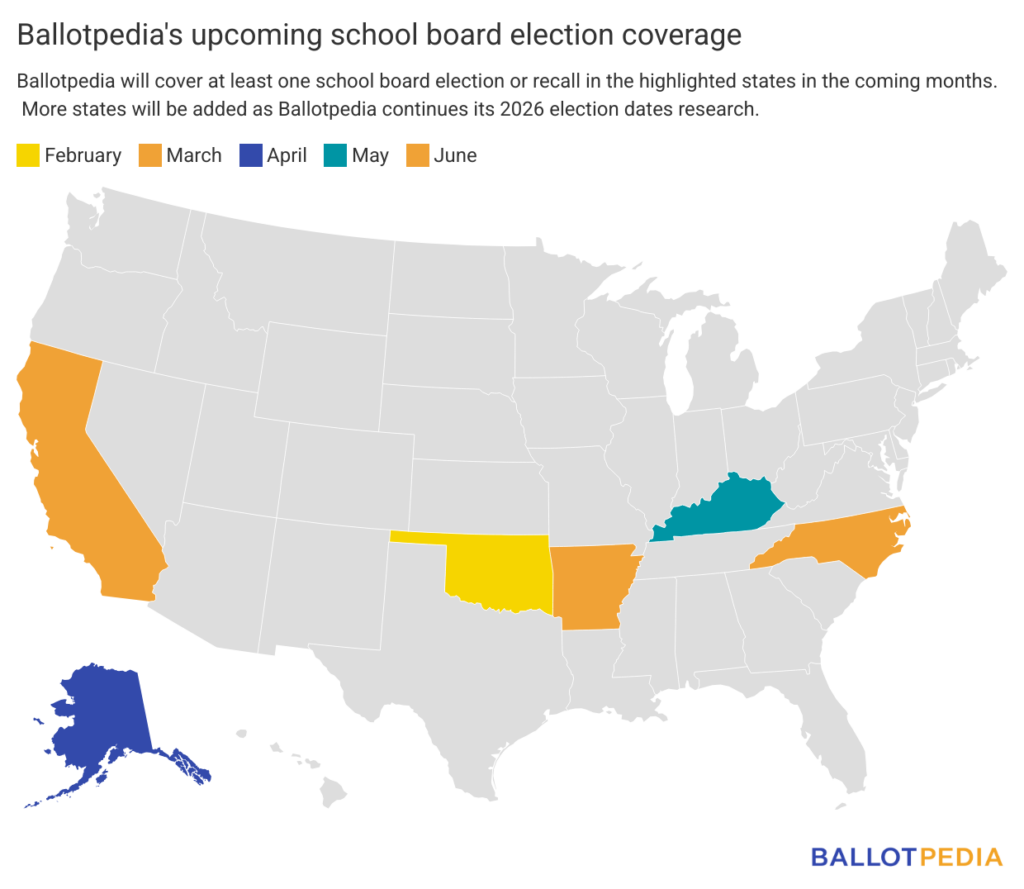
Ballotpedia is covering all school board elections in the Sooner State in 2026 (including Tulsa Public Schools, Oklahoma City Public Schools, and Edmond Public Schools—the state’s three largest by student enrollment). Districts will hold primaries on Feb. 10 and general elections on April 7.
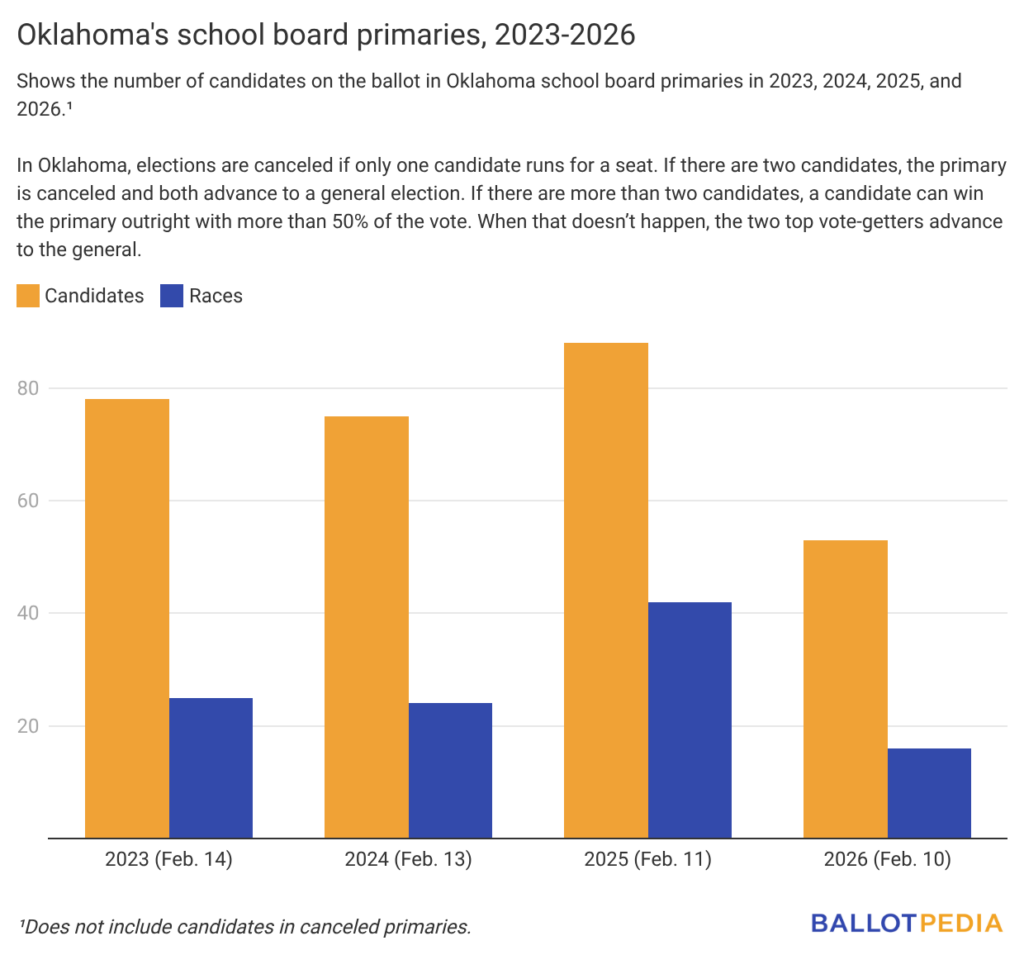
This year, Ballotpedia will cover 16 elections with 53 candidates. Last year, Ballotpedia covered 42 elections with 88 candidates.
Arkansas
Ballotpedia will cover general elections for all seven of the seats on the Little Rock School District school board on March 3. Little Rock School District is the second largest in the state, with roughly 21,000 students.
North Carolina
Ballotpedia will cover elections for several districts, including Guilford County Schools and Union County Public Schools, on March 3.
Click here to learn more about 2026 school board elections.
Five states have formally opted into the federal school choice tax credit program
While states wait for the U.S. Treasury to finalize the rules governing the nation’s first K-12 federal school choice tax credit program, titled the Education Freedom Tax Credit, a flood of officials in recent weeks has moved to opt into it. Since the start of 2026, governors or lawmakers in 11 states have indicated they would participate in the program, with five states submitting the formal paperwork to sign up.
The program was established in July 2025 when President Donald Trump (R) signed the One Big Beautiful Bill Act (OBBBA). Since then, a total of 21 states have indicated participation in the program. When the program takes effect on Jan. 1, 2027, individuals will be able to lower their federal tax liability up to $1,700 when they donate to authorized scholarship-granting organizations (SGOs). SGOs will then distribute the donated scholarship funds to eligible families for use on a variety of private or public educational expenses, including private school tuition, tutoring services, textbooks, and more.
States are required to submit a list of SGOs to the U.S. Treasury to formally opt into the program.
Activity since the start of January
- Five states — Georgia, Idaho, Mississippi, Montana, and Virginia — formally opted into the program by submitting Internal Revenue Service (IRS) Form 15714, according to public records.
- Two states — Alabama and Arizona — took official action to participate in the program through an executive order and legislation, respectively, but did not formally opt in. Arizona Governor Katie Hobbs (D) vetoed the legislation on Jan. 16.
- Governors of four states — Arkansas, Indiana, Iowa, and North Dakota — said their states would participate in the program, but did not formally opt in, according to public records.
The IRS issued a notice on Dec. 12, 2025, allowing states to submit IRS Form 15714 to make an advance election to participate in the program. The notice said that the deadline and procedure for "perfecting the [a]dvance [e]lection by submitting the State SGO list will be provided in future guidance."
As of this writing, North Dakota was the most recent state to indicate an interest in participating in the program. On Jan. 26, Gov. Kelly Armstrong (R) said, “This program incentivizes charitable giving to support our state’s most precious resource – its students. We look forward to implementing the program with additional federal guidance to empower school choice and support North Dakota students in their education.” In a press release, Armstrong’s office said the state would share eligible SGOs in the future.
Nearly half of all states have indicated an interest in joining the program since July 2025, while three states have said no
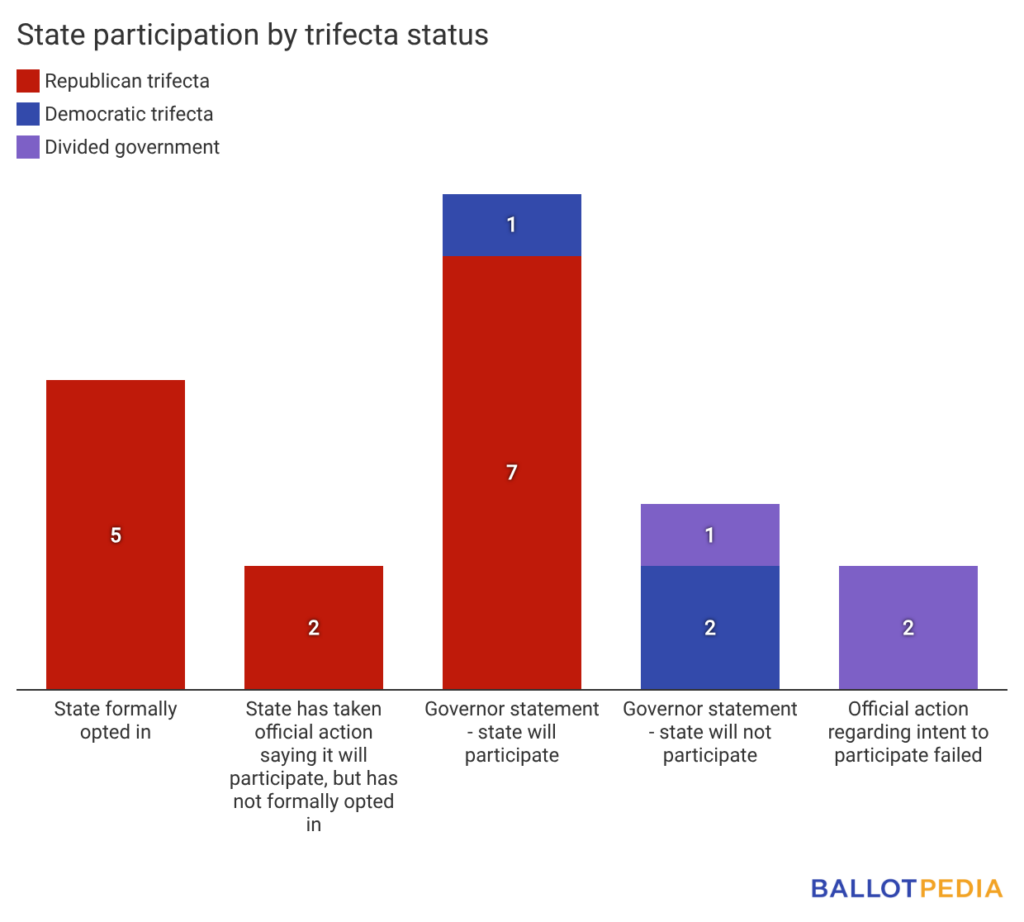
Governors or lawmakers in a total of 21 states have indicated an interest in participating in the tax credit scholarship program since July 2025. Of those states, 14 have Republican trifectas, four have Democratic trifectas, and three have divided governments.
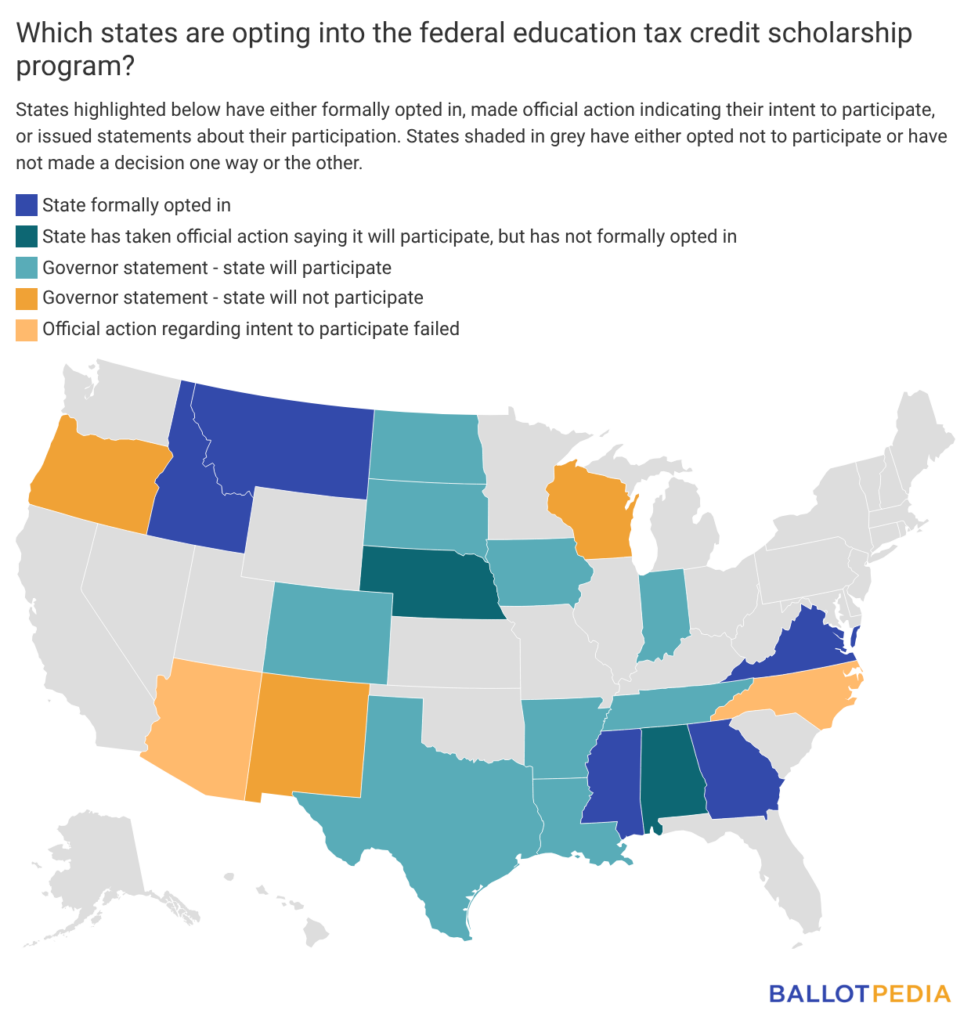
In Arizona and North Carolina, governors vetoed legislation that would have required the states to opt into the program. Both Arizona and North Carolina have divided governments.
- On Jan. 16, Arizona Governor Katie Hobbs (D) vetoed SB 1106, a budget bill that, among other provisions, would've required Arizona to participate in the federal school choice tax credit scholarship program.
- On Aug. 6, 2025, North Carolina Gov. Josh Stein (D) vetoed HB 87, a bill that would have directed the State Education Assistance Authority to submit to the U.S. Department of the Treasury a list of qualified scholarship granting organizations in the state, thereby opting the state into the federal program. In his veto message, Stein said he intended on opting the state into the program once the U.S. Department of the Treasury issues formal guidance.
Governors in three states—New Mexico, Oregon, and Wisconsin—have all said they would not opt into the program. Oregon and New Mexico have Democratic trifectas, while Wisconsin has a divided government.
Ballotpedia is closely tracking state responses to the federal K-12 education tax credit. Click here to see the latest news, a timeline of state actions, and a taxonomy of arguments for and against the program.
Thirty-one states have released official AI guidance for K-12 public schools
Schools face both challenges and opportunities as they navigate generative artificial intelligence (AI). Since 2022, when ChatGPT was released to the public, state education departments in 31 states have released official guidance to help districts understand and navigate the technology.
At the end of 2024, that number stood at 20.
While the guidance isn’t legally binding, it provides a window into how state education officials are weighing the risks and benefits of AI and telegraphing how districts should talk about it with students.
Of the 31 states that’ve released AI guidance for schools, 12 have a Democratic trifecta, 13 have a Republican trifecta, and six have a divided government.
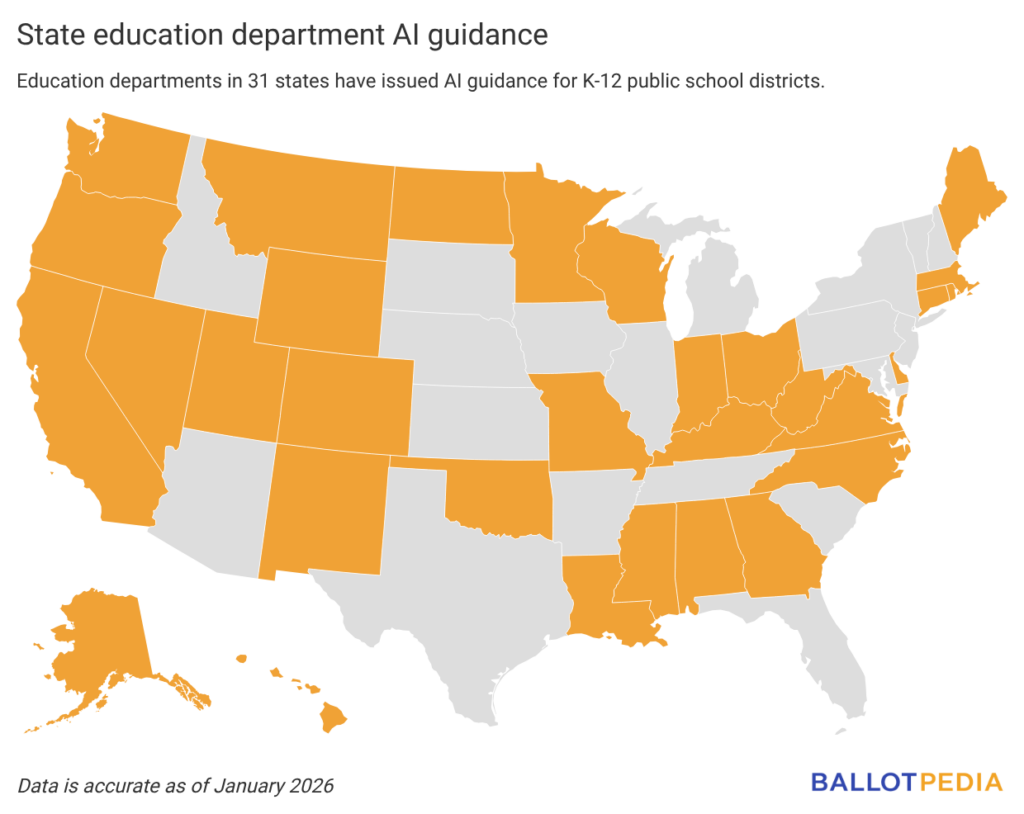
The guidance documents address some common themes. Below, you’ll find a sample of those themes, along with representative excerpts from state guidance documents:
- AI literacy: "AI literacy refers to the knowledge, skills, and attitudes associated with how AI works." (Colorado)
- Bias and ethical concerns: "AI can perpetuate social biases in training data, leading to unfair or unethical outcomes." (Delaware)
- Privacy and security: "Ensure inputs into public-facing AI tools are free from personal identifiable information (PII)." (Indiana)
- Access: "Access to AI tools may vary across families and schools, potentially widening the digital divide and creating new inequities." (Minnesota)
- Academic integrity: "Do students know how to properly document, account for, and cite AI usage in a transparent manner?" (Wyoming)
- Strategies for AI integration: "Host regular conversations with business leaders, educators, governing members, leaders, and families about AI and how schools are preparing students with the skills to thrive in an AI-infused world." (Virginia)
The documents differ in some respects, however. For example, some states, such as Hawaii and Washington, cautioned educators against using AI detection tools. Mississippi's guidance document, on the other hand, advised educators to cautiously use AI detection tools, while keeping in mind that they can be inaccurate.
In general, states have been cautious about dictating how public schools should use AI, relying on districts to develop their own rules and guidelines. However, at least two states—Ohio and Tennessee—have enacted laws requiring districts to establish AI policies. In Tennessee, Gov. Bill Lee (R) signed SB 1711 in 2024, requiring districts to establish an AI policy by July 1, 2025.
Ohio lawmakers included a similar provision in the state’s 2025-26 budget, which Gov. Mike DeWine (R) signed into law in June 2025. The law required the Ohio Department of Education and Workforce to create and share a model AI policy by Dec. 31, 2025. That policy can be found here. The law also requires districts to either adopt the state’s policy or write their own no later than July 1, 2026.
Click here to learn more about state education department AI guidance.
Extracurricular: education news from around the web
This section contains links to recent education-related articles from around the internet. If you know of a story we should be reading, reply to this email to share it with us!
- Schools Overhauled Reading Programs. Older Students Are Being Left Behind. | EdSurge
- Colorado school district may drop attorney who helped create state’s ‘first public Christian school’ | Chalkbeat Colorado
- Wisconsin superintendents ask Legislature to put politics aside and provide more funding | Wisconsin Public Radio
- Outcomes at Houston schools improve after state takeover | The Center Square
- 4 education legal and policy trends to watch in 2026 | K-12 Dive
- Could Another Federal Shutdown Affect Education? What We Know | Education Week
- Critchfield: Feds could give Idaho leeway on testing requirements | Idaho Ed News
- 25 predictions about AI and edtech | eSchool News
Take our Candidate Connection survey to reach voters in your district
Today, we’re looking at two candidates running in February school board elections.
Brandy Ann Baugh is running in the Feb. 10 primary to represent Office 1 on the Drumright Public Schools school board, in Oklahoma. Baugh’s career experience includes working as a special education teacher.
Daryn Christy and Teena Nishimuta are also running in the election.
Drumright Public Schools is located northeast of Oklahoma City, near Stillwater. During the 2023-24 school year, it enrolled roughly 420 students.
Here’s how Baugh answered the question, “What are the main points you want voters to remember about your goals for your time in office?”
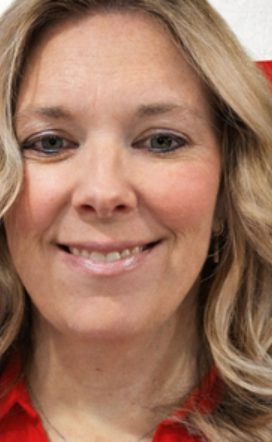
- “For higher academic opportunities
- Balanced opportunities for all students academically and in extra curriculars
- Student and teacher advocacy”
Click here to read the rest of Baugh’s responses.
Kaleena Stephan is running in the April 7 general election for one of two at-large seats on the Sun Prairie Area Board of Education, in Wisconsin. Stephan’s career experience includes working in marketing operations and data analysis.
Incumbent Isaac Sung and Gary Benjamin are also running. A Feb. 17 primary was cancelled because only three candidates ran in the race.
Sun Prairie Area School District is the 11th largest in Wisconsin, with roughly 8,400 students.
Here’s how Stephan answered the question, “What areas of public policy are you personally passionate about?”
- “Education
- Childcare
- Economic equality
- Racial/gender justice”
Click here to read the rest of Stephan’s responses.
If you're a school board candidate or incumbent planning to run this year, click here to take the survey. The survey contains more than 30 questions, and you can choose the ones you feel will best represent your views to voters. If you complete the survey, a box with your answers will appear in your Ballotpedia profile. Your responses will also appear in our sample ballot. If there is an election in your community, share the link with your candidates and urge them to take the survey!


