The Ballot Bulletin: January 23, 2026

Welcome to The Ballot Bulletin: Ballotpedia’s Weekly Digest on Election Administration. Every Friday, we deliver the latest updates on election policy around the country, including nationwide trends and recent legislative activity.
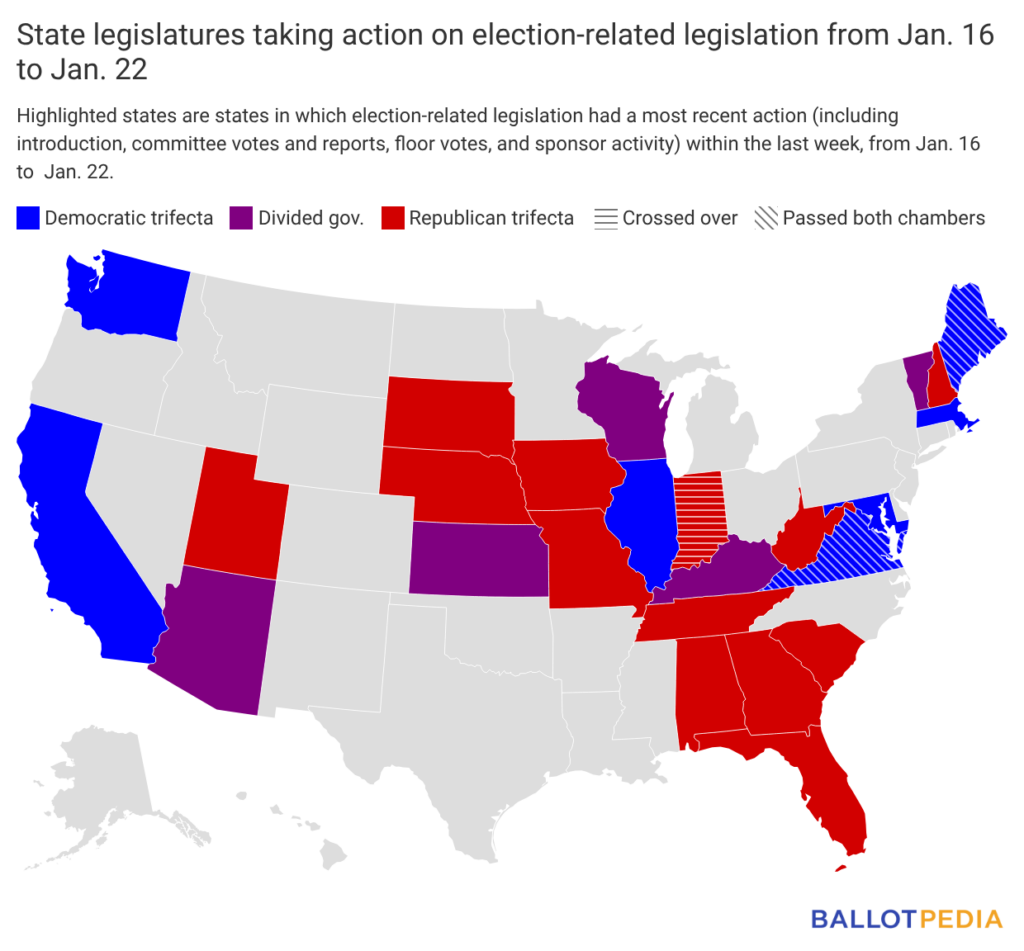
In this week’s Ballot Bulletin, we cover 137 bills state legislatures acted on in the past week. We also highlight Ballotpedia’s contribution to the legislative process in one state.
Weekly highlights
The big takeaways from the past week's legislative actions.
Lawmakers in 25 states acted on 138 bills over the last week, 97 fewer than last week. Thirty-nine state legislatures are in regular or special sessions.
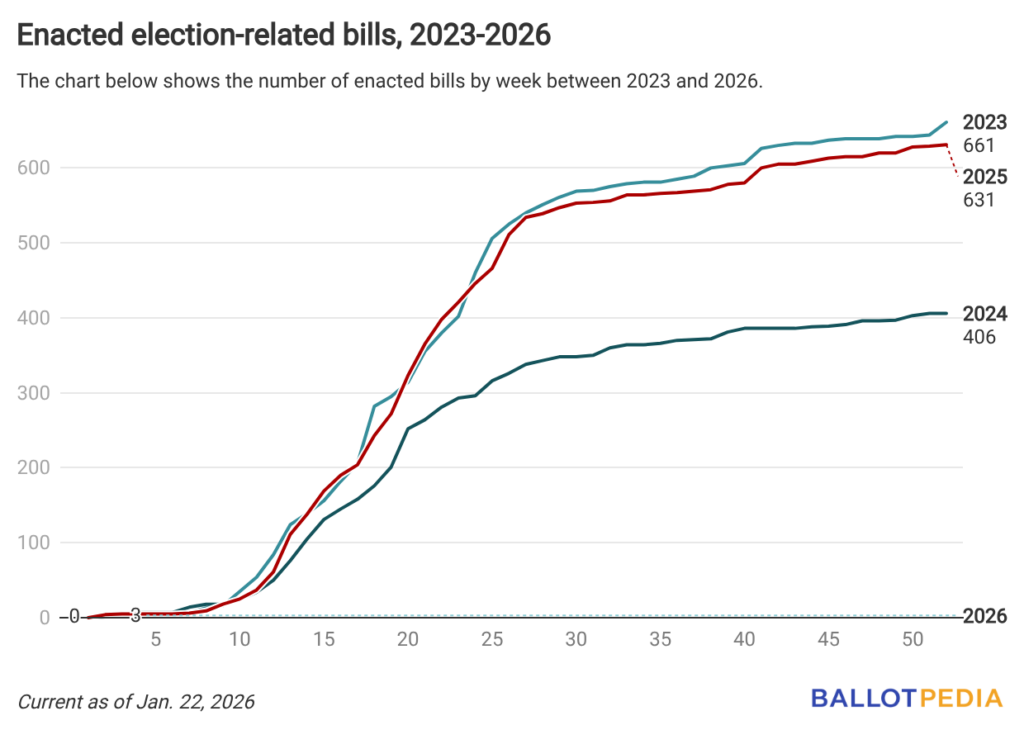
- No bills were enacted this week. One bill was enacted during the same week in 2025, one bill was enacted during the same week in 2024, and no bills were enacted during the same week in 2023.
- Legislators acted on 198 bills in 2025 and 50 bills in 2024 during the same week.
- Forty-five of the bills acted on this week are in states with Democratic trifectas, 82 are in states with a Republican trifecta, and 11 are in states with divided government.
- The most active bill categories this week were election types and contest-specific procedures (77), election dates and deadlines (36), and campaign finance (35).
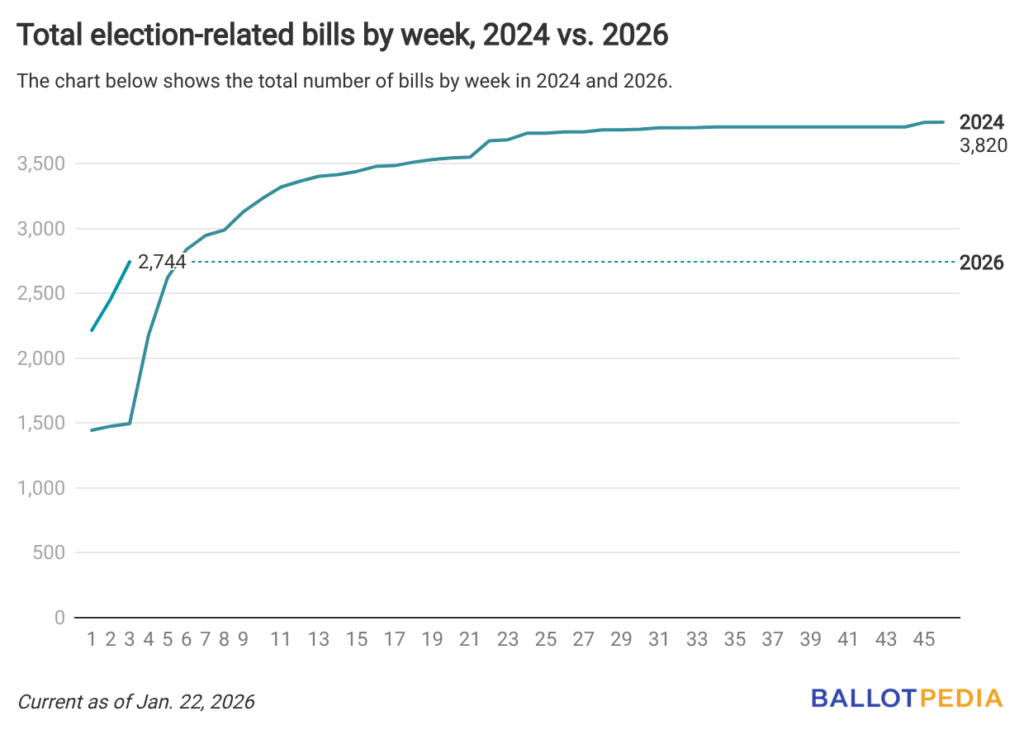
- The numbers in this newsletter include 2,744 bills. We are actively processing bills filed since Jan. 14 as legislative activity ramps up for 2026.
In Kansas, legislators on the House Elections Committee heard testimony on HB 2452 on Jan. 20, which would move elections for city and county offices, as well as school board races, from odd-numbered years to even-numbered years.
The hearing featured testimony from Ballotpedia staff writer Spencer Richardson on turnout in even and odd-numbered year elections in Kansas. Richardson’s research found that an average of 61.7% of registered voters cast a ballot in Kansas during the last four presidential elections, compared with 88.5% nationally. In the last four midterm elections, turnout averaged 46.15% in Kansas, compared with 72.56% nationally. And turnout in Kansas’ four largest counties in the last four odd-numbered year elections averaged 20.91%. Richardson also found that turnout in Kansas’ 2025 elections was around 44 percentage points lower than in the 2024 presidential election.
The House Elections Committee has not yet scheduled a vote on HB 2452.
In the news
A glance at what's making headlines in the world of election law.
- On Jan. 21, a New York judge ruled that lawmakers must redraw the boundaries of the state’s 11th Congressional District, which is currently held by U.S. Rep. Nicole Malliotakis (R). New York Supreme Court Judge Jeffrey Pearlman ordered the state’s Independent Redistricting Commission to redraw the lines before Feb. 6. It is unclear if the order will be appealed; the New York Supreme Court is the state’s highest trial court, not the court of last resort. New York would be the seventh state to redraw their congressional maps ahead of the 2026 midterm elections.
- On Jan. 20, the Indiana Senate approved a bill, SB 12, banning ranked-choice voting in the state. The legislation, which Sen. Blake Doriot (R) introduced, would make Indiana the 19th state to ban ranked-choice voting. It was approved on a 38-9 vote, with 37 Republicans and one Democrat voting in favor, nine Democrats voting against, and two Republican senators absent. The bill now heads to the Indiana House of Representatives for consideration.
- On Jan. 20, a federal judge dismissed a lawsuit challenging a Texas policy of using electronic voting equipment to randomly number ballots. U.S. District Court Judge David Alan Ezra ruled that the lawsuit was moot because the Texas Secretary of State in 2024 banned the use of electronic pollbooks to generate ballot numbers. Plaintiffs in the case have said they will appeal the decision.
- On Jan. 15, the Alabama House of Representatives approved legislation to require post-election audits. Under HB 95, each county would audit all ballots in one precinct from a randomly-selected county or statewide race. Alabama currently does not require post-election audits. The bill was approved on a 72-25 vote and now heads to the Alabama Senate for consideration.
Key movements
A look at what bills are moving and where.
No bills were enacted in the past week. One bill was enacted during the same week in 2025, one bill was enacted during the same week in 2024, and no bills were enacted during the same week in 2023. To see all enacted bills, click here.
Three bills passed both chambers of a state legislature. To see the full list of all bills awaiting
gubernatorial action, click here.
- Maine (Democratic trifecta)
No bills were vetoed in the past week. No bills have been vetoed so far this year. No bills were vetoed during this period in 2025, 2024, and 2023. To see all vetoed bills, click here.
The big picture
Zooming out to see the macro-level trends in election policy so far this year.
Enacted bills
All bills
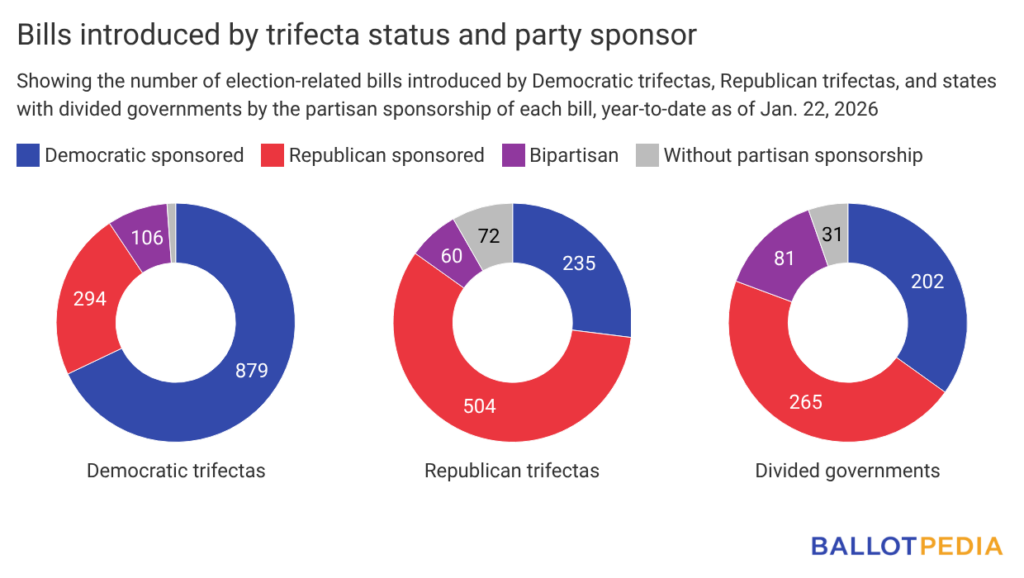
We are following 2,744 election-related bills, including bills carried over from the previous year.
- Trifecta status
- Democratic: 1,294 (47.2%)
- Republican: 871 (31.7)
- Divided: 579 (21.1)
- Partisan sponsorship
- Democratic: 1,316 (48%)
- Republican: 1,063 (38.7%)
- Bipartisan: 247 (9%)
- Other: 118 (4.3%)
We were following 1,496 bills at this point in 2024. Below is a breakdown of those bills by trifecta status and partisan sponsorship.
- Trifecta status
- Democratic: 831 (55.5%)
- Republican: 453 (30.3%)
- Divided: 212 (14.2%)
- Partisan sponsorship
- Democratic: 709 (47.4%)
- Republican: 664 (44.4%)
- Bipartisan: 101 (6.8%)
- Other: 22 (1.5%)
See the charts below for a comparison of total bills between 2024 and 2026 and a breakdown of all 2026 legislation by trifecta status and partisan sponsorship.