

El Dorado County, California, Land Use and Zoning Policies Initiative, Measure G (June 2016)

| Measure G: El Dorado County Zoning and Land Use Policies Initiative |
|---|
|
| The basics |
| Election date: |
| June 7, 2016 |
| Status: |
 Defeated Defeated
|
| Topic: |
| Local zoning, land use and development |
| Related articles |
| Local zoning, land use and development on the ballot June 7, 2016 ballot measures in California El Dorado County, California ballot measures |
| See also |
| El Dorado County, California |
An initiative concerning zoning and land use policies was on the ballot for Rancho Mirage voters in El Dorado County, California, on June 7, 2016. It was defeated by a margin of 377 votes.
This initiative was called the "Initiative to Retain El Dorado County’s Current Zoning and Rural Assets" by petitioners.[1]
| A "yes" vote was a vote in favor of enacting the proposed initiative, establishing the zoning and land use policies summarized below. |
| A "no" vote was a vote against enacting the proposed initiative, leaving the zoning and land use policies of the county unchanged. |
Election results
| El Dorado County, Measure G | ||||
|---|---|---|---|---|
| Result | Votes | Percentage | ||
| No | 30,242 | 50.63% | ||
| Yes | 29,489 | 49.37% | ||
- Election results from El Dorado County Elections Office
Overview
What was Measure G designed to do?
Some of the most notable provisions of the initiative were designed to:[2]
- prohibit new commercial and residential development if they lack existing water supplies or the ability to connect to existing public water systems;
- restrict development near agricultural areas; and
- protect “scenic corridors” and “vista points," especially along Highway 50, an area eyed by developers for new projects.[2]
Why was it proposed?
This initiative, which was backed by slow-growth activists, was written to reduce the amount of new development in the county and preserve rural and agricultural areas.[2]
The proposed initiative sought, in many areas, to restore zoning and land use policies to those found in the 2004 General Plan in order to preserve rural areas and restrict commercial, residential and industrial development. Specifically, the initiative would:
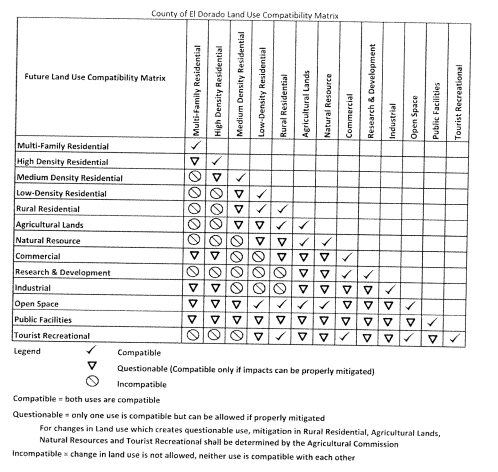
- require property zoning to match land designation in the county's general plan and establishing a Compatibility chart to govern zoning changes;
- restore a 2004 agricultural buffer standard for developments;
- restore the Mixed Use development policies to where they were in 2004;
- restore the Cultural and Historial Resource policies found in the 2004 General Plan, with an exception for Highway 49;
- largely restore water policies to those found in the 2004 General Plan; and
- enact the Scenic Corridor and Vista Point regulations found in the 2004 General Plan
Background
2014 measures
Proponents of both slow-growth initiatives on the ballot worked to put Measure O, an initiative designed to restrict and discourage residential development in certain areas of the county, on the ballot in November 2014. Two other initiatives, Measure N and Measure M, were also put before voters in 2014. All three 2014 development-related initiatives were defeated.[2]
Text of measure
Ballot question
The following question appeared on the ballot:[3]
| “ |
Shall the ordinance be adopted to (1) add, amend, or delete fifteen distinct policies in the El Dorado County General Plan concerning land use, agriculture, mixed use, cultural and historical resources, and water supply and (2) preclude El Dorado County from approving any future discretionary project until it implements twelve enumerated General Plan policies related to community design guidelines, cultural and historical resources, water supply, and scenic corridors, as more fully described in the proposed ordinance?[4] |
” |
Ballot summary
The following summary of this initiative was provided by the office of the county counsel:[5]
| “ |
The El Dorado County General Plan provides for long range direction and policy for land use within El Dorado County. The Land Use Element describes, and maps, the numerous land use designations assigned to all land within El Dorado County. Those land use designations identify the areas suitable for certain uses and limits the density and intensity of those uses. The Zoning Ordinance establishes various districts within the County. Each parcel of land is assigned to a district, which governs the uses that may take place and types of buildings that may be erected on that parcel. The zoning classification assigned to a given parcel of land must be consistent with the General Plan land use designation assigned to that parcel. Where land use designations are inconsistent with current zoning, the initiative would require that the County amend the land use designation to match existing zoning. The initiative would also require that future decisions for land use changes be based on the land use compatibility matrix attached to the initiative. General Plan Policy 8.1.3.1 generally requires that parcels created next to agriculturally zoned lands be at least 10 acres. Policy 8.1.3.2 generally requires that agriculturally incompatible uses adjacent to agriculturally zoned lands provide a minimum setback of 200 feet from the agriculturally zoned land. Policy 8.4.1.2 generally requires a setback of at least 200 feet on parcels adjacent to lands identified as timber production lands designated Natural Resource and/or lands zoned Timberland Production Zone. The initiative would revise Policy 8.1.3.2 to provide that administrative relief from the setback requirements may only be granted by the Agricultural Commission. The initiative also seeks to restore Policies 8.1.3.1 and 8.4.1.2 to their original language from 2004. “Mixed use development” is a type of development that combines various uses (such as office, commercial, institutional, and residential) in a single project. General Plan Policies 2.1.1.3, 2.1.2.5, and 2.2.1.2 allow mixed use development on parcels designated as Commercial, with maximum residential densities of sixteen dwelling units per acre in Community Regions and four dwelling units per acre in Rural Centers. The initiative seeks to restore those policies to the language in place when the 2004 General Plan was adopted. General Plan Policy 5.2.1.3 requires that all medium-density residential, high-density residential, multifamily residential, commercial, industrial, and research and development projects in Rural Centers connect to either a public water system or an approved private water system. The initiative would require that such projects connect to a public water system. General Plan Policy 5.2.1.14 requires the County to collect and make available information on water supply and demand. The initiative would require that such information recognize the water needs of existing unimproved parcels. The initiative would also delete Policy 5.2.1.7, which, in times of declared water shortages, provides priority to approving affordable housing and non-residential development projects. The initiative provides that it is not applicable within the jurisdiction of the Tahoe Regional Planning Agency and the City of Placerville and that its policies are to remain in effect indefinitely unless amended by voter approval.[4] |
” |
Compatibility chart
The following compatibility chart would, under the initiative, determine whether or not a parcel could be rezoned:
Support
Supporters
Sue Taylor, a member of Save Our County (SOC), and Laurel Stroud, a member of Residents Involved in Positive Planning (RIPP), organized the signature petition campaign to put both this initiative and an initiative designed to restrict traffic congestions caused by development before voters.[1][6]
Local Voter Control of Land Use in El Dorado County also sponsored both initiatives.[7]
The following individuals signed the official argument in favor of Measure G:[3]
- Patricia G. Chelseth of My Sisters' Farm
- Tim Taylor, owner of a building in Historic Hangtown
- Rod Pimental, owner of El Dorado Norther Lumber Company
- Bill Thorpe
- Dennis Smith, owner of Ranting Raven Fruits and Vegetables
Arguments in favor
Fran Duchamp, a county resident, told the county board of supervisors that the initiatives were needed since “the citizens of El Dorado County have been asking for clarity and protections of our way of life for decades.” She accused the supervisors and the county planning commissioners of having "continued to ignore, change, re-interpret or amend parts of the general plan that were promised to the public as protections.”[2]
Supporters of these initiatives argued that the county board of supervisors was being influenced by development and business interests, leading to large developments that were harmful to the rural nature and character of the county. The Local Voter Control of Land Use in El Dorado County website stated, "Enough is enough! The only way to control development is for citizens to take local voter control of land use through the initiative process."[8]
Official argument
The following official argument was submitted in favor of Measure G:[3]
| “ |
El Dorado County voters were promised that the 2004 General Plan would control growth, protect agriculture, limit traffic, protect open space and our water, encourage healthy economic growth, and preserve our rural quality of life. Most voters didn't realize that those protections would have to be implemented AFTER the plan was approved. To date, the Board of Supervisors has yet to implement those policies. As a result, our rural resources, jobs, forests, historic structures, native cultural sites and roads have been devastated.
Implementing protective policies will preserve our historical downtowns, cultural sites, farms, ranches, water resources and safeguard against incompatible land uses. Creating Community plans will protect the unique character of each individual community within the county, promote rural commerce and improve economic development. Measure G is endorsed by farmers, local contractors, small businesses, historians, taxpayer and environmental advocates along with the unspoken dedicated army of unpaid petition gathers who labored relentlessly to gather the necessary signatures for this measure. Vote "Yes" on Measure G to bring common sense back to controlling growth and protecting our quality of life![4] |
” |
Opposition
Opponents
The chief opponents of this initiative and it's traffic-related counterpart were from the ranks of business, development and ranching interests.[2]
The Alliance for Responsible Planning, a group that advocates for businesses, opposed both initiatives.[2][9]
Maryann Argyres, the president of the alliance, said that the initiatives would cause lawsuits, confusion and chaos.[2]
The following individuals signed the official argument in opposition to Measure G:[3]
- Jim Davies, president of the El Dorado County Farm Bureau
- Alexis Boeger, vice president of the El Dorado Winery Association
- Doug Leisz, chairman Citizens for Water
- Debbie Manning, President/CEO of the El Dorado Hills Chamber of Commerce
- Laurel Brent-Bumb, CEO of the El Dorado County Chamber of Commerce
Arguments against
Opponents of this initiative argued that it would impede smart and responsible growth, hurting the economy and the job market in the county.[9]
Official argument
The following official argument was submitted in opposition to Measure G:[3]
| “ |
Measure G threatens El Dorado County water rights, jobs and our economy. It could cost the County needed revenue and Measure G could tie the County up in costly court battles for years. EL DORADO COUNTY PREPARED AN OFFICIAL MEASURE G ANALYSIS, AND THE REPORT SHOWS THE DAMAGE MEASURE G COULD DO TO EL DORADO COUNTY: .... hurt the County's ability to maintain a reliable supply of water for farmers and residents .... hurt the local economy by preventing new jobs from being created, and making it harder for the county to produce high-paying quality jobs needed to maintain a strong local economy .... make the El Dorado County economy less diverse, which would make the county's economy more volatile and vulnerable to recessions .... result in lawsuits and legal challenges because of conflicts with existing county and state laws .... Reduce funding to repair and improve local roads and highways FARMERS OPPOSE MEASURE G BECAUSE IT PUTS EL DORADO COUNTY WATER AT RISK AND THREATENS OUR OPEN SPACE. Measure G will push development to more rural areas of the county — eating up more open space and increasing traffic on rural roads and neighborhood streets. And Measure G could further damage local farmers, ranchers and other businesses that have already been hurt by the drought, and result in higher local water rates for residents. BUSINESS LEADERS AND LABOR OPPOSE MEASURE G BECAUSE IT WILL COST JOBS, HURT SMALL BUSINESSES AND UPSET THE APPROPRIATE BALANCE BETWEEN PROVIDING A STRONG ECONOMY AND PROTECTING OPEN SPACE. Get the facts. Join farmers, business, labor, public safety, educators and other community leaders who are voting "no" on Measure G — protect our rural open space.[4] |
” |
Path to the ballot
In Fall 2014, petitioners turned in 9,858 signatures to qualify this initiative for the ballot. On October 23, 2014, the county elections office certified that 8,289 of the submitted signatures were valid, qualifying the initiative for the county election ballot. Petitioners needed valid signatures equal to 10 percent of the votes cast for governor in the county in the preceding gubernatorial election. This minimum threshold amounted to 7,757. The sufficient signature petition gave the county board of supervisors the option of enacting the initiative directly or putting it before voters on June 7, 2016. The board voted to put the measure before voters.[10]
Related measures
2016
- El Dorado County, California, Road and Traffic Congestion Policies Initiative, Measure E (June 2016)

2014
Measure M: El Dorado County Residential Subdivision or Re-zoning Restrictions
Measure N: El Dorado County Traffic and Road Improvement Funding Policies
Measure O: El Dorado County Community Region Removal and Rural Center Establishment
Recent news
The link below is to the most recent stories in a Google news search for the terms El Dorado County zoning and land use initiative Measure G. These results are automatically generated from Google. Ballotpedia does not curate or endorse these articles.
See also
|


External links

Support
- Save Our County website
- Local Voter Control of Land Use in El Dorado County website and Facebook page
Opposition
Footnotes
- ↑ 1.0 1.1 El Dorado County Elections Office, "Notice of Intent to Circulate," accessed January 12, 2016
- ↑ 2.0 2.1 2.2 2.3 2.4 2.5 2.6 2.7 The Sacramento Bee, "Defeated in 2014, slow-growth El Dorado activists gear up for 2016," November 27, 2014
- ↑ 3.0 3.1 3.2 3.3 3.4 El Dorado County Elections Office, "June 7, 2016 Local Measures," accessed April 20, 2016
- ↑ 4.0 4.1 4.2 4.3 Note: This text is quoted verbatim from the original source. Any inconsistencies are attributable to the original source.
- ↑ El Dorado County Elections Office, "A Ballot Summary for: An Initiative Measure Relating to El Dorado County Land Use Policies and Zoning," accessed January 12, 2016
- ↑ Save Our County, "Home," accessed January 12, 2016
- ↑ Local Voter Control of Land Use in El Dorado County, "Home," accessed January 12, 2016
- ↑ Local Voter Control of Land Use in El Dorado County, "Why Do We Need These Initiatives Now?" accessed January 12, 2016
- ↑ 9.0 9.1 Alliance for Responsible Planning, "Home," accessed January 12, 2016
- ↑ Local Voter Control of Land Use in El Dorado County Facebook page, "Purple petition made it!" October 23, 2014

 |
State of California Sacramento (capital) |
|---|---|
| Elections |
What's on my ballot? | Elections in 2026 | How to vote | How to run for office | Ballot measures |
| Government |
Who represents me? | U.S. President | U.S. Congress | Federal courts | State executives | State legislature | State and local courts | Counties | Cities | School districts | Public policy |


