

City of San Francisco Mission District Housing Moratorium Initiative, Proposition I (November 2015)
| Voting on Housing | |||
|---|---|---|---|

| |||
| Ballot Measures | |||
| By state | |||
| By year | |||
| Not on ballot | |||
|
An initiative establishing an 18-month moratorium on new market-rate housing in the Mission district was on the ballot for voters in San Francisco, California, on November 3, 2015. It was defeated.
If approved, Proposition I would have established a temporary, 18-month prohibition on the construction of any housing project larger than five units in the area called the Mission District. It would also have prohibited permits for the "demolition, conversion, or elimination of Production, Distribution and Repair (PDR) use" buildings, which included structures of many business-related types such as buildings for industrial, automotive, storage and wholesale uses. The initiative was designed to grant exceptions for the construction of units to be used exclusively for affordable housing.[1][2]
Although housing and development were the chief focuses of both support and opposition campaigns for Proposition I, the issue of permits for zoning conversions surfaced as another important aspect of the debate. The issue was highlighted by the opposition to Prop I from Armory Studios, which is owned by the administrators of a porn website called Kink.com. Armory Studios and Kink.com renovated a building to construct a music and entertainment venue called the Armory Drill Court in 2014 and were trying to change the zoning of the facility from PDR to Entertainment to allow for more frequent events and shows. Proposition I would have prevented this zoning change for at least 18 months.[3]
Housing was one of the most important issues in the city's 2015 election. Gabriel Metcalf, president and CEO of public policy research company SPUR, said, “It’s the No. 1 issue in every poll.” Five propositions on the ballot dealt with housing and development, either directly or indirectly, and proposed solutions for the housing availability issues facing the city were essential to candidate platforms. Voters decided housing-related propositions that addressed affordable housing bonds, restrictions on short-term rentals, a moratorium on market-rate construction in the city's Mission District, housing developments on surplus public lands and a specific development proposal on the waterfront.[4]
Election results
| San Francisco, Proposition I | ||||
|---|---|---|---|---|
| Result | Votes | Percentage | ||
 No No | 111,543 | 57.2% | ||
| Yes | 83,451 | 42.8% | ||
- Election results from San Francisco Elections Office
Text of measure
Ballot question
The following question for this measure appeared on the ballot:[1]
| “ |
Shall the City suspend the issuance of permits on certain types of housing and business development projects in the Mission District for at least 18 months; and develop a Neighborhood Stabilization Plan for the Mission District by January 31, 2017?[5] |
” |
Ballot summary
The following summary of this measure appeared on the ballot:[6]

| “ |
San Francisco's Mission District is a neighborhood roughly bounded to the west by Guerrero Street, to the south by Cesar Chavez Street, to the east by Potrero Avenue, and to the north by U.S. Route 101. A person seeking to build new housing, demolish old housing, or to change the use of a property must, among other things, obtain a permit from the City. This measure would impose an 18-month moratorium — meaning a complete suspension of City permits — on certain types of development projects in the Mission District, and would authorize a majority of the members of the Board of Supervisors to extend the moratorium for another 12 months. Specifically, this measure would prohibit the City from issuing the following types of permits for projects in the Mission District:
These prohibitions would not apply to the issuance of permits for 100% affordable housing projects. This measure would require the City to develop a Neighborhood Stabilization Plan by January 31, 2017. The goal of this plan would be to propose legislation, policies, programs, funding, and zoning controls intended to enhance and preserve affordable housing in the Mission, such that at least 50% of all new housing be affordable to low-, moderate-, and middle-income households, and to ensure that those units would be available to resident of the Mission. This measure also makes findings regarding the need for the measure.[5] |
” |
Full text
The full text of this measure is available here.
Support
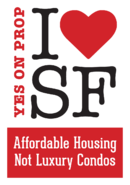
Supporters
The Committee to Save the Mission was behind this initiative and backed the Save the Mission, Vote Yes on Prop I campaign.[7][8]
A housing advocacy organization called the Tenants and Owners Development Corp (TODCO) backed the signature petition campaign for Proposition I and supported a "yes" vote in November.[2][9]
The San Francisco Labor Council endorsed a "yes" vote on Proposition I.[10]
An organization called the Yerba Buena Neighborhood Consortium also supported the measure.[11]
See this page for the full list of supporters of Proposition I, which is provided by the Save the Mission, Vote Yes on Prop I website.
|
|
Arguments in favor
John Elberling, organizer and director of TODCO, said, “The problem with any market rate development now isn’t just that it’s taking away prospective (affordable housing) sites. It’s that once you generate a critical mass of new, high-end, market-rate housing, you fundamentally change the character of the neighborhood. The invading army takes over. You can’t roll back that once it happens.”[2]
Total campaign cash  as of July 2016 (Final) | |
 Support: Support:
|
$713,462 |
 Opposition: Opposition:
|
$1,847,161 |
The Save the Mission, Vote Yes on Prop I campaign website posted the following argument in favor of Proposition I:
| “ |
Developers are throwing $1.7 million to defeat Proposition I. That's because it will delay the gravy train and allow city residents a say about how their neighborhoods are developed. Don't fall for the lies. No on Proposition I mailers are filled to the brim with statements that .... just aren't true. A livable San Francisco relies on balanced development that includes housing for working and middle class households and small businesses. Prop I provides a model for how to slow down the speculative rush and replace it with sensible and balanced planning.[5] |
” |
| —Save the Mission, Vote Yes on Prop I[12] | ||
Supporters also made the following arguments:[12]
- The city controller said Prop I would delay 85 units of housing, rather than the 1,500 units referred to by some opposition mailers.
- Prop I would delay about $1 million in tax revenue, rather than the $1 billion referred to by some opposition mailers.
Campaign finance
Final campaign finance reports showed that $713,462 was donated in support of Proposition I.[13]
The table below shows the top five largest donors in support of Proposition I.[13]
| Donor | Amount |
|---|---|
| Unite Here Local 2 | $120,000 |
| California Nurses Association | $120,000 |
| SEIU Local 1021 | $50,000 |
| United Educators of San Francisco | $31,500 |
| Yerba Buena Consortium | $25,000 |
Editorials
The San Francisco Examiner editorial board endorsed a "Yes" vote on Proposition I. The board argued that development was occurring too rapidly and that the proposition would result in slower, more thoughtful development. The board wrote:[14]
| “ |
Taking a pause from the break-neck luxury development in the Mission is a good idea for the neighborhood and for The City as a whole. The more measured and thoughtful we can be about the shifting makeup of our neighborhoods, the better. This is especially true for the Mission, which is shifting quicker than most. Proposition I arose from frustration that City Hall refused to take action to ease The City’s housing crisis in the neighborhood. Prop. I would impose an 18-month moratorium — which the Board of Supervisors could extend for another 12 months — on projects in the Mission that demolish, convert or build at least five units, excluding projects of 100 percent below-market-rate housing. There is no doubt that the new wave of market-rate developments are changing the feel and the face of the Mission, long the center of The City’s Latino population. According to Planning Department data, more than 900 low- and moderate-income families have left the Mission in the past five years, through evictions and displacement. Two dozen projects with about 1,220 units of housing are currently planned in the Mission, and as many as 85 new units could be delayed up to 18 months if Prop. I passes.[5] |
” |
| —San Francisco Examiner editorial board[14] | ||
Opposition

Opponents
The chief group formed to oppose Proposition I was called San Franciscans for Real Housing Solutions, No on I. The creation of this group was largely backed by the San Francisco Housing Action Coalition, the San Francisco Alliance for Jobs and Sustainable Growth, and the San Francisco Association of Realtors.[15][16][17]
Armory Studios created a campaign against Proposition I called Save the Music, Vote No on Prop I. Armory Studios is an entertainment company operating out of The Mission Armory, which is owned by the administrators of a porn website called Kink.com.[18]
Two top officials of Maximus Real Estate Partners, a development company behind one of the largest planned projects that would be halted by the approval of Proposition I, together donated about $200,000 to San Franciscans for Real Housing Solutions.[19] Grow SF also opposed Proposition I.[20]
Supervisor Scott Wiener wrote a ballot argument in opposition to Proposition I.[7]
Mayor Ed Lee and supervisors Mark Farrell, Julie Christensen and Katy Tang joined Supervisor Wiener in opposition to Proposition I.[2]
See this page for the full list of opponents of Proposition I posted on the Save the Music, Vote No on Prop I website.
Arguments against
Opponents of the measure argued that market-rate construction projects were needed to provide housing to the city at a time when city residents were experiencing a lack of housing. They also argued that market-rate construction boosts the city's economy and provides revenue to the city, which it can use to fund affordable housing programs and projects.[2]
Tim Colen, executive director of the San Francisco Housing Action Coalition, said, “I just don’t get how [a moratorium] is going to solve anything. We already don’t produce enough housing, so let’s wait a year or two, put a moratorium on new supply, and see if that’ll improve? I wish someone could explain to me how that works, economically.”[17]

Kink.com completed the renovation of a music and entertainment venue called the Armory Drill Court. The facility was zoned for Production, Distribution and Repair (PDR). Proposition I would have prevented the city from changing the zoning of the building to Entertainment as requested by Kink.com. As a Production, Distribution and Repair (PDR) building, the Armory Drill Court could only be used for one event per month.[21]
Peter Acworth, the founder and CEO of Kink.com, said that Proposition I authors had good intentions, yet he wrote the following argument against Proposition I:
| “ |
However, the restriction to one event per month is not sustainable. We have had to turn down any event that spans more than twenty-four hours, such as a sporting tournament, or a weekend flea market. No business can function in this manner. It is only because the remainder of the building has other uses that the plan to resurrect the Drill Court as a public venue still has legs. Astonishingly, Prop I will block any change of use away from PDR, including the Armory Drill Court. Thus, for eighteen months and up to thirty, the plans to open the Drill Court to the public will be frozen. [...] I aim to bring back the Madison Square Garden of the West to the people of San Francisco as a matter of right. That is why I am fighting Prop I with everything I have left to fight with. It is bad policy, a mistake for the Mission and a mistake for this city.[5] |
” |
| —Peter Acworth, founder and CEO of Kink.com[21] | ||
The Save the Music, Vote No on Prop I website, which was funded largely by Armory Studios and Kink.com, featured the following argument against Proposition I:
| “ |
Prop I, the Mission housing moratorium, could stop construction and permitting in the Mission district for nearly three years. The Armory, an arts and cultural space once known as the Madison Garden Square of the West, will be forced to close if Prop I passes, as our entertainment permitting will not be complete. Since 2013, The Armory has become an integral part of the cultural life of the Mission District. With our limited permitting, we’ve already hosted:
Please help keep the Armory open. #SaveTheMusic by voting No on Prop I[5] |
” |
| —Save the Music, Vote No on Prop I[18] | ||
Campaign finance
Final campaign finance reports showed that $1,847,161 was donated in opposition to Proposition I.[13]
Below is a chart showing the top five largest donors in opposition to Proposition I.[13]
Campaign finance
| Donor | Amount |
|---|---|
| Robert Rosania | $450,000 |
| California Assiciation of Realtors | $310,800 |
| National Assiciation of Realtors | $200,000 |
| 2070 Bryant Street JV LLC | $137,500 |
| Lennar Homes of California, Inc | $82,500 |
Campaign Ads
|
|
|
Editorials
The San Francisco Chronicle editorial board endorsed a "No" vote on Proposition I. The board argued that the proposition was the wrong solution to San Francisco's housing crisis. Instead, members of the board argued, San Francisco should let the forces of supply and demand remedy the problem. The board wrote:[22]
| “ |
The fundamental flaw in Prop. I is the futility of trying to address a housing crisis by suppressing the construction of new housing. “There’s a belief among some people that supply and demand doesn’t exist in San Francisco,” observed Supervisor Mark Farrell, an opponent of Prop. I. It does. The folly of the Prop. I reasoning was put in high relief in a recent report by the city’s Office of Economic Analysis, which reasonably noted that the moratorium would have no effect on the underlying trend that is stressing the neighborhood: upper-income residents who want to move into the Mission. If anything, the analysis found, the moratorium would result in a “surge of new building permits and construction” — and high prices — once it was lifted.[5] |
” |
| —San Francisco Chronicle editorial board[22] | ||
Reports and analysis
Ballot simplification digest
| Voting on Property | ||||
|---|---|---|---|---|
| ||||
| Ballot Measures | ||||
| By state | ||||
| By year | ||||
| Not on ballot | ||||
|
The following summary of the measure was provided by the San Francisco Ballot Simplification Committee:
| “ |
The Way It Is Now: Persons seeking to build new housing, renovate or demolish existing housing, or change the use of a property in San Francisco must obtain permits from the City. The Proposal: Proposition I would suspend the issuance of City permits on certain types of housing and business development projects in the Mission District for 18 months. San Francisco’s Mission District is a neighborhood roughly bounded to the west by Guerrero Street, to the south by Cesar Chavez Street, to the east by Potrero Avenue, and to the north by U.S. Route 101. Other neighborhoods would not be subject to suspension. Proposition I also would authorize a possible extension of this suspension for an additional 12 months by a majority of the Board of Supervisors. Proposition I would cover these types of developments:
These prohibitions would not apply to the issuance of permits for housing developments where all units are defined as affordable to low- and moderate-income households. Proposition I would require the City to develop a Neighborhood Stabilization Plan by January 31, 2017. The goal of this plan would be to propose legislation, policies, programs, funding, and zoning controls so that at least 50% of all new housing would be affordable to low-, moderate-, and middle-income households and available to residents of the Mission. A "YES" Vote Means: If you vote “yes,” you want to suspend the issuance of City permits on certain types of housing and business development projects in the Mission District for at least 18 months. You also want the City to develop a Neighborhood Stabilization Plan for the Mission District by January 31, 2017. A "NO" Vote Means: If you vote “no,” you do not want to make these changes.[5] |
” |
| —San Francisco Ballot Simplification Committee[23] | ||
Controller analysis
The following estimate of the fiscal impact of this measure on the city's budget was prepared by the city controller and appeared on the ballot:[1]
| “ |
Should the proposed ordinance be approved, in my opinion, it would have a moderate impact on the cost of government. The City could expect a marginal short-term loss in tax revenue depending on a wide variety of factors including project status, projected completion times, and assessed value of housing units. The proposed ordinance would require the Planning Department to temporarily withhold approval of building projects within specified Mission District boundaries. Analysis by the Planning Department and the Controller's Office estimates that there are currently 24 projects at various states of planning and permitting processes, representing up to 1,220 units of housing within the area designated by the ordinance. It is not possible to determine with certainty how many units' completion might be delayed by the moratorium but estimates are that up to 85 units could be delayed by 18 months or more. Using market prices to estimate the assessed value of the new units at sale, the loss in property tax and related revenues over the 18-month moratorium could range up to $1 million. If the Board of Supervisors chooses to extend the moratorium by an additional 12 months, as is allowed by the ordinance, this would further extend the period during which the City would not collect increased property tax on new developments and would increase the overall revenue loss. The Planning Department collects various types of fees, including permitting fees, impact fees and fees developers pay in lieu of providing affordable housing. These fees are used to support other housing development projects. The moratorium could also delay fee collection and therefore delay implementation of certain housing projects in the pipeline. However the City would be able to collect these fees once the moratorium is ended. There may be additional costs associated with developing the Affordable Housing Strategy and Neighborhood Stabilization Strategy called for in the ordinance if this work cannot be conducted within existing strategy development efforts being carried out by the Planning Department staff and stakeholders. Note that this statement does not analyze or estimate the impact of the measure on the private economy.[5] |
” |
| —San Francisco Controller[24] | ||
Path to the ballot
On May 19, 2015, proponents of this initiative submitted it to the San Francisco elections office, requesting an official title and summary. On June 3, 2015, the petition form was provided to petitioners. On July 6, 2015, petitioners submitted just over 15,000 signatures. They needed 9,700 valid signatures to qualify the measure for the ballot. On July 14, 2015, the initiative petition was verified as sufficient, and the initiative was certified for the ballot.[7]
Other elections
Mayoral election
Mayor Ed Lee was the incumbent candidate in the city's 2015 mayoral race. Mayor Lee was re-elected on November 3, 2015.[25]
Board of supervisors
The consolidated city-county's District 3 board of supervisors position was up for election on November 3, 2015. Aaron Peskin defeated incumbent Julie Christensen.
Related measures
- City of San Francisco Housing Bond Issue, Proposition A (November 2015)

- City of San Francisco Housing Development on Surplus Public Lands, Proposition K (November 2015)
- City of San Francisco Mission Rock Development Initiative, Proposition D (November 2015)
- City of Tracy Active Adult Residential Allotment Program, Measure K (December 2015)
- Town of Mammoth Lakes Voter Approval of Short-Term Rental Zoning Initiative, Measure Z (October 2015)
- City of San Francisco Initiative to Restrict Short-Term Rentals, Proposition F (November 2015)
Recent news
The link below is to the most recent stories in a Google news search for the terms San Francisco housing moratorium Proposition I. These results are automatically generated from Google. Ballotpedia does not curate or endorse these articles.
See also
- Local zoning, land use and development on the ballot
- Local housing on the ballot
- San Francisco City and County, California ballot measures
- November 3, 2015 ballot measures in California
External links

Support
Opposition
- Grow SF website
- San Franciscans for Real Housing Solutions website
- Save the Music, Vote No on Prop I website
- San Francisco Housing Action Coalition website and Facebook page
Footnotes
- ↑ 1.0 1.1 1.2 San Francisco Elections Office, “Ballot Question text,” accessed August 25, 2015
- ↑ 2.0 2.1 2.2 2.3 2.4 San Francisco Business Journal, "S.F. housing moratorium hits ballot, city leaders scramble on alternatives," July 15, 2015
- ↑ sfist, "Mission Moratorium Would Kill Plans To Make Armory Into Concert Venue," September 29, 2015
- ↑ San Francisco Chronicle, "Housing is No. 1 issue in city election," September 4, 2015
- ↑ 5.0 5.1 5.2 5.3 5.4 5.5 5.6 5.7 5.8 Note: This text is quoted verbatim from the original source. Any inconsistencies are attributable to the original source.
- ↑ San Francisco Elections Office, “Mission District Housing Moratorium initiative summary,” accessed July 15, 2015
- ↑ 7.0 7.1 7.2 San Francisco Elections Office, “Local Ballot Measure Status,” accessed July 15, 2015
- ↑ Save the Mission, Vote Yes on Prop I, "Home," accessed October 15, 2015
- ↑ TODCO, "Home," accessed August 30, 2015
- ↑ San Francisco Labor Council, "Endorsements," accessed August 27, 2015
- ↑ Yerba Buena Neighborhood Consortium, "Home," accessed August 20, 2015
- ↑ 12.0 12.1 Save the Mission, Vote Yes on Prop I, "Myths and realities," accessed October 15, 2015
- ↑ 13.0 13.1 13.2 13.3 San Francisco Ethics Commission, "Campaign finance dashboard for the election on November 3, 2015," accessed October 15, 2015
- ↑ 14.0 14.1 San Francisco Examiner, "San Francisco Examiner’s 2015 Endorsements," October 15, 2015
- ↑ San Franciscans for Real Housing Solutions, "Fundraising page," accessed August 30, 2015
- ↑ San Francisco Housing Action Coalition, "Home," accessed August 30, 2015
- ↑ 17.0 17.1 The San Francisco Examiner, "Halt on building new Mission housing has support, poll says," March 29, 2015
- ↑ 18.0 18.1 Save the Music, "Home," accessed October 15, 2015
- ↑ San Francisco Business Times, "Embattled Mission developer pours big bucks into beating moratorium," August 28, 2015
- ↑ Grow SF, "Home," accessed August 30, 2015
- ↑ 21.0 21.1 Huffington Post, "SF's Prop I Will Kill Plans for an Armory Event Center," September 29, 2015
- ↑ 22.0 22.1 San Francisco Chronicle, "Chronicle recommends: No on S.F. Prop. I," September 19, 2015
- ↑ San Francisco Ballot Simplification Committee, "Final digest," accessed August 26, 2015
- ↑ San Francisco Elections Office, "Controller Analysis of Proposition I," accessed August 26, 2015
- ↑ Cite error: Invalid
<ref>tag; no text was provided for refs namedArticle

 |
State of California Sacramento (capital) |
|---|---|
| Elections |
What's on my ballot? | Elections in 2026 | How to vote | How to run for office | Ballot measures |
| Government |
Who represents me? | U.S. President | U.S. Congress | Federal courts | State executives | State legislature | State and local courts | Counties | Cities | School districts | Public policy |



