Rancho Mirage, California, County Sales Tax Revenue for Coachella Valley Link Advisory Question, Measure 4 (April 2016)

| Measure 4: Rancho Mirage County Funding for Coachell Valley Link |
|---|

|
| The basics |
| Election date: |
| April 12, 2016 |
| Status: |
 Defeated Defeated
|
| Topic: |
| Local transportation |
| Related articles |
| Local transportation on the ballot April 12, 2016 ballot measures in California Riverside County, California ballot measures |
| See also |
| Rancho Mirage, California CV Link information |
An advisory question about diverting county sales tax funds to the Coachella Valley Link project (CV Link) was on the ballot for Rancho Mirage voters in Riverside County, California, on April 12, 2016. It was defeated.[1]
| A "yes" vote indicated support for allowing up to $20 million in county Measure A sales tax revenue to be diverted to funding the Coachella Valley Link. |
| A "no" vote indicated opposition to allowing up to $20 million in county Measure A sales tax revenue to be diverted to funding the Coachella Valley Link. |
Measure A, a ½ cent county sales tax increase, was first approved in 1988 and renewed in 2002. The sales tax revenue was earmarked for transportation purposes.[2]
This measure, as well as the other three measures on the Rancho Mirage ballot, concerned the 50-mile CV Link proposed by the Coachella Valley Association of Governments (CVAG).
Election results
Text of measure
Ballot question
The following question appeared on the ballot:[3]
| “ |
Because in 2002 County voters approved Measure A, which is a ½ cent increase in our sales tax to be used to repair dilapidated and crumbling roads and highways in the Coachella Valley, should CVAG be allowed to divert up to $20 million dollars ($20,000,000) from this Measure A fund, to pay for the construction of the Neighborhood Electric Vehicles portion of the CV Link?[4] |
” |
Impartial analysis
The following impartial analysis of Measure 4 was prepared by the office of the city attorney:
| “ |
The City of Rancho Mirage is authorized pursuant to California Elections Code Section 9603 to hold an advisory election for the purpose of enabling qualified voters of the City to voice their opinions on substantive issues pertaining to the proposed CV Link project. As such, the results of Measure 4 will provide an indication of general voter opinion regarding whether CVAG should be allowed to use $20,000,000 of Measure A funds to pay for the construction and/or maintenance of CV Link. Measure A (as codified in Ordinance No. 02-001) is a one-half cent sales tax that was approved by the voters in 1988 and was extended in 2002 by the voters for an additional thirty-year term. Measure A is considered to be a 'special tax.' The California Constitution defines a 'special tax' as any tax imposed for specific purposes and Government Code Section 53724 (e) specifically provides that "the revenues from any special tax shall be used only for the purpose or service for which it was imposed, and for no other purpose whatsoever." The specific purposes of Measure A funds for the Coachella Valley Area are limited to the following:
To ensure that Measure A funds are only used for the specific purposes presented to and approved by the voters, as required by Government Code Section 53724 (e), Measure A mandates that an annual financial audit of program expenditures be conducted to verify that all Measure A funds are expended in accordance with the CVAG Transportation Program set forth in Ordinance No. 02-001. At the February 2012 CVAG Executive Committee meeting, the Executive Committee approved using $20,000,000 of Measure A funds for CV Link. The Master Plan specifically states that CVAG planned to complete a Neighborhood Electric Vehicle (NEV) Transportation Plan in 2015 that will consist of 211 miles of various NEV paths, lanes and routes that will include CV Link. California Streets & Highways Code Section 1962, et seq. is the legal authority that authorizes the establishment of a NEV Transportation Plan in Riverside County. Section 1962, however, was not adopted until 2011 —nine years after Measure A was presented to the voters for its thirty-year extension. As such, it was not included as one of the specific purposes of Measure A. As a special tax, Measure A is subject to Government Code Section 53724 (e), which provides that its revenues shall be used only for the purpose for which it was imposed, and for no other purpose whatsoever.[4] |
” |
| —Steven B. Quintanilla, Rancho Mirage City Attorney [2] | ||
Support

Supporters
The following individuals signed the official argument in favor of Measure 4:[5]
- Gary Lueders, vice president of Friends of CV Link
- Beverly Fitzgerald, president of the California Desert Association of Realtors
- Craig Karsen, president of the Coachella Valley Hiking Club
- David Fierstone, member of Desert Bicycle Club
- Roger Snoble, former CEO of Los Angeles County Metropolitan Transportation Authority
Friends of CV Link was active in the campaign in favor of a "yes" vote on Measure 2, Measure 3 and Measure 4. The group opposed Measure 1.[6]
Arguments in favor
Official argument
The following official argument was submitted in favor of Measure 4:
| “ |
Rancho Mirage City officials are quick to bring up Measure A when discussing CV Link. Here's the truth: Not a single dime of 'Measure A' funding has been used for CV Link. 'Measure A' is a half-cent sales tax that Riverside County voters approved so we could invest in our transportation network. The money has made a huge difference for our entire Valley by improving the way traffic flows along Highway 111, constructing new interchanges along Interstate 10 and a long list of other projects. Nowhere in 'Measure A' does it state that money must be used for 'dilapidated and crumbling roads.' Every time you exit Interstate 10 at Bob Hope Drive, you can thank the voters for supporting a proactive approach to addressing traffic and congestion. 'Measure A' is important, but it is not the only source of funding that the Coachella Valley Association of Governments uses for transportation projects. It is used to fund the region's priority projects, as long as the local cities or jurisdictions can agree to match some of the costs with their own funding. The CVAG Executive Committee voted in 2012 to commit $20 million in transportation funds for CV Link — but only if it doesn't delay construction of other pending high-priority projects. They did it as a match, and secured more than $55 million in grants with the commitment. Our own Mayor voted to support the idea. The lawyers that crafted the original 'Measure A' ordinance opinion is that it can be a funding source for CV Link. But that doesn't mean it will be. Again, the $20 million could come from a variety of sources. VOTE YES on Measure 4 —just like Mayor Hobart voted yes to approve this funding.[4] |
” |
| —Gary Lueders, Beverly Fitzgerald, Craig Karsen, David Fierstone and Roger Snoble[5] | ||
Opposition
Opponents
The following individuals signed the official argument in opposition to Measure 4:[7]
- Dana Hobart, mayor of Rancho Mirage
- Ted Weill, mayor pro-tem of Rancho Mirage
- Richard W. Kite, city council member
- Iris M. Smotrich, city council member
- Charles Vinci
Arguments against
Official argument
The following official argument was submitted in opposition to Measure 4:
| “ |
In 2002 Riverside County voters approved Measure A, a 1/2 cent increase in our sales taxes. Measure A mandates that this money "will be used for State highways and regional road improvements." The Coachella Valley Association of Governments (CVAG) will receive about $19 million of these Measure A funds during FY 2015-2016 and CVAG plans to give $20 million to CV Link. CVAG is currently rewriting the rules to build an argument in support of their effort to divert over 20 million of our Measure A funds to help build the brand new CV Link; money which was promised to be spent on repairing and replacing dilapidated roadways, intersections and bridges in the Coachella Valley. Never before have our Regional Measure A funds been spent on an utterly brand new project. CVAG is charged with protecting our Regional Measure A funds and distributing them among the 250 identified and prioritized unsafe roadways in the Coachella Valley. With the advent of the CV Link, however, CVAG has abandoned its role as a sentry guarding our Regional Measure A funds to becoming the fox guarding the hen house. CVAG was entrusted to protect our funds and it has failed. CVAG justifies this abandonment of established policy in favor of constructing two lanes of travel (7' wide each) on the CV Link for Neighborhood Electric Vehicles (NEVs). NEVs must be licensed and insured, have turn signals, capable of reaching 25MPH, etc. Furthermore, as CVAG concedes, there are only 440 NEVs registered in the Coachella Valley; most are probably being used commercially. They are a dying breed of vehicle according to CVAG and sales authorities in the field. As CVAG's NEV Plan states, 'the NEV fleet has not grown over the last decade.' We recommend a 'No' vote on this effort to misuse Measure A funds.[4] |
” |
| —Dana Hobart, Ted Weill, Richard W. Kite, Iris M. Smotrich and Charles Vinci[7] | ||
Background
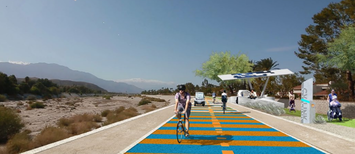
In 2016, proposed CV Link, a pathway designed for foot travel, bicycles, low speed electric vehicles and disability mobile devices, was a key issue in the political discussion in several cities along the proposed path of the link, including Rancho Mirage, Indian Wells, Palm Desert, and Cathedral City. The project was proposed by the Coachella Valley Association of Governments to connect cities within the area from Palm Springs to Alton Sea by a 50-mile "transportation corridor" that excludes automobile traffic. The project would cost about $100 million, with funding coming from a variety of state and local agencies and departments.[8]
In October 2016, the Rancho Mirage City Council passed a resolution prohibiting neighborhood electric vehicles from operating on major streets, including Bob Hope Drive and Highway 111. The Indian Wells City Council voted to prohibit any part of the CV Link project from crossing the city's golf course or Highway 111. Decisions like these by local governments impeded the plan for the Coachella Valley Link, since NEVs were one of the chief purposes of the link and the proposed route went through these areas of the city.[1]
For details about CV Link, see the project's master plan and the overview map shown below.[8]

Path to the ballot
Measure 4 was put on the ballot by a vote of the city council.[2]
Related measures
- Rancho Mirage, California, Coachella Valley Link Construction Advisory Question, Measure 2 (April 2016)
- Rancho Mirage, California, Neighborhood Electric Vehicles Ordinance Voter Approval Requirement, Measure 1 (April 2016)

- Rancho Mirage, California, City Funding for Coachella Valley Link Advisory Question, Measure 3 (April 2016)
Recent news
The link below is to the most recent stories in a Google news search for the terms Rancho Mirage CV Link Measure 4. These results are automatically generated from Google. Ballotpedia does not curate or endorse these articles.
See also
|


External links

- Rancho Mirage Government website
- Riverside County Elections Office website
- CV Link information website and master plan
Footnotes
- ↑ 1.0 1.1 Desert Sun, "Rancho Mirage council OKs wording for CV Link measures," December 17, 2015
- ↑ 2.0 2.1 2.2 Rancho Mirage City Clerk Office, "Impartial Analysis of Measure 4," accessed January 8, 2016
- ↑ Rancho Mirage City Clerk Office, "Ballot measures for election on April 12, 2016," accessed January 8, 2016
- ↑ 4.0 4.1 4.2 4.3 Note: This text is quoted verbatim from the original source. Any inconsistencies are attributable to the original source.
- ↑ 5.0 5.1 Rancho Mirage City Clerk Office, "Argument in Favor of Measure 4," accessed January 8, 2016
- ↑ Friends of CV Link, "Home," accessed January 8, 2016
- ↑ 7.0 7.1 Rancho Mirage City Clerk Office, "Argument in opposition to Measure 4," accessed January 8, 2016
- ↑ 8.0 8.1 Coachella Valley Link, "CV Link project information page," accessed January 9, 2016

 |
State of California Sacramento (capital) |
|---|---|
| Elections |
What's on my ballot? | Elections in 2026 | How to vote | How to run for office | Ballot measures |
| Government |
Who represents me? | U.S. President | U.S. Congress | Federal courts | State executives | State legislature | State and local courts | Counties | Cities | School districts | Public policy |