Daily Brew: March 3, 2026

Welcome to the Tuesday, March 3, 2026, Brew.
By: Lara Bonatesta
Here’s what’s in store for you as you start your day:
- It's Election Day in Arkansas, North Carolina, and Texas
- Idaho Supreme Court upholds state school choice tax credit
- EPA cites major administrative state cases in revoking Obama-era endangerment finding on greenhouse gas emissions
It's Election Day in Arkansas, North Carolina, and Texas
Voters in Arkansas, North Carolina, and Texas are headed to the polls today, March 3. In addition to kicking off the first statewide congressional and state-level primaries of the year, there are also local general elections on the ballot.
If you’re a voter in one of these states, make sure to check out our Sample Ballot Lookup Tool before you get to the polls. Plus, check out our resources on poll closing times and voter identification requirements to make sure you’re prepared.
Here’s an overview of what voters in each of these states will see on their ballots today.
Arkansas
Arkansas is holding elections for one U.S. Senate seat and all four of its House seats. Both the Democratic and Republican U.S. Senate primaries are contested. There are two contested Democratic House primaries and one contested Republican House primary. Heading into the 2026 elections, both of Arkansas’ U.S. senators and all four U.S. Representatives are Republicans.
According to the Arkansas Advocate’s Tess Vrbin, “Arkansas’ four U.S. House seats have been held by Republicans since 2013. Democrats have portrayed the 2nd District as winnable given its diversity and youth, but have fallen short in efforts to reclaim the seat. The majority-GOP Legislature redrew the district in 2021, moving thousands of predominantly Black voters out of the 2nd District. Arkansas’ other three Republican Congressmen have no primary opponents, but all will have a Democratic opponent in November.”
At the state level, there is at least one contested primary for governor, secretary of state, and Commissioner of State Lands. There are also 28 contested state legislative primaries this year, up from 24 in 2024.
In addition to the partisan primaries, Arkansas is also holding nonpartisan general elections for judicial and local offices. Two seats on the Arkansas Supreme Court are up for general election. There is also a contested election for a seat on an intermediate appellate court.
Ballotpedia is also covering one recall election in Arkansas today, targeting school board member Kenny King in the Deer-Mount Judea School District.
North Carolina
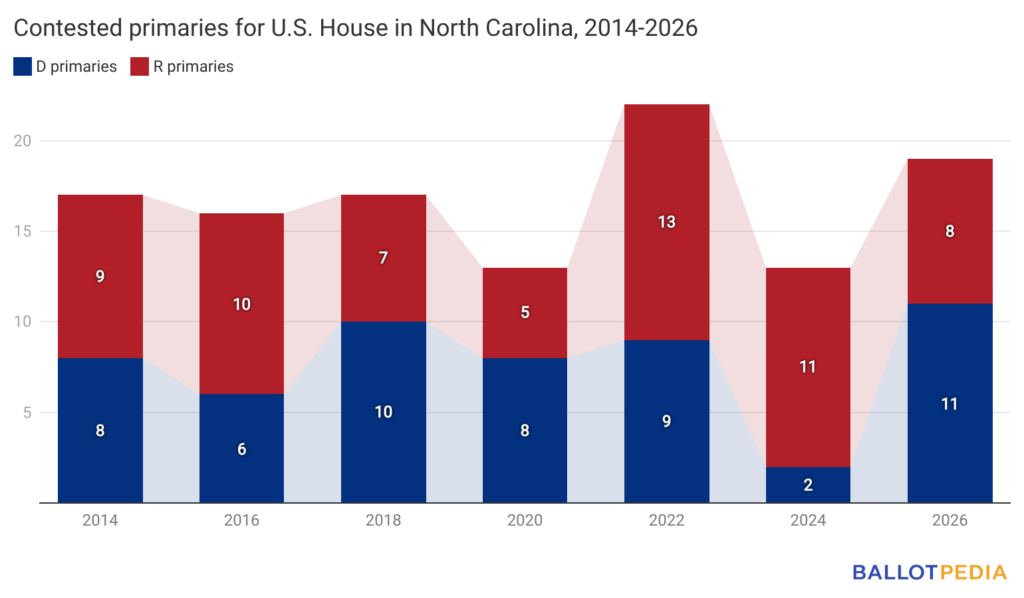
North Carolina is holding elections for one Senate seat and all 14 of its U.S. Representatives. Both Senate primaries are contested. There are 11 contested Democratic House primaries and eight contested Republican House primaries. This is the most contested Democratic primaries since 2014. Heading into the elections, both of North Carolina’s Senators are Republicans. Four of the states' U.S. House Representatives are Democrats, and 10 are Republicans.
The North Carolina General Assembly redrew the state’s congressional map in October 2025. The new map aims to shift the 1st District, which U.S. Rep. Donald Davis (D) currently represents, toward Republicans.
There are three candidates running in the Democratic primary in the 4th District. The primary is also a rematch between incumbent Valerie Foushee and Nida Allam.
At the state level, there are 60 contested state legislative primaries, up from 43 in 2024. There are 21 contested Democratic primaries and 39 contested Republican primaries.
There are also two contested primaries for seats on the North Carolina Court of Appeals.
Texas
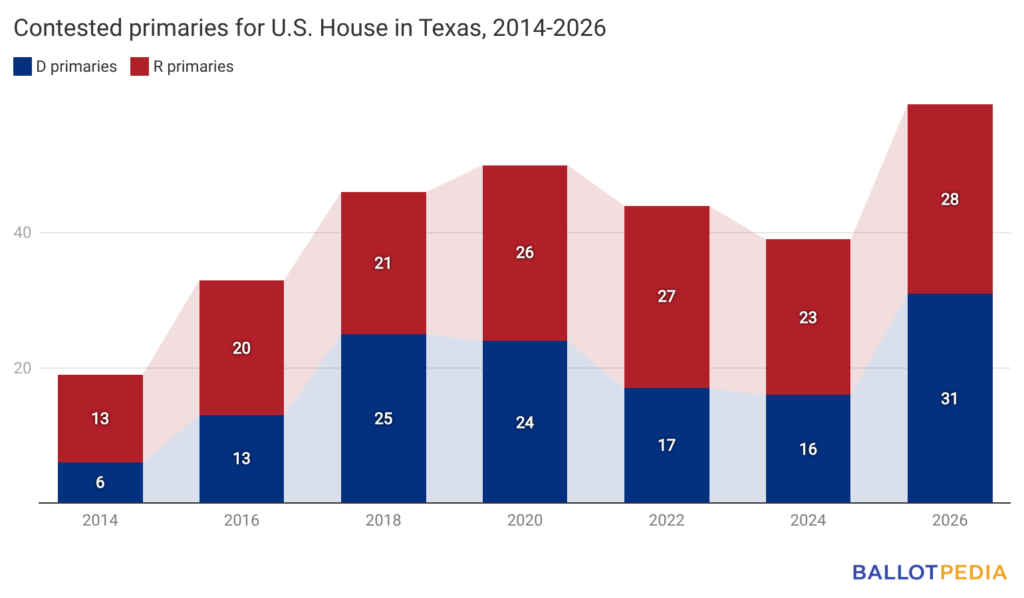
Texas is holding elections for one U.S. Senate seat and all 38 of its U.S. House seats. Both Senate primaries are contested. There are 31 contested Democratic House primaries and 28 contested Republican House primaries. This is the most contested primaries for both parties since 2014.
The Texas Legislature passed and Gov. Greg Abbott (R) signed a new congressional map in August 2025. The new map shifted five Democratic districts toward Republicans, according to the 2024 presidential results.
In a recent episode of Ballotpedia’s On The Ballot, the Texas Tribune’s Gabby Birenbaum said: “In multiple districts, you had multiple Democratic incumbents drawn into the same district…This is going to be a massive opportunity for Republicans … to make that jump to Congress. So you have a lot of interest in these seats. There’s going to be competitive Republican primaries in the open seats. And you had a lot of members sort of scrambling to figure out where to run. Multiple members of the delegation [are] jumping to run for higher office or to run for local office in Texas. And so it’s really scrambled the delegation.”
Ballotpedia identified 17 congressional primaries as battlegrounds.
Heading into the 2026 elections, both of Texas’ U.S. Senators are Republicans. Texas has 25 Republican U.S. House members and 13 Democratic House members.
At the state level, there are contested primaries for governor, lieutenant governor, attorney general, and several other state executives.
Texas has 103 contested state legislative primaries this year, up from 93 in 2024. There are 46 contested Democratic primaries and 57 contested Republican primaries.
Arkansas, North Carolina, and Texas are among the 31 states in which Ballotpedia is expanding our coverage to include all local elections. Click here to learn more about that coverage, and click here to see a list of elections Ballotpedia is covering on March 3.
After March 3, the next statewide primary elections will be on March 10 in Mississippi. Click here for a list of 2026 election dates.
Idaho Supreme Court upholds state school choice tax credit
On Feb. 5, the Idaho Supreme Court unanimously upheld the state's private school choice refundable tax credit, rejecting a challenge to the program on the grounds that it violated the Idaho Constitution and judicial precedent.
In September 2025, a group of petitioners – including the Committee to Protect and Preserve the Idaho Constitution, Inc., Mormon Women for Ethical Government, School District No. 281, Latah County, and the Idaho Education Association, Inc., – asked the Court to stop the program, saying it violated Article IX, section 1 of the Idaho Constitution and the public purpose doctrine.
Article IX, section 1 charges the Idaho Legislature with establishing and maintaining a "general, uniform, and thorough system of public, free common schools."
Chief Justice G. Richard Bevan wrote the opinion. It held that Article IX, section 1, did not limit the Legislature’s authority to do more than what the provision minimally required, and that the Legislature has plenary authority to enact laws, so long as they are not unconstitutional.
Bevan held that the express intention of the tax credit was to increase education choice for parents. He said that since education was a public purpose, the tax credit did not violate the public purpose doctrine.
Legislative background on the Idaho Parental Choice Tax Credit
On Feb. 27, 2025, Idaho Gov. Brad Little (R) signed House Bill 93 into law. It created the Idaho Parental Choice Tax Credit, a refundable tax credit of up to $5,000 per student enrolled in a private school, or $7,500 for students with qualifying disabilities. The Legislature capped the program at $50 million annually. The bill also required the Idaho State Tax Commission to prioritize awarding refunds to families with an adjusted gross income below 300% of the federal poverty level, though all families are eligible to apply.
School choice in context
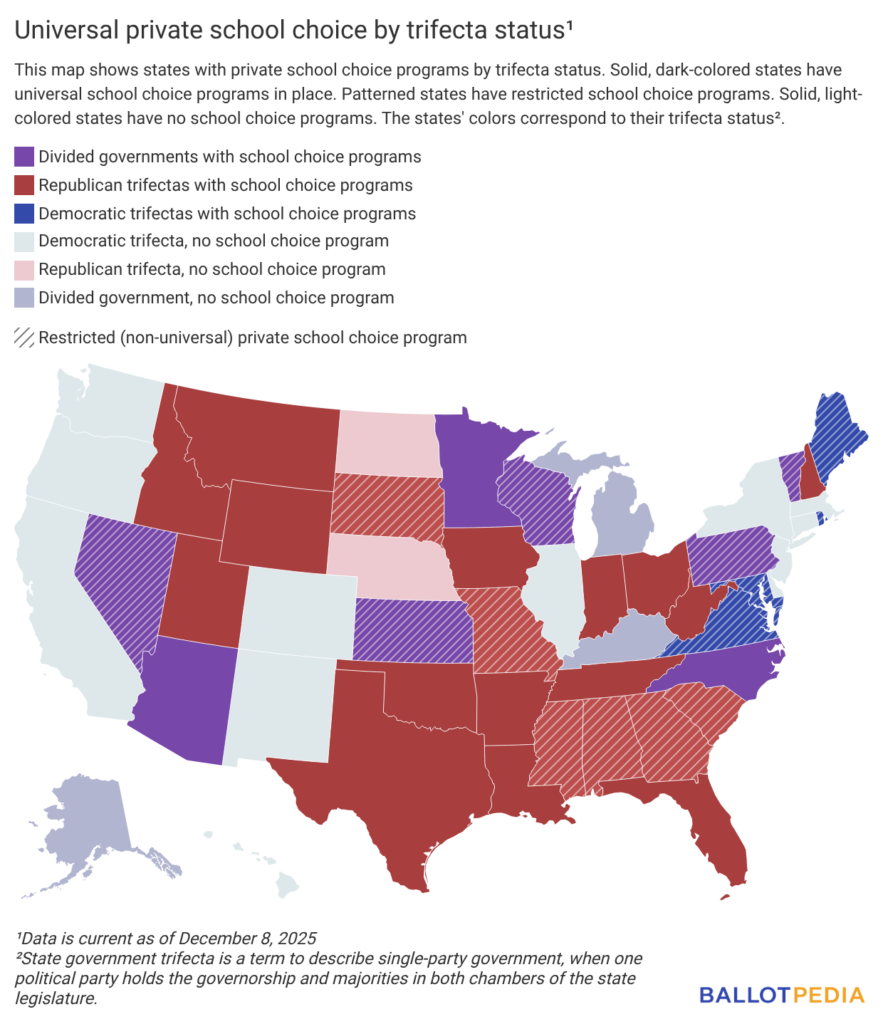
Private school choice programs provide public funds to families for alternatives to public schools, such as private schools and homeschooling. A universal school choice program is one for which all students are eligible, regardless of family income, location, demographic, or disability. Non-universal school choice programs are available to a subset of qualifying students, such as students in families with income below a certain threshold, students with disabilities or special needs, or students zoned for certain schools or living in certain districts.
Eighteen states run 24 universal private school choice programs. Ten of them are education savings account (ESA) programs, 10 are educational tax credit programs, and four are voucher programs. Some states run limited private school choice programs in addition to universal programs.
Depending on the tax credit program, the funds can be used for private or public educational expenses. As of Jan. 2026, 25 states had enacted tax-credit or tax-scholarship programs. Eleven states had implemented policies allowing individuals to write off or deduct educational expenses from their personal taxes.
Click here to learn more about universal school choice programs in the U.S.
EPA cites major administrative state cases in revoking Obama-era endangerment finding on greenhouse gas emissions
On Feb. 18, the Environmental Protection Agency (EPA) published a final rule which revokes the agency’s 2009 endangerment finding on greenhouse gas emissions. The endangerment finding was an interpretation of the Clean Air Act that found that greenhouse gases could be regulated as pollutants under the Act.
The EPA's new rule cited two recent major Supreme Court cases that touch on major concepts related to administrative law and the administrative state as part of its reasoning — West Virginia v. Environmental Protection Agency (2022) and Loper Bright Enterprises v. Raimondo (2024).
The Clean Air Act (CAA) is a federal law that allows the EPA to regulate air pollutants. In the 2007 case of Massachusetts v. Environmental Protection Agency, the U.S. Supreme Court ruled that the EPA could regulate carbon dioxide, a greenhouse gas, as a pollutant under the CAA. In 2009, the EPA published a finding that greenhouse gases were a danger to public health and welfare, and could be regulated under Section 202(a) of the CAA. This finding was the basis for a number of subsequent regulations of greenhouse gas emissions.
In proposing the rule that the EPA finalized on Feb. 18, the agency wrote "that CAA section 202(a) does not authorize the EPA to prescribe emission standards to address global climate change concerns."
In West Virginia v. EPA, the Supreme Court found that the EPA had exceeded its authority in regulating greenhouse gas emissions from power plants under the CAA because the major questions doctrine required Congress to specifically grant authority for such a major policy. This doctrine refers to the administrative law principle that Congress must provide clear authorization to an agency before the agency can issue regulations on matters of economic or political significance.
In Loper Bright v. Raimondo, the Court struck down the Chevron doctrine of judicial deference to agency interpretations of federal law. Previously, the Chevron doctrine compelled federal courts to defer to a federal agency's interpretation of an ambiguous or unclear statute that Congress delegated to the agency to administer.
Click here to learn more about the EPA’s rescission of the 2009 endangerment finding. Additionally, Ballotpedia's Administrative State project provides a framework for understanding the authority, influence, and actions of administrative agencies, as well as the policies and arguments surrounding them. Click here to learn more.