

Pliny's Point on July 12, 2017
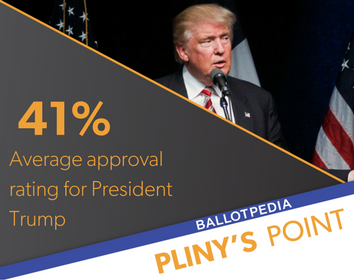


July 12, 2017: Recent polls show a slight increase in favor towards President Donald Trump, as new polls from Politico/Morning Consult and Gallup increase his average approval rating to 41 percent. This rating has been relatively steady, between 39 and 41 percent, since May 17.
| Source | Date range | Sample size | Job approval rating | Margin of error (+/-) |
|---|---|---|---|---|
| Gallup[1] | 7/8 - 7/10 | 1,500 adults | 40% | 3% |
| Rasmussen Reports[2] | 7/6 - 7/10 | 1,500 likely voters | 45% | 2.5% |
| Politico/Morning Consult[3] | 7/7 - 7/9 | 1,983 registered voters | 46% | 2% |
| Reuters/Ipsos[4] | 6/30 - 7/4 | 1,600 adults | 38% | 2.8% |
| Economist/YouGov[5] | 7/3 - 7/4 | 1,323 registered voters | 41% | 3.2% |
| IBD/TIPP[6] | 6/23 - 6/29 | 900 adults | 37% | 3.3% |
| USA Today/Suffolk University[7] | 6/24 - 6/27 | 1,000 registered voters | 42% | 3% |
| Fox News[8] | 6/25 - 6/27 | 1,017 registered voters | 44% | 3% |
| Quinnipiac University[9] | 6/22 - 6/27 | 1,212 registered voters | 40% | 3.4% |
| Wall Street Journal/NBC[10] | 6/17 - 6/20 | 900 adults | 40% | 3.27% |
| Pew Research[11] | 6/8 - 6/18 | 2,504 adults | 39% | 2.3% |
| CBS News[12] | 6/15 - 6/18 | 1,117 adults | 36% | 4% |
A study by FiveThirtyEight found that variances in polls about President Trump's favorability stemmed primarily from the collection method. Polls of registered or likely voters tended to be more favorable to Trump than those that polled adults generally. Automated or online polls also resulted in more favorable rankings than those conducted with live phone calls. The data for these findings was taken from polls conducted between Feb. 1 and Feb. 19, 2017.[13] For more on the types of polling methods used in Ballotpedia's polling averages, see Pliny's Point polling methodology.
Methodology
For Ballotpedia's presidential approval, congressional approval, and direction of the country polling results, we take an average of the most recent polls on one or more of these topics conducted by 12 sources. Polls may be included in the average for up to 30 days, though this timeline may be adjusted to account for major news events as we attempt to balance the need for a larger sample of results with the need to remove outdated information. For a full description of our methodology and polling explanations, see: Ballotpedia's Polling Indexes.
What's in a name?
Pliny the Elder, a scholar from the Roman Empire, is most well known for writing the encyclopedic work Naturalis Historia, or “Natural History.” His extremely thorough work covered everything from botany to technology. Naturalis Historia, one of the largest Roman works that still exists from the first century A.D., became an example for future encyclopedic works through its formatting, references, and comprehensiveness.
Today, Ballotpedia works to preserve and expand knowledge, just like Pliny did hundreds of years ago. One of the features of Ballotpedia, the encyclopedia of American politics, was a daily statistic called Pliny’s Point. Each day, between January 20, 2017 and September 1, 2017, readers learned where Americans stood on the direction of the country, or their approval of elected officials.
Click here for more Pliny's Point articles.
See also
Ballotpedia daily polling averages:
Stay in the know:
- The Weekly Brew
- The Daily Brew
- You're Hired: Tracking the Trump Administration Transition, 2016-2017
- Policy issues under the Trump administration, 2017-2021
- 115th United States Congress
- Special elections to the 115th United States Congress (2017-2018)
Footnotes
- ↑ Gallup, "Trump Job Approval," accessed July 12, 2017
- ↑ Rasmussen Reports, "Trump Approval Index History," accessed July 12, 2017
- ↑ Politico/Morning Consult, "National Tracking Poll," July 7-9, 2017
- ↑ Ipsos/Reuters, "Core Political Data," July 5, 2017
- ↑ YouGov, "The Economist/YouGov Poll," July 3 - 4, 2017
- ↑ Investors.com, "People Like The Senate Health Bill More Than They Realize: IBD/TIPP Poll," July 5, 2017
- ↑ Suffolk University, "Suffolk University/USA TODAY Poll Marginals," June 28, 2017
- ↑ Fox News, "Fox News Poll," June 28, 2017
- ↑ Quinnipiac University, "Trump Gets Small Bump From American Voters, Quinnipiac University National Poll Finds...", June 29, 2017
- ↑ MSNBC, "NBC News/Wall Street Journal Survey," June 17-20, 2017
- ↑ Pew Research Center, "Public Has Criticisms of Both Parties, but Democrats Lead on Empathy for Middle Class," June 20, 2017
- ↑ CBS News, "Trump's handling of Russia investigations weighs on approval ratings" accessed June 20, 2017
- ↑ FiveThirtyEight, "Why Polls Differ On Trump’s Popularity," February 20, 2017

