

School District of Philadelphia, Pennsylvania: Difference between revisions
m (Replaced ==References== with ==Footnotes==.) |
|||
| Line 631: | Line 631: | ||
{{School District See Also | {{School District See Also | ||
|State=Pennsylvania | |State=Pennsylvania | ||
|Elections= | |Elections={{School board election see also|state= Pennsylvania}} | ||
}} | }} | ||
Revision as of 22:05, 30 April 2019
| School District of Philadelphia |
|---|
 |
| Philadelphia, Pennsylvania |
| District details |
| Superintendent: William R. Hite Jr. |
| # of school board members: 5 |
| Website: Link |
The School District of Philadelphia is a school district in Pennsylvania. In the 2012-2013 school year, the district was the largest school district in Pennsylvania and served 143,898 students.[1]
In December 2001, the district was put under the control of a School Reform Commission (SRC).[2] Learn more about the SRC and the debate over district governance here.
About the district
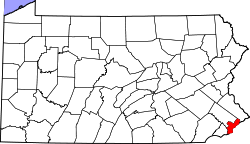
The School District of Philadelphia is located in the consolidated city-county of Philadelphia in southeastern Pennsylvania. In 2014, the city-county was home to an estimated 1,560,297 residents, according to the United States Census Bureau.[3]
Demographics
Philadelphia underperformed compared to Pennsylvania as a whole in terms of higher education attainment between 2009 and 2013. County-city residents had bachelor's degrees or higher at a rate of 23.9 percent compared to state residents at 34.5 percent. The median household income in the county-city was $37,192 compared to the state at $52,259. The poverty rate was 26.0 percent in the city, 26.5 percent in the county and 20.3 percent in the state.[3]
|
| ||||||||||||||||||||||||||||||||||||||||||||||||||||||||||||||||
Note: Percentages for race and ethnicity may add up to more than 100 percent because respondents may report more than one race and the Hispanic/Latino ethnicity may be selected in conjunction with any race. Read more about race and ethnicity in the census here.
Budget
From 1993 to 2013, the School District of Philadelphia had an average of $2,067,427,429 in revenue and $2,225,548,286 in expenditures, according to the United States Census Bureau's survey of school system finances. The district had a yearly average of $2,139,091,810 in outstanding debt. The district retired $272,307,048 of its debt and issued $430,354,238 in new debt each year on average.[5]
Revenue
The table below separates the district's revenue into the three sources identified by the agency: local, state, and federal.
| Revenue by Source | |||||||||||
|---|---|---|---|---|---|---|---|---|---|---|---|
| Fiscal Year |
Local | State | Federal | Revenue Total | |||||||
| Total | % of Revenue | Total | % of Revenue | Total | % of Revenue | ||||||
| Click [show] on the right to display the revenue data for prior years. | |||||||||||
|---|---|---|---|---|---|---|---|---|---|---|---|
| 1993 | $545,329,000 | 38.08% | $709,341,000 | 49.53% | $177,364,000 | 12.39% | $1,432,034,000 | ||||
| 1994 | $537,613,000 | 37.95% | $715,157,000 | 50.49% | $163,776,000 | 11.56% | $1,416,546,000 | ||||
| 1995 | $541,323,000 | 37.95% | $721,578,000 | 50.59% | $163,445,000 | 11.46% | $1,426,346,000 | ||||
| 1996 | $587,851,000 | 39.06% | $757,631,000 | 50.34% | $159,471,000 | 10.60% | $1,504,953,000 | ||||
| 1997 | $649,732,000 | 40.59% | $775,718,000 | 48.46% | $175,280,000 | 10.95% | $1,600,730,000 | ||||
| 1998 | $600,720,000 | 38.65% | $771,302,000 | 49.63% | $182,186,000 | 11.72% | $1,554,208,000 | ||||
| 1999 | $633,557,000 | 38.69% | $810,100,000 | 49.48% | $193,693,000 | 11.83% | $1,637,350,000 | ||||
| 2000 | $615,170,000 | 36.89% | $831,061,000 | 49.84% | $221,366,000 | 13.27% | $1,667,597,000 | ||||
| 2001 | $639,457,000 | 36.92% | $854,006,000 | 49.30% | $238,677,000 | 13.78% | $1,732,140,000 | ||||
| 2002 | $674,462,000 | 36.45% | $924,052,000 | 49.93% | $252,091,000 | 13.62% | $1,850,605,000 | ||||
| 2003 | $701,504,000 | 34.98% | $1,020,091,000 | 50.87% | $283,834,000 | 14.15% | $2,005,429,000 | ||||
| 2004 | $721,367,000 | 34.16% | $1,057,020,000 | 50.05% | $333,586,000 | 15.79% | $2,111,973,000 | ||||
| 2005 | $794,794,000 | 34.68% | $1,152,984,000 | 50.31% | $343,999,000 | 15.01% | $2,291,777,000 | ||||
| 2006 | $796,963,000 | 33.90% | $1,211,038,000 | 51.51% | $342,845,000 | 14.58% | $2,350,846,000 | ||||
| 2007 | $826,059,000 | 33.83% | $1,303,631,000 | 53.40% | $311,782,000 | 12.77% | $2,441,472,000 | ||||
| 2008 | $887,680,000 | 34.57% | $1,368,208,000 | 53.29% | $311,595,000 | 12.14% | $2,567,483,000 | ||||
| 2009 | $864,614,000 | 32.37% | $1,479,741,000 | 55.40% | $326,710,000 | 12.23% | $2,671,065,000 | ||||
| 2010 | $859,639,000 | 30.36% | $1,415,203,000 | 49.98% | $556,585,000 | 19.66% | $2,831,427,000 |
| 2011 | $848,447,000 | 29.29% | $1,411,582,000 | 48.73% | $636,770,000 | 21.98% | $2,896,799,000 |
| 2012 | $936,603,000 | 34.92% | $1,292,598,000 | 48.20% | $452,562,000 | 16.88% | $2,681,763,000 |
| 2013 | $980,119,000 | 35.73% | $1,333,752,000 | 48.62% | $429,562,000 | 15.66% | $2,743,433,000 |
| Avg. | $725,857,286 | 35.72% | $1,043,609,238 | 50.38% | $297,960,905 | 13.91% | $2,067,427,429 |
Expenditures
The table below separates the district's expenditures into five categories identified by the agency:
- Instruction: operation expenditures, state payments on behalf of the district for instruction and benefits, and retirement system transfers
- Support Services: support services, food services, and retirement system transfers for support service staff
- Capital Spending: capital outlay expenditures (i.e., construction, land or facilities purchases, and equipment purchases)
- Debt & Gov. Payments: payments to state and local governments and interest on school system debt
- Other: all other non-K-12 programs, except food services
| Expenditures by Category | |||||||||||
|---|---|---|---|---|---|---|---|---|---|---|---|
| Fiscal Year |
Instruction | Support Services | Capital Spending | Debt & Gov. Payments | Other | Budget Total | |||||
| Total | % of Budget | Total | % of Budget | Total | % of Budget | Total | % of Budget | Total | % of Budget | ||
| Click [show] on the right to display the expenditure data for prior years. | |||||||||||
|---|---|---|---|---|---|---|---|---|---|---|---|
| 1993 | $830,498,000 | 55.05% | $472,478,000 | 31.32% | $46,422,000 | 3.08% | $32,307,000 | 2.14% | $126,817,000 | 8.41% | $1,508,522,000 |
| 1994 | $667,970,000 | 45.77% | $456,703,000 | 31.29% | $62,707,000 | 4.30% | $53,297,000 | 3.65% | $218,816,000 | 14.99% | $1,459,493,000 |
| 1995 | $683,068,000 | 50.47% | $419,350,000 | 30.99% | $8,400,000 | 0.62% | $31,857,000 | 2.35% | $210,637,000 | 15.56% | $1,353,312,000 |
| 1996 | $716,376,000 | 49.29% | $457,199,000 | 31.46% | $11,876,000 | 0.82% | $32,261,000 | 2.22% | $235,679,000 | 16.22% | $1,453,391,000 |
| 1997 | $742,685,000 | 48.82% | $474,222,000 | 31.17% | $13,339,000 | 0.88% | $46,279,000 | 3.04% | $244,753,000 | 16.09% | $1,521,278,000 |
| 1998 | $733,824,000 | 48.57% | $479,846,000 | 31.76% | $13,584,000 | 0.90% | $43,776,000 | 2.90% | $239,755,000 | 15.87% | $1,510,785,000 |
| 1999 | $728,268,000 | 41.90% | $524,252,000 | 30.16% | $150,838,000 | 8.68% | $51,231,000 | 2.95% | $283,471,000 | 16.31% | $1,738,060,000 |
| 2000 | $726,001,000 | 39.69% | $584,904,000 | 31.97% | $156,675,000 | 8.56% | $49,624,000 | 2.71% | $312,095,000 | 17.06% | $1,829,299,000 |
| 2001 | $788,137,000 | 40.21% | $609,509,000 | 31.10% | $161,899,000 | 8.26% | $55,004,000 | 2.81% | $345,581,000 | 17.63% | $1,960,130,000 |
| 2002 | $794,278,000 | 39.97% | $613,515,000 | 30.88% | $141,936,000 | 7.14% | $53,476,000 | 2.69% | $383,815,000 | 19.32% | $1,987,020,000 |
| 2003 | $834,962,000 | 40.94% | $620,639,000 | 30.43% | $67,160,000 | 3.29% | $72,219,000 | 3.54% | $444,409,000 | 21.79% | $2,039,389,000 |
| 2004 | $907,007,000 | 37.45% | $715,853,000 | 29.56% | $147,005,000 | 6.07% | $157,514,000 | 6.50% | $494,379,000 | 20.41% | $2,421,758,000 |
| 2005 | $922,485,000 | 36.44% | $733,786,000 | 28.99% | $209,732,000 | 8.29% | $130,817,000 | 5.17% | $534,603,000 | 21.12% | $2,531,423,000 |
| 2006 | $903,805,000 | 34.66% | $749,560,000 | 28.74% | $237,165,000 | 9.09% | $136,140,000 | 5.22% | $581,162,000 | 22.29% | $2,607,832,000 |
| 2007 | $840,547,000 | 31.28% | $760,947,000 | 28.32% | $334,395,000 | 12.44% | $154,819,000 | 5.76% | $596,706,000 | 22.20% | $2,687,414,000 |
| 2008 | $872,336,000 | 30.82% | $750,851,000 | 26.53% | $387,859,000 | 13.70% | $172,100,000 | 6.08% | $647,291,000 | 22.87% | $2,830,437,000 |
| 2009 | $956,638,000 | 34.64% | $774,387,000 | 28.04% | $249,282,000 | 9.03% | $84,701,000 | 3.07% | $697,014,000 | 25.24% | $2,762,022,000 |
| 2010 | $1,082,196,000 | 36.68% | $809,468,000 | 27.43% | $180,847,000 | 6.13% | $135,772,000 | 4.60% | $742,259,000 | 25.16% | $2,950,542,000 |
| 2011 | $1,109,832,000 | 35.31% | $824,572,000 | 26.24% | $203,291,000 | 6.47% | $147,097,000 | 4.68% | $858,187,000 | 27.30% | $3,142,979,000 |
| 2012 | $993,871,000 | 35.32% | $689,868,000 | 24.52% | $89,663,000 | 3.19% | $132,414,000 | 4.71% | $908,096,000 | 32.27% | $2,813,912,000 |
| 2013 | $1,695,669,000 | 46.74% | $688,221,000 | 18.97% | $80,438,000 | 2.22% | $150,225,000 | 4.14% | $1,012,963,000 | 27.92% | $3,627,516,000 |
| Avg. | $882,402,524 | 40.95% | $629,053,810 | 29.04% | $140,691,095 | 5.86% | $91,568,095 | 3.85% | $481,832,762 | 20.29% | $2,225,548,286 |
Debt
The table below shows the amount of debt retired, issued, and outstanding in the district for each year.
| Debt | |||
|---|---|---|---|
| Fiscal Year |
Retired | Issued | Outstanding |
| Click [show] on the right to display the debt data for prior years. | |||
|---|---|---|---|
| 1993 | $236,283,000 | $214,816,000 | $782,436,000 |
| 1994 | $30,686,000 | $184,985,000 | $936,268,000 |
| 1995 | $35,452,000 | $18,484,000 | $690,995,000 |
| 1996 | $89,744,000 | $234,769,000 | $832,000,000 |
| 1997 | $90,722,000 | $166,204,000 | $908,728,000 |
| 1998 | $15,097,000 | $33,417,000 | $915,981,000 |
| 1999 | $146,529,000 | $257,328,000 | $1,021,706,000 |
| 2000 | $115,688,000 | $221,537,000 | $1,118,670,000 |
| 2001 | $47,189,000 | $206,309,000 | $1,261,372,000 |
| 2002 | $35,223,000 | $475,029,000 | $1,974,107,000 |
| 2003 | $100,834,000 | $180,130,000 | $2,053,403,000 |
| 2004 | $1,460,637,000 | $2,396,537,000 | $2,989,303,000 |
| 2005 | $411,733,000 | $454,850,000 | $3,032,421,000 |
| 2006 | $36,691,000 | $141,361,000 | $3,137,091,000 |
| 2007 | $757,616,000 | $1,009,225,000 | $3,336,074,000 |
| 2008 | $749,376,000 | $724,300,000 | $3,275,519,000 |
| 2009 | $284,718,000 | $496,565,000 | $3,496,553,000 |
| 2010 | $429,497,000 | $676,295,000 | $3,738,134,000 |
| 2011 | $439,412,000 | $425,880,000 | $2,980,922,000 |
| 2012 | $91,117,000 | $254,423,000 | $3,144,227,000 |
| 2013 | $114,204,000 | $264,995,000 | $3,295,018,000 |
| Avg. | $272,307,048 | $430,354,238 | $2,139,091,810 |
Issues
Debates over School Reform Commission
The School District of Philadelphia has never been run by an elected school board, a unique situation among Pennsylvania school districts. The board was selected by the city's common pleas judge from 1905 to 1965, when the mayor was given the power to appoint members. In 2001, the mayor consented to the creation of the School Reform Commission (SRC), a five-member board with three members appointed by the governor and two members appointed by the mayor. The SRC was created in the midst of public concerns over district finances and academic performance.[6]
A push for local control gained momentum in 2015 with voter approval of a non-binding ballot question seeking the end of the SRC. Former Mayor Michael Nutter called for the end of the commission before leaving office, and successor James Kenney supports more local control once the district improves its finances.[7] The SRC was also analyzed by The Pew Charitable Trusts in a January 2016 report. The report titled "Governing Urban Schools in the Future: What's Facing Philadelphia and Pennsylvania" concluded with the following statement:
| “ |
Education experts say that state takeovers of local districts have, at least in some cases, cured financial ills created through mismanagement. But there is no indication that any particular system for governing urban school districts is superior to another in improving long-term academic performance. Too many other factors, experts say, help determine what happens in the classroom, including the quality of principals and teachers, funding, and parental expectations. There is broad agreement on at least one conclusion: Governance systems that produce uncertainty, distrust, and ambiguous accountability can impede districts’ progress on any front. [8] |
” |
| —The Pew Charitable Trusts (2016), [6] | ||
Contact information

School District of Philadelphia
440 N. Broad St.
Philadelphia, PA 19130
Phone: (215) 400-4000
Email: ask@philasd.org
See also
| Pennsylvania | School Board Elections | News and Analysis |
|---|---|---|
 |
 |
 |
External links
- School District of Philadelphia
- Philadelphia, Pennsylvania
- Pennsylvania Department of Education
- Pennsylvania School Boards Assoication
- Philadelphia Federation of Teachers
Footnotes
- ↑ National Center for Education Statistics, "ELSI Table Generator," accessed April 17, 2015
- ↑ School District of Philadelphia, "About Us," accessed July 15, 2015
- ↑ 3.0 3.1 3.2 United States Census Bureau, "QuickFacts Beta: Philadelphia County, Pennsylvania," accessed October 8, 2015
- ↑ Office of the Philadelphia City Commissioners, "Prior Year Election Results," accessed October 8, 2015
- ↑ United States Census Bureau, "Public School System Finances: Historical Data," accessed December 1, 2015
- ↑ 6.0 6.1 The Pew Charitable Trusts, "Governing Urban Schools in the Future: What's Facing Philadelphia and Pennsylvania," January 2016
- ↑ Philly.com, "Pew: No magic from local or state school control," January 14, 2016
- ↑ Note: This text is quoted verbatim from the original source. Any inconsistencies are attributable to the original source.
| |||||
 |
State of Pennsylvania Harrisburg (capital) |
|---|---|
| Elections |
What's on my ballot? | Elections in 2026 | How to vote | How to run for office | Ballot measures |
| Government |
Who represents me? | U.S. President | U.S. Congress | Federal courts | State executives | State legislature | State and local courts | Counties | Cities | School districts | Public policy |
 |
This school board-related article is a sprout; we plan on making it grow in the future. If you would like to help it grow, please consider donating to Ballotpedia. |


