

Louis Butler

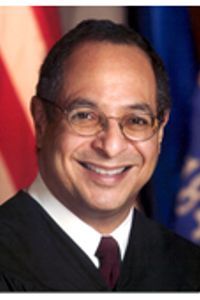
Louis Bennett Butler, Jr. is a former justice of the Wisconsin Supreme Court. He served on the court from August 2004 to July 2008. He was appointed to the court by Governor Jim Doyle in August 2004, becoming the first African-American Supreme Court justice in Wisconsin history. Butler was defeated by Michael Gableman in the 2008 election.[1][2]
On May 20, 2009, Butler was recommended by Senators Herb Kohl and Russ Feingold to replace John C. Shabaz to the Western District of Wisconsin. On September 30, 2009, Butler was nominated by President Obama to the United States District Court for the Western District of Wisconsin. However, Butler's nomination was returned to the President on December 24, 2009.[3]
In the end, Butler was nominated to the Western District of Wisconsin by President Obama four times, and all of the nominations were returned without a full Senate vote.
Federal judgeship nomination
 |
| Nominee Information |
| Name: Louis Butler |
| Court: Western District of Wisconsin |
| Progress |
| Returned 808 days after nomination. |
 Nominated: September 30, 2009 Nominated: September 30, 2009
|
| ABA Rating: Unanimously Well Qualified
|
| Questionnaire: Questionnaire |
| Hearing: November 4, 2009
|
| QFRs: (Hover over QFRs to read more) |
| Reported: September 23, 2010 Dec. 3, 2009, Feb. 4, 2010
|
 Confirmed: Confirmed:
|
| Returned: December 17, 2011
|
On March 30, 2009, the Federal Nominating Commission of the Wisconsin State Bar selected Butler as a finalist to replace John C. Shabaz on the United States District Court for the Western District of Wisconsin. On May 20, 2009, Butler was formally recommended by U.S. Senators Russ Feingold and Herb Kohl for the seat.[4][5] Butler was nominated by Barack Obama on September 30, 2009,[6][7][8][9] but the nomination was returned to the President on December 24, 2009.[10][11] The President renominated Judge Butler on January 20, 2010, [12] and the Senate Judiciary Committee again recommended approval to the Senate with a 12 - 7 vote.[13]
On September 13, 2010, President Obama again nominated Butler to the federal court.[14]
Nomination reactions
Wisconsin Representative Jim Sensenbrenner (R) panned the nomination, noting that Butler is the first Wisconsin Supreme Court justice to have been voted off of the court in 41 years. "Mr. Butler lost a statewide election, held by the people of Wisconsin, to continue serving on Wisconsin's Supreme Court. Now, the man who was voted off the bench in Wisconsin is being given a promotion, a lifetime appointment and a pay raise." Sensenbrenner also took issue with the way that the Commission handled the recommendation process, saying that "Senator Kohl and Senator Feingold sent this nomination to the White House with no input from individuals on the other side of the aisle".[15][16]
Sens. Feingold and Kohl stood by their recommendation, saying Butler has "the qualifications, experience and intellect that will serve him well" as a federal judge.[17] Progressive Wisconsin paper The Capital Times called Butler the "best choice" for the Western District of Wisconsin.[18]
The Concerned Women for America issued a memo saying that Butler's nomination ought to be rejected by the Senate. Among the reasons they indicate for his unsuitability are "a far-left agenda of personal beliefs and political ideology," opposition to the rights of gun owners and his being twice rejected by the voters of Wisconsin for the state Supreme Court. Signatories to the memo include former Attorney General Edwin Meese, President of Americans for Tax Reform Grover Norquist and former Indiana Congressman David McIntosh.[19]
Judiciary Committee hearing
Butler faced a confirmation hearing from the Senate Judiciary Committee on November 4, 2009 and you can find his Committee Questionnaire available here. Republicans on the committee had pointed questions for him, citing concerns that he may issue rulings slanted by judicial activism. As Senator Jeff Sessions put it, some "of his speeches and cases, on the surface, show pretty significant activist tendencies". Senator John Cornyn of Texas, a former Texas Supreme Court Justice, accused Butler of disregarding legal precedent on medical malpractice caps.[20] Democrats on the Committee defended Butler, saying he "possesses all the best qualities that we look for in a judge: intelligence, diligence, humility and integrity."[21] The Committee voted 12-7 to support Butler's nomination, with Democrats voting for and Republicans voting against.[22] The Senate returned the nomination to President Obama in December 2009.[23]
Nomination returned to President
On August 5, 2010, the Senate returned the nomination of Butler to President Obama for a second time, refusing to debate and offer a vote before the body adjourned for its month-long recess.[24] Obama re-nominated Butler once again on September 13, 2010.[25]
Judiciary Committee vote
On September 23, 2010 (dead link) , the Senate Judiciary Committee voted 12-7 to send Butler's nomination to the U.S. Senate for a vote.[26]
- For more information, read: Wislawjournal.com, "Butler confirmation still up in the air," September 27, 2010
Butler's nomination was returned to the President at the end of the 111th Congress. President Obama resubmitted the nomination on January 5, 2011. Butler's nomination was returned to the president on December 17, 2011.[27]
Legal education and experience
| Sound bite |
|---|
| Hear audio of Butler before the Supreme Court in Ellis T. McCoy, Etc., v. Court of Appeals of Wisconsin, District 1. |
Butler earned his bachelor’s degree from Lawrence University in Appleton in 1973 and his law degree from the University of Wisconsin Law School in 1977.
After serving as an assistant state public defender from 1979 to 1992, Justice Butler was appointed to the Milwaukee Municipal Court. He served as a municipal judge until 2002, when he was elected to Branch 9 of the Milwaukee County Circuit Court.[28]
Elections
2008
Justice Butler ran for re-election to the Wisconsin Supreme Court in 2008. He was defeated by Burnett County Circuit Court Judge Michael Gableman.[29]
| Candidate | Incumbent | Election % |  |
|---|---|---|---|
Michael Gableman  |
No | 51.1% | |
| Louis Butler | Yes | 48.5% |
2000
In 2000, while Justice Butler was a Milwaukee County Municipal Court judge, he challenged Supreme Court Justice Diane Sykes. Sykes retained her seat, winning 65.5% of the vote.[31]
Notable rulings of Louis Butler |
|---|
On Criminal Justice
Justice Louis B. Butler, Jr. dissented from the majority opinion, instead concluding that a criminal defendant who was convicted by a jury of being selling illegal narcotics was entitled to a new trial, because it was mentioned during the trial that a recipient of the illegal narcotics had died of a drug overdose from their ingestion, and that this information likely had an unduly prejudicial effect on the jury.
Justice Butler authored the majority opinion, which concluded, over the vigorous dissents of Justices John P. Wilcox and David T. Prosser, that Article I, Section 8 of the Wisconsin Constitution provided greater protection to criminal defendants than does the identically worded Fifth Amendment to the United States Constitution. In so holding the Majority found that a bloody sweatshirt was inadmissible as evidence in a murder case because the defendant told police officers of its location prior to being read his Miranda rights. The Court stated "[w]e conclude that the fruit of the poisonous tree doctrine applies under the circumstances of this case under Article I, Section 8 of the Wisconsin Constitution. Where physical evidence is obtained as the direct result of an intentional violation of Miranda rights, we conclude that Wisconsin Constitution requires that the evidence must be suppressed.
Justice Butler concurred in the majority opinion, and wrote a separate concurring opinion, noting that a prisoner was entitled to raise the argument that he had received ineffective assistance of counsel at his trial sixteen (16) years after that trial was over. On Class Actions & Class Action Abuse
Justice Butler authored the majority opinion, which, over the vigorous dissents of Justices John P. Wilcox and David T. Prosser, concluded that Retail buyer of used automobile was entitled to award of "reasonable costs," in pursuing claim under statute prohibiting unsavory practices in the retail sale or lease of a motor vehicle, and not just “taxable costs” as specified in the rule actually governing the matter in civil actions, even though such costs would possibly exceed the total recovery under the statute. The dissent heavily criticized the Majority decision, noting that it ignored the plain-language of the statute in order to obtain a plaintiff-friendly result.
In this lead-paint liability case from 2005, Justice Butler authored the 4-2 majority opinion (concurring Justices Abrahamson, Bradley and Crooks), over the vigorous dissents of Justices John P. Wilcox and David Prosser (Justice Roggensack did not participate). In the decision, the court ruled:
On Employer and Employee Rights
Justice Butler authored the majority opinion, which concluded, over vigorous dissent, that Wisconsin employers were required to extend "clemency" to employees who were absent from work for medical reasons, even where many of the absences are unrelated to medical reasons. In doing so, the Majority effectively eviscerates any employer attendance requirements. According to the dissent, authored by David T. Prosser, the Majority's rule "requires an employer to suspend its attendance requirements even if an employee fails to submit medical documentation confirming that his absence was disability related." On Regulation
Justice Butler concurred in the Majority opinion, but wrote separately. In this separate opinion, Justice Butler lables auto title companies as "predatory lenders," and notes that the interest rates the charge to consumers with low credit ratings are "ridiculous, unreasonable and unconscionable." On Tort Reform
Justice Butler concurred in the Majority Opinion, written by Justice Shirley S. Abrahamson, but wrote a separate concurring opinion as well. The Majority held, in a medical malpractice action, that the recently-passed $350,000 cap, adjusted for inflation, on non-economic damages in medical malpractice actions not involving wrongful death of the patient (1) was not rationally related to legislative objective of compensating victims fairly; (2) was not rationally related to legislative objective of lowering medical malpractice insurance premiums;(3) statute was not rationally related to legislative objectives of keeping Wisconsin Patients Compensation Fund's annual assessments to healthcare providers at low rate and enabling Fund, which provided excess liability coverage for healthcare providers, to operate on sound financial basis; (4) was not rationally related to legislative objective of lowering overall healthcare costs for consumers of healthcare; and (5) was not rationally related to legislative objective of ensuring quality healthcare by creating an environment in which healthcare providers were likely to move into, or less likely to move out of, Wisconsin. |
External links
- Gonzalez Saggio & Harlan LLP, Louis B. Butler Biography
- The Wall Street Journal Opinion: "The White House Butler," November 19, 2009
- Milwaukee Journal-Sentinel, "Money keeps flowing in Supreme Court race," March 25, 2008
Footnotes
- ↑ Milwaukee Journal Sentinel, "Supreme Court race still too close to call, Prosser has narrow lead," April 6, 2011
- ↑ Gonzalez Saggio & Harlan LLP, Louis B. Butler Biography
- ↑ United States Senate, Committee on the Judiciary, Judicial Nomination Materials: 111th Congress (dead link)
- ↑ "Louis Butler recommended to Replace Shabaz," May 20, 2009
- ↑ "Chicago Tribune" Ex-Wis. Supreme Court justice up for federal job, September 30, 2009
- ↑ White House Press Release "NOMINATIONS SENT TO THE SENATE: 9/30/09
- ↑ Senator Feingold Press Release "KOHL, FEINGOLD LAUD PRESIDENT OBAMA'S NOMINATION OF LOUIS BUTLER TO WESTERN DISTRICT JUDGESHIP," October 1, 2009
- ↑ Wisconsin State Journal "Butler nomination to federal court will likely change judicial style," October 1, 2009
- ↑ Milwaukee Journal-Sentinel "Butler nomination for U.S. district judge draws heat," October 2, 2009
- ↑ Judicial Nomination Materials: 111th Congress (dead link)
- ↑ The Cap Times, "Plain Talk: Butler deserves better than he’s getting in confirmation process," January 18, 2010
- ↑ Point of Law.com, "President renominates previously blocked judicial candidates," January 21, 2010
- ↑ State Bar of Wisconsin "Senate Judiciary Committee recommends Louis Butler as Western District judge," February 4, 2010 (dead link)
- ↑ Wisconsin State Journal, "Obama again nominates Butler for U.S. District Judge," September 13, 2010
- ↑ Sensenbrenner Press Release "Sensenbrenner Statement on Nomination of Louis Butler as U.S. District Judge," October 1, 2009
- ↑ Milwaukee Journal-Sentinel "Butler nomination for U.S. district judge draws heat," October 2, 2009
- ↑ Feingold Press Release "KOHL, FEINGOLD LAUD PRESIDENT OBAMA'S NOMINATION OF LOUIS BUTLER TO WESTERN DISTRICT JUDGESHIP," October 1, 2009
- ↑ Capitol Times "Butler is the right choice," October 5, 2009
- ↑ Concerned Women for America Press Release "Senate Should Reject Nomination of Louis Butler to District Court in Wisconsin," December 14, 2009 (dead link)
- ↑ "Point of Law" Senate Judiciary OKs Louis Butler of Wisconsin for federal bench, December 4, 2009
- ↑ Milwaukee Journal Sentinel "Butler faces pointed queries at confirmation hearing," November 5, 2009
- ↑ Milwaukee Journal Sentinel:All Politics Blog "Key Senate panel endorses Butler judicial nomination," December 3, 2009
- ↑ "Point of Law" Senate sends Justice, judicial nominees back to White House, December 27, 2009
- ↑ United States Senate, Committee on the Judiciary, Judicial Nomination Materials: 111th Congress
- ↑ Judicial Nomination Materials
- ↑ San Jose Mercury News, "Democrats: GOP now blocking picks for lower courts," September 23, 2010 (dead link)
- ↑ 112th Congress Nomination Materials
- ↑ Justice Butler's Bio (dead link)
- ↑ Wisconsin State Elections Booard, Election Results Summary 4/21/2008
- ↑ Wisconsin Government Accountability Board, 2008 Spring Election Results
- ↑ Wisconsin State Election Board, Elections Results Summary 4/4/2000

| |||
|---|---|---|---|
| Nominated | |||

Federal courts:
Seventh Circuit Court of Appeals • U.S. District Court: Eastern District of Wisconsin, Western District of Wisconsin • U.S. Bankruptcy Court: Eastern District of Wisconsin, Western District of Wisconsin
State courts:
Wisconsin Supreme Court • Wisconsin Court of Appeals • Wisconsin Circuit Courts • Wisconsin Municipal Courts
State resources:
Courts in Wisconsin • Wisconsin judicial elections • Judicial selection in Wisconsin

