

Daily Brew: January 13, 2026

Welcome to the Tuesday, Jan. 13, Brew.
By: Briana Ryan
Here’s what’s in store for you as you start your day:
- We're breaking down state legislative competitiveness in all 50 states. First up are Illinois, Arkansas, and North Carolina.
- Fifty-five members of Congress have announced they will not seek re-election in 2026
- Iowa becomes the eighth state to indicate participation in the federal school choice tax credit program
We're breaking down state legislative competitiveness in all 50 states. First up are Illinois, Arkansas, and North Carolina.
As filing deadlines pass for the 2026 state legislative elections, we’ll take a look at the primary election competitiveness of each state. Ballotpedia gauges primary competitiveness by tracking:
- Open seats, meaning no incumbent filed
- Contested primaries, in which candidates from the same party compete for their party’s general election nomination
- Contested incumbents, or the share of incumbents who face primary challenges
Today, we'll examine these three factors in the context of our three states with early filing deadlines—Illinois, Arkansas, and North Carolina. The first factor considers the share of seats that are guaranteed to newcomers because no incumbent is running. The second considers the share of primaries that drew more than one candidate, meaning voters can choose which candidate earns their party’s spot on the general election ballot. The third considers the share of incumbents facing primary challengers, meaning voters could choose to advance a new candidate to the general election over their current senator or representative.
In the 50 states, there are 99 state legislative chambers altogether. Across 46 states, 88 of those chambers are holding regular legislative elections in 2026. The general election for state legislative races is on Nov. 3, 2026. Before November, voters will vote in primary elections to decide which candidate appears on the general election ballot for their party.
Seats guaranteed to newcomers
Arkansas has the largest share of open seats, and North Carolina has the smallest.
In Arkansas, 24 seats are open, up 85% from 13 in 2024. That means no incumbent filed for 21% of the 117 seats up for election across the Arkansas House and Senate. As a result, newcomers will represent at least 18% of Arkansas’ 135 state legislative seats next year.
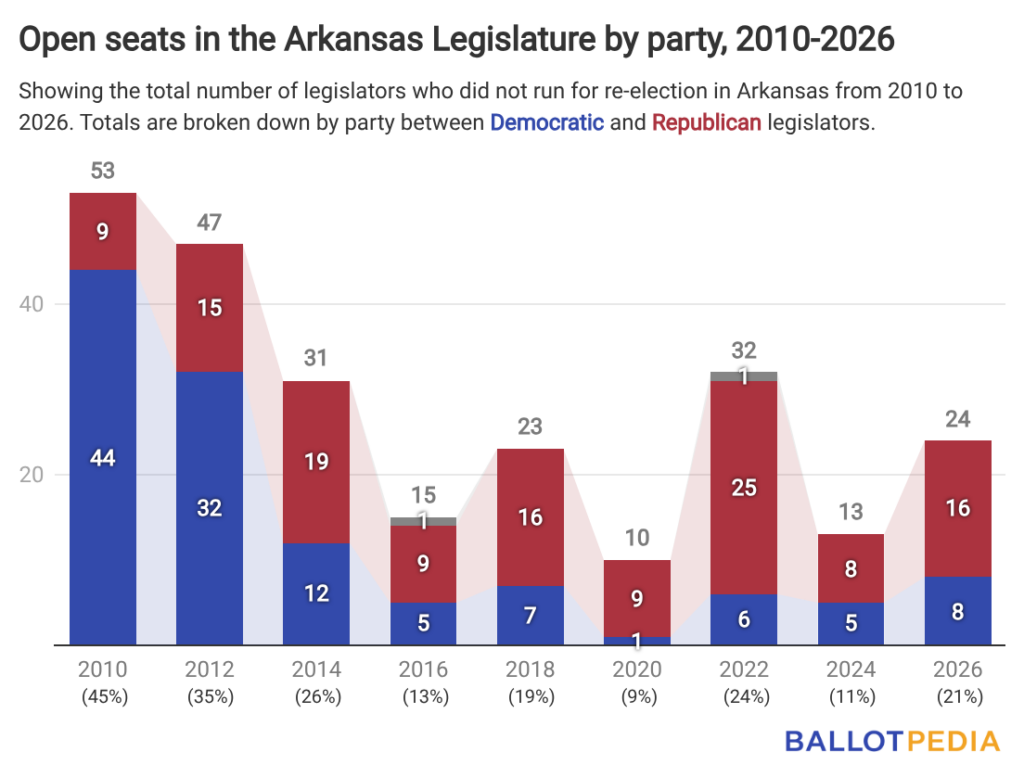
Ten seats are open in North Carolina’s state legislative elections this year. That is the fewest open seats since 2010 and means newcomers could represent as little as 6% of the Legislature next year. The average number of open seats each cycle from 2010 to 2024 was 24.
Fifteen Illinois state legislative seats are open, or 10% of the 157 seats up for election. That’s up from six in 2024. Newcomers are guaranteed to represent at least 8% of Illinois’ 177 state legislative seats next year.
Primaries with more choice for voters
Not all possible state legislative primaries draw multiple candidates, meaning a single candidate can sometimes advance to the general election by default. Contested primaries are those in which multiple candidates appear on the primary ballot for voters to decide.
North Carolina has 60 contested state legislative primaries in 2026 of a possible 340, a 40% increase from 43 in the preceding cycle, and the largest share among the first three states. Voters will get to decide between multiple primary candidates in 18% of the total possible primaries. The state had its most contested primaries in 2012, when 91 primaries (27%) were contested.

Illinois has 33 contested state legislative primaries in 2026 of a possible 314, an 18% increase from 28 in the preceding cycle, but the smallest share among the first three states. Voters will get to decide between multiple primary candidates in 11% of the total possible primaries. The state had its most contested primaries in 2012, when 67 primaries (19%) were contested.
Arkansas has 28 contested state legislative primaries this year, up 17% from 24 in 2024. That means voters will get to decide between multiple primary candidates in 12% of the total possible primaries.
Primaries where voters could choose newcomers over incumbents
Lastly, Ballotpedia tracks the share of incumbents running in each state who face primary challenges. In these primaries, voters could choose a newcomer over their current representative to proceed to the general election. North Carolina has the largest share of contested incumbents, and Arkansas has the smallest.
Thirty-nine North Carolina state legislative incumbents face primary challenges, tying 2010 and 2018 for the most since 2010. That means voters could choose a new candidate over up to 24% of the 160 incumbents who are running for re-election.

Nine Arkansas state legislative incumbents face primary contests this year, the fewest since eight incumbents ran in contested 2014 primaries. All nine of the contested incumbents are Republicans. This is the first year without any Democratic incumbents in contested primaries in the state since Ballotpedia began tracking this data in 2010. In the primaries, voters could choose a new candidate over up to 10% of the incumbents who are running.
In Illinois, 18 state legislative incumbents running for re-election (13%) will face primary contests, down from 14% in 2024 and the lowest percentage since 2016, when 12% of incumbents faced primaries. Voters could choose a new candidate over up to 13% of the incumbents who are running.
Click here to read more about primary election competitiveness this year.
Fifty-five members of Congress have announced they will not seek re-election in 2026
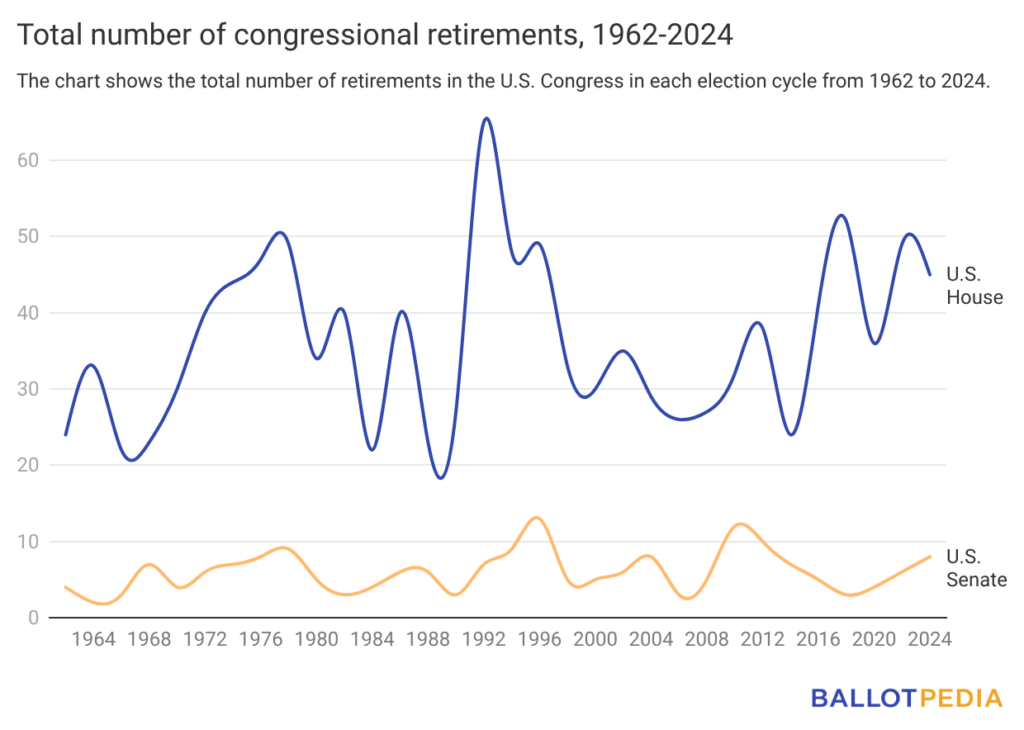
Fifty-five members of Congress — 46 representatives and nine senators — have announced they will not seek re-election in 2026.
Looking at each election cycle since 1962, the 55 retirements that have happened so far in the 2026 cycle is the same number of announcements that happened in the entire 2022, 2018, and 1976 election cycles.
Since our Dec. 17 update, four representatives and one senator announced they will not seek re-election. Here’s a list of how independent election forecasters have rated the 2026 general election for each district these incumbents currently represent.
- Rep. Dan Newhouse (R-Wash.) announced on Dec. 17 that he is retiring from public office. Election forecasters have rated the election for the district as either Solid or Safe Republican.
- Sen. Cynthia Lummis (R-Wyo.) announced on Dec. 19 that she is retiring from public office. Election forecasters have rated the election for the seat as either Solid or Safe Republican.
- Rep. Harriet Hageman (R-Wyo.) announced on Dec. 23 that she is running for the U.S. Senate in Wyoming. Election forecasters have rated the election for the district as either Solid or Safe Republican.
- Rep. Steny Hoyer (D-Md.) announced on Jan. 7 that he is retiring from public office. Election forecasters have rated the election for the district as either Solid or Safe Democratic.
- Rep. Julia Brownley (D-Calif.) announced on Jan. 8 that she is retiring from public office. Election forecasters have rated the election for the district as either Solid or Safe Democratic.
Additionally, Marjorie Taylor Greene (R-Ga.) resigned on Jan. 5, and Doug LaMalfa (R-Calif.) died Jan. 6. Since Greene and LaMalfa did not finish their terms in the U.S. House, they are not included in our analysis of congressional retirements.
U.S. House of Representatives
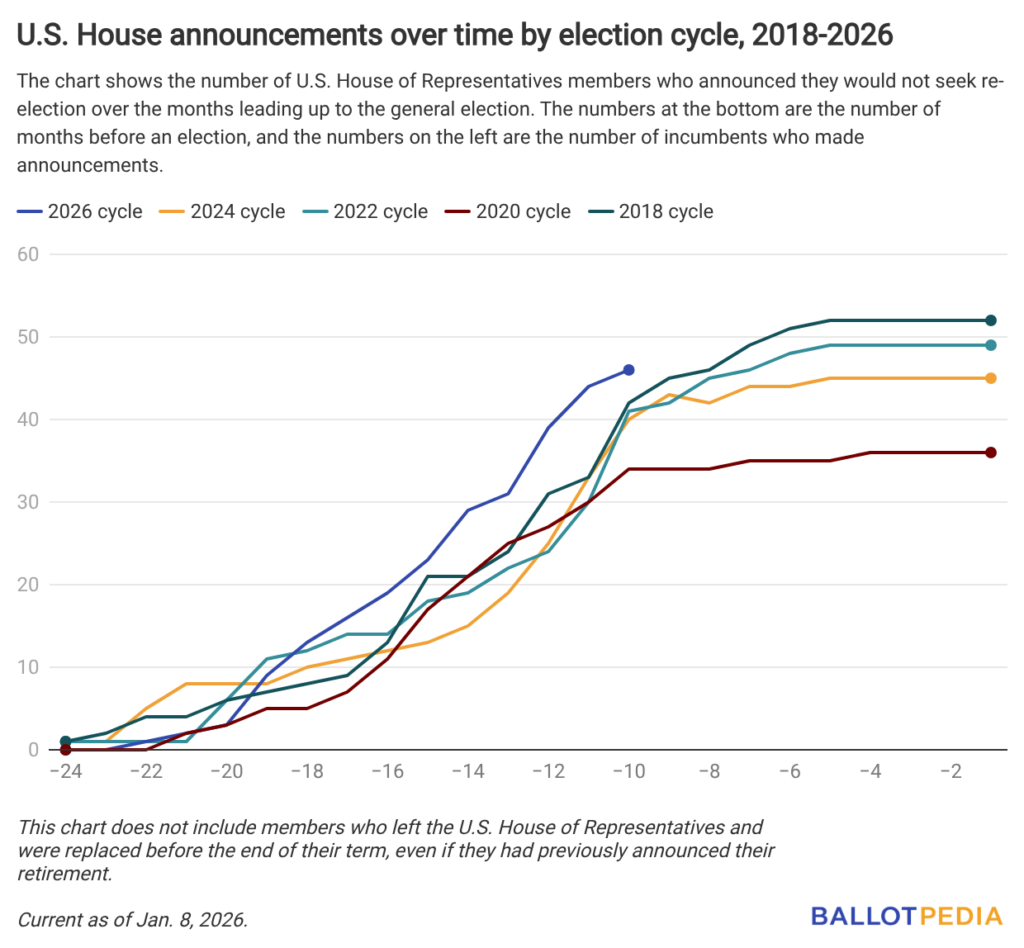
Forty-six representatives — 21 Democrats and 25 Republicans — will not seek re-election in 2026. Of the 46 members not seeking re-election:
- Twenty — 13 Democrats and seven Republicans — are retiring from public office
- Fourteen — seven Democrats and seven Republicans — are running for the U.S. Senate
- Eleven — one Democrat and 10 Republicans — are running for governor
- One Republican is running for attorney general of Texas
At this point in the last four election cycles, there were 40 retirement announcements in 2024, 41 in 2022, 34 in 2020, and 42 in 2018.
Six of the 46 retiring representatives — two Democrats and four Republicans — won by 10 percentage points or fewer in 2024. Three representatives — Jared Golden (D-Maine), Don Bacon (R-Neb.), and David Schweikert (R-Ariz.) — won by fewer than five percentage points.
U.S. Senate
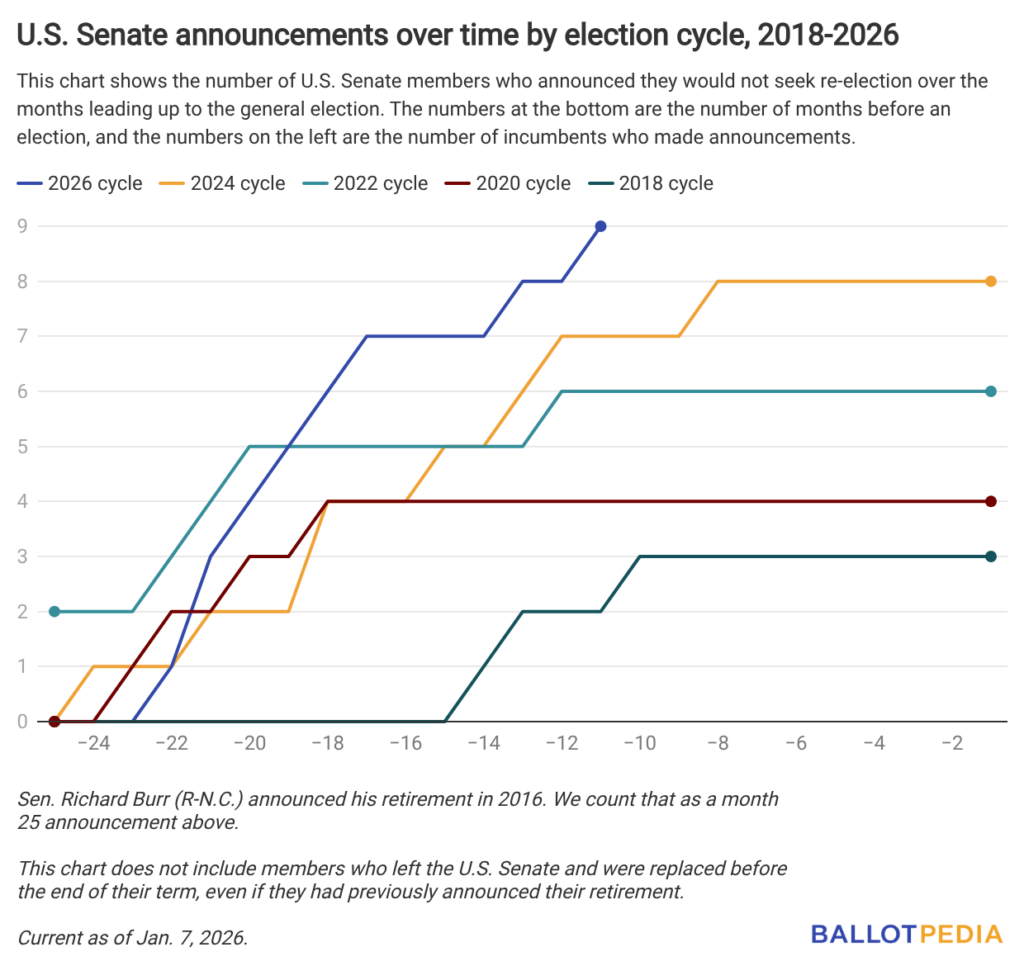
Nine senators — four Democrats and five Republicans — announced they will not seek re-election in 2026. Senators Lummis, Joni Ernst (R-Iowa), Thom Tillis (R-N.C.), Dick Durbin (D-Ill.), Mitch McConnell (R-Ky.), Jeanne Shaheen (D-N.H.), Tina Smith (D-Minn.), and Gary Peters (D-Mich.) are retiring from public office. Sen. Tommy Tuberville (R-Ala.) is running for governor of Alabama.
At this point in the last four election cycles, there were seven retirement announcements in 2024, six in 2022, four in 2020, and three in 2018.
Looking at the last time those nine senators ran in 2020, four of them — two Democrats and two Republicans — won by 10 percentage points or less. Tillis and Peters won by less than five percentage points.
Click here to read more about members of the U.S. Congress who are not seeking re-election in 2026.
Iowa becomes the eighth state to indicate participation in the federal school choice tax credit program
On Jan. 5, Iowa Gov. Kim Reynolds (R) announced that the state would participate in the U.S. school choice tax credit scholarship program, which the One Big Beautiful Bill Act (OBBBA) established when President Donald Trump (R) signed the bill in July 2025.
The announcement makes Iowa the sixth state to say that it will participate in the program. The program is a nonrefundable tax credit that allows individuals to receive up to $1,700 in federal tax credits for equivalent donations they make to scholarship-granting organizations (SGOs). In turn, SGOs distribute the donated scholarship funds to eligible families, which can be used on a variety of private or public educational expenses, including private school tuition, tutoring services, and textbooks. To qualify for scholarships, students must live in households earning no more than 300% of the area's median gross income and be eligible to enroll in K-12 schools.
States must opt into the program and submit a list of SGOs to the U.S. Treasury. Students in states that do not opt into the program cannot receive scholarships funded under the program. However, individuals in those states can donate to SGOs in participating states and receive a federal tax credit.
Officials in the following states have taken action regarding participation in the program:
- Governors of six states with Republican trifectas — Nebraska, Iowa, Louisiana, South Dakota, Tennessee, and Texas —said they would participate.
- Gov. Jared Polis (D) said Colorado — which has a Democratic trifecta — would participate.
- Governors of two states with Democratic trifectas — New Mexico and Oregon — said they would not participate.
- Gov. Josh Stein (D) said North Carolina — which has a divided government — would participate.
- Gov. Tony Evers (D) said Wisconsin — which has a divided government — would not participate.
Click here for more information about the federal school choice tax credit program.


