

John Lewis (Georgia)
| John Lewis | ||
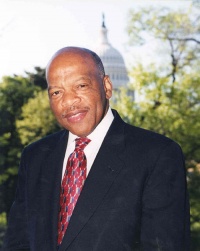 | ||
| U.S. House, Georgia, District 5 | ||
| Incumbent | ||
| Tenure | ||
| January 3, 1987-Present | ||
| Term ends | ||
| January 3, 2017 | ||
| Years in position 39 | ||
| Party | Democratic | |
| Predecessor | Wyche Fowler, Jr. (D) | |
| Leadership | ||
| 3rd Chairman, Student Nonviolent Coordinating Committee | ||
| 1963-1966 | ||
| Report an officeholder change | ||
| Compensation | ||
| Base salary | $174,000/year | |
| Elections and appointments | ||
| Last election | November 4, 2014 | |
| Cost per vote | $4.38 in 2014[1] | |
| First elected | November 4, 1986 | |
| Election date | November 8, 2016 | |
| Campaign $ | $6,313,350 | |
| Term limits | N/A | |
| Prior offices | ||
| Atlanta City Council | ||
| 1982-1986 | ||
| Education | ||
| High school | Pike County Training High School | |
| Bachelor's | American Baptist Theological Seminary, Fisk University | |
| Personal | ||
| Date of birth | February 21, 1940 | |
| Place of birth | Troy, Alabama | |
| Profession | Civil Rights Leader, Political Consultant | |
| Net worth | (2012) $72,004.50 | |
| Religion | Baptist | |
| Websites | ||
| Office website | ||
| Campaign website | ||
John Robert Lewis (b. February 21, 1940, in Troy, AL) is a Democratic member of the U.S. House of Representatives. Lewis was elected by voters from Georgia's 5th Congressional District. Lewis was first elected to the U.S. House in 1986.[2]
Lewis ran for re-election to the U.S. House in 2014. He won an uncontested general election.[3] He also ran unopposed in the Democratic primary on May 20, 2014.[4]
Lewis served as the Senior Chief Deputy Whip of the Democratic caucus for the 113th Congress.[5]
As of a 2014 analysis of multiple outside rankings, Lewis is one of the most reliable Democratic votes, meaning he can be considered a safe vote for the Democratic Party in Congress.
Career
Below is an abbreviated outline of Lewis's academic, professional and political career:[6]
- 1987-Present: U.S. Representative from Georgia's 5th Congressional District
- 1982-1986: Atlanta City Council
- 1963-1966: 3rd Chairman, Student Nonviolent Coordinating Committee
Committee assignments
U.S. House
2015-2016
Lewis serves on the following committees:[7]
2013-2014
Lewis served on the following committees:[8][9]
- Ways and Means Committee
- Subcommittee on Oversight Ranking Member
- Subcommittee on Human Resources
2011-2012
- Ways and Means Committee[10]
- Subcommittee on Oversight Chairman
- Subcommittee on Income Security and Family Support
Key votes
114th Congress

The first session of the 114th Congress enacted into law six out of the 2,616 introduced bills (0.2 percent). Comparatively, the 113th Congress had 1.3 percent of introduced bills enacted into law in the first session. In the second session, the 114th Congress enacted 133 out of 3,159 introduced bills (4.2 percent). Comparatively, the 113th Congress had 7.0 percent of introduced bills enacted into law in the second session.[11][12] For more information pertaining to Lewis's voting record in the 114th Congress, please see the below sections.[13]
Economic and fiscal
Trade Act of 2015
Trade adjustment assistance
 On June 12, 2015, the House rejected the trade adjustment assistance (TAA) measure in HR 1314—the Trade Act of 2015—by a vote of 126-302. Trade adjustment assistance (TAA) is a federal program providing American workers displaced by foreign trade agreements with job training and services. The measure was packaged with trade promotion authority (TPA), also known as fast-track authority. TPA is a legislative procedure that allows Congress to define "U.S. negotiating objectives and spells out a detailed oversight and consultation process for during trade negotiations. Under TPA, Congress retains the authority to review and decide whether any proposed U.S. trade agreement will be implemented," according to the Office of the United States Trade Representative. Lewis was one of 144 Democrats to vote against the bill.[14][15]
Trade promotion authority
On June 12, 2015, the House passed the trade promotion authority (TPA) measure in HR 1314—the Trade Act of 2015 —by a vote of 219-211. TPA gives the president fast-track authority to negotiate trade agreements sent to Congress without the opportunity for amendment or filibuster. Although the House approved TPA, it was a largely symbolic vote given the measure was part of a package trade bill including trade adjustment assistance (TAA), which was rejected earlier the same day. Lewis was one of 157 Democrats to vote against the measure.[16][17]
Trade promotion authority second vote
After the trade adjustment assistance (TAA) and trade promotion authority (TPA) did not pass the House together on June 12, 2015, representatives voted to authorize TPA alone as an amendment to HR 2146—the Defending Public Safety Employees' Retirement Act—on June 18, 2015. The amendment passed by a vote of 218-208, with all voting members of the House maintaining his or her original position on TPA except for Ted Yoho (R-Fla.). Lewis was one of 158 Democrats to vote against the amendment.[18][19]
Trade adjustment assistance second vote
 The House passed HR 1295—the Trade Preferences Extension Act of 2015—on June 25, 2015, by a vote of 286-138. The Senate packaged trade adjustment assistance (TAA) in this bill after the House rejected the TAA measure in HR 1314—the Trade Act of 2015. Along with trade promotion authority (TPA), which Congress passed as part of HR 2146—the Defending Public Safety Employees' Retirement Act—TAA became law on June 29, 2015. Lewis was one of 175 Democrats to vote in favor of HR 1295.[20][21]
Defense spending authorization
On May 15, 2015, the House passed HR 1735—the National Defense Authorization Act for Fiscal Year 2016—by a vote of 269-151. The bill "authorizes FY2016 appropriations and sets forth policies for Department of Defense (DOD) programs and activities, including military personnel strengths. It does not provide budget authority, which is provided in subsequent appropriations legislation." Lewis voted with 142 other Democrats and eight Republicans against the bill.[22] The Senate passed the bill on June 18, 2015, by a vote of 71-25. President Barack Obama vetoed the bill on October 22, 2015.[23]
2016 Budget proposal
 On April 30, 2015, the House voted to approve SConRes11, a congressional budget proposal for fiscal year 2016, by a vote of 226-197. The non-binding resolution will be used to create 12 appropriations bills to fund the government. All 183 Democrats who voted, voted against the resolution. Lewis and four other Democrats did not vote on the resolution.[24][25][26]
Foreign Affairs
Iran nuclear deal
- See also: Iran nuclear agreement, 2015
On May 14, 2015, the House approved HR 1191—the Iran Nuclear Agreement Review Act of 2015—by a vote of 400-25. The bill required President Barack Obama to submit the details of the nuclear deal with Iran for congressional review. Congress had 60 days to review the deal and vote to approve, disapprove, or take no action on the deal. During the review period, sanctions on Iran could not be lifted. Lewis voted with 176 Democrats to approve the bill.[27][28]
Approval of Joint Comprehensive Plan of Action
On September 11, 2015, the House rejected HR 3461—To approve the Joint Comprehensive Plan of Action, signed at Vienna on July 14, 2015, relating to the nuclear program of Iran—by a vote of 162-269. The legislation proposed approving the nuclear agreement with Iran. Lewis voted with 161 Democrats for the bill.[29][30]
Suspension of Iran sanctions relief
On September 11, 2015, the House approved HR 3460—To suspend until January 21, 2017, the authority of the President to waive, suspend, reduce, provide relief from, or otherwise limit the application of sanctions pursuant to an agreement related to the nuclear program of Iran—by a vote of 247-186. HR 3460 prohibited "the President, prior to January 21, 2017, from: limiting the application of specified sanctions on Iran or refraining from applying any such sanctions; or removing a foreign person (including entities) listed in Attachments 3 or 4 to Annex II of the Joint Comprehensive Plan of Action (JCPA) from the list of designated nationals and blocked persons maintained by the Office of Foreign Asset Control of the Department of the Treasury." Lewis voted with 185 Democrats against the bill.[31][32]
Presidential non-compliance of section 2
On September 10, 2015, the House passed H Res 411—Finding that the President has not complied with section 2 of the Iran Nuclear Agreement Review Act of 2015—by a vote of 245-186. Section 2 of the Iran Nuclear Agreement Review Act of 2015 required the president to submit all materials related to the nuclear agreement for congressional review. House Republicans introduced the resolution because two agreements between the International Atomic Energy Agency and Iran were not submitted to Congress. Lewis voted with 185 Democrats against the resolution.[33][34]
Domestic
USA FREEDOM Act of 2015
On May 13, 2015, the House passed HR 2048—the Uniting and Strengthening America by Fulfilling Rights and Ensuring Effective Discipline Over Monitoring Act of 2015 or the USA FREEDOM Act of 2015—by a vote of 338-88. The legislation revised HR 3199—the USA PATRIOT Improvement and Reauthorization Act of 2005—by ending the bulk collection of metadata under Sec. 215 of the act, requiring increased reporting from the Foreign Intelligence Surveillance Court, and requiring the use of "a specific selection term as the basis for national security letters that request information from wire or electronic communication service providers, financial institutions, or consumer reporting agencies." Lewis voted with 40 Democrats and 47 Republicans against the legislation. It became law on June 2, 2015.[35][36]
Pain-Capable Unborn Child Protection Act
On May 13, 2015, the House passed HR 36—the Pain-Capable Unborn Child Protection Act—by a vote of 242-184. The bill proposed prohibiting abortions from being performed after a fetus was determined to be 20 weeks or older. The bill proposed exceptions in cases of rape, incest, or to save the life of the mother. Lewis voted with 179 Democrats against the bill.[37][38]
113th Congress
The second session of the 113th Congress enacted into law 224 out of the 3215 introduced bills (7 percent). Comparatively, the 112th Congress had 4.2 percent of introduced bills enacted into law in the second session.[39] For more information pertaining to Lewis's voting record in the 113th Congress, please see the below sections.[40]
National security
DHS Appropriations
Lewis voted against HR 2217 - the DHS Appropriations Act of 2014. The bill passed the House on June 6, 2013, with a vote of 245 - 182 and was largely along party lines.[41]
Keystone Pipeline Amendment
Lewis voted in favor of House Amendment 69, which would have amended HR 3 to "require that the Pipeline and Hazardous Materials Safety Administration, in consultation with the Department of Homeland Security, conduct a study of the vulnerabilities of the Keystone XL pipeline to a terrorist attack and certify that necessary protections have been put in place." The amendment failed on May 22, 2013, with a vote of 176 - 239 and was largely along party lines.[41]
CISPA (2013)
Lewis voted against HR 624 - the CISPA (2013). The bill passed the House on April 18, 2013, with a vote of 288 - 127. The bill permitted federal intelligence agencies to share cybersecurity intelligence and information with private entities and utilities.[42] The bill was largely supported by Republicans, but divided the Democratic Party.[41]
NDAA
Lewis voted in support of HR 1960 - the National Defense Authorization Act for Fiscal Year 2014. The bill passed the House on June 14, 2013, with a vote of 315 - 108. Both parties were somewhat divided on the vote.[41]
Economy
Farm bill
On January 29, 2014, the U.S. House approved the Federal Agriculture Reform and Risk Management Act of 2013, H.R. 2642, known as the Farm Bill.[43] The bill passed by a vote of 251-166. The nearly 1,000-page bill provides for the reform and continuation of agricultural and other programs of the Department of Agriculture through 2018. The $1 trillion bill expanded crop insurance for farmers by $7 billion over the next decade and created new subsidies for rice and peanut growers that would kick in when prices drop.[44][45] However, cuts to the food stamp program cut an average of $90 per month for 1.7 million people in 15 states.[45] Lewis voted with 102 other Democratic representatives against the bill.
2014 Budget
On January 15, 2014, the Republican-run House approved H.R. 3547, a $1.1 trillion spending bill to fund the government through September 30, 2014.[46][47] The House voted 359-67 for the 1,582 page bill, with 64 Republicans and three Democrats voting against the bill.[47] The omnibus package included 12 annual spending bills to fund federal operations.[48] It included a 1 percent increase in the paychecks of federal workers and military personnel, a $1 billion increase in Head Start funding for early childhood education, reduced funding to the Internal Revenue Service and the Environmental Protection Agency, and the protection of the Affordable Care Act from any drastic cuts. Lewis joined with the majority of the Democratic party and voted in favor of the bill.[46][47]
Government shutdown
- See also: United States budget debate, 2013
On September 30, 2013, the House passed a final stopgap spending bill before the shutdown went into effect. The bill included a one-year delay of the Affordable Care Act's individual mandate and would have also stripped the bill of federal subsidies for congressional members and staff. It passed through the House with a vote of 228-201.[49] At 1 a.m. on October 1, 2013, one hour after the shutdown officially began, the House voted to move forward with going to a conference. In short order, Sen. Harry Reid rejected the call to conference.[50] Lewis voted against the stopgap spending bill that would have delayed the individual mandate.[51]
The shutdown ended on October 16, 2013, when the House took a vote on HR 2775 after it was approved by the Senate. The bill to reopen the government lifted the $16.7 trillion debt limit and funded the government through January 15, 2014. Federal employees also received retroactive pay for the shutdown period. The only concession made by Senate Democrats was to require income verification for Obamacare subsidies.[52] The House passed the legislation shortly after the Senate, by a vote of 285-144, with all 144 votes against the legislation coming from Republican members. Lewis voted for HR 2775.[53]
Federal Pay Adjustment Elimination
Lewis voted against HR 273 - Eliminates the 2013 Statutory Pay Adjustment for Federal Employees. The bill passed the House on February 15, 2013, with a vote of 261 - 154. The bill called for a stop to a 0.5 percent pay increase for all federal workers from taking effect, saving the federal government $11 billion over 10 years.[41]
Immigration
Morton Memos Prohibition
Lewis voted against House Amendment 136 - Prohibits the Enforcement of the Immigration Executive Order. The amendment was adopted by the House on June 6, 2013, with a vote of 224 - 201. The purpose of the amendment as stated on the official text is to "prohibit the use of funds to finalize, implement, administer, or enforce the Morton Memos." These memos would have granted administrative amnesty to certain illegal aliens residing in the United States. The vote largely followed party lines.[41]
Healthcare
Healthcare Reform Rules
Lewis voted against House Amendment 450 - Requires Congressional Approval for Any Rules Under the Patient Protection and Affordable Care Act. The amendment was adopted by the House on August 2, 2013, with a vote of 227-185. The amendment requires all changes to the Patient Protection and Affordable Care Act be approved by Congress before taking effect. The vote was largely along party lines.[41]
Keep the IRS Off Your Healthcare Act
Lewis voted against HR 2009 - Keep the IRS Off Your Healthcare Act of 2013. The bill passed through the House on August 2, 2013, with a vote of 232-185. The bill would prevent the IRS and Treasury Secretary from enforcing the powers provided to them in the Patient Protection and Affordable Care Act. The vote largely followed party lines.[41]
Social issues
Amash amendment
Lewis voted in favor of House Amendment 413 - Prohibits the National Security Agency from Collecting Records Under the Patriot Act. The amendment failed on July 4, 2013, by a vote of 205-217. The amendment would have prohibited the collection of records by the National Security Agency under the Patriot Act. Both parties were split on the vote.[41]
Previous congressional sessions
Fiscal Cliff
Lewis did not cast a vote regarding the fiscal cliff compromise bill, which made permanent most of the Bush tax cuts originally passed in 2001 and 2003 while also raising tax rates on the highest income levels. The bill was passed in the House by a 257 - 167 vote on January 1, 2013.[54]
Issues
On The Issues Vote Match

- See also: On The Issues Vote Match
On The Issues conducts a VoteMatch analysis of elected officials based on 20 issue areas. Rather than relying on incumbents to complete the quiz themselves, the VoteMatch analysis is conducted using voting records, statements to the media, debate transcripts or citations from books authored by or about the candidate.[55]

The table below contains the results of analysis compiled by staff at On The Issues.
| On The Issues Vote Quiz[56] | |||
|---|---|---|---|
| Economic Issues | Social Issues | ||
| Issue | Stance | Issue | Stance |
| Legally require hiring women & minorities | Strongly Favors | Abortion is a woman's unrestricted right | Strongly Favors |
| Expand Obamacare | Strongly Favors | Comfortable with same-sex marriage | Strongly Favors |
| Vouchers for school choice | Strongly Opposes | Keep God in the public sphere | Opposes |
| Absolute right to gun ownership | Strongly Opposes | No "rights" to clean air and water | Strongly Opposes |
| Higher taxes on the wealthy | Strongly Favors | Stricter punishment reduces crime | Strongly Opposes |
| Support & expand free trade | Opposes | Pathway to citizenship for illegal aliens | Strongly Favors |
| More enforcement of the right to vote | Strongly Favors | Maintain U.S. sovereignty from UN | Strongly Opposes |
| Prioritize green energy | Strongly Favors | Expand the military | Strongly Opposes |
| Stimulus better than market-led recovery | Strongly Favors | Stay out of Iran | Favors |
| Privatize Social Security | Strongly Opposes | Never legalize marijuana | Strongly Opposes |
| Note: Information last updated: May 20, 2015.[55] If you notice the rating has changed, email us. | |||
National security
American response in Syria
- See also: United States involvement in Syria
On August 29, 2013, 53 House Democrats signed a letter written by California Rep. Barbara Lee that called for a congressional resolution on strikes and said that the situation in Syria "should not draw us into an unwise war—especially without adhering to our constitutional requirements."[57][58] The letter also called on the Obama administration to work with the U.N. Security Council to build international consensus condemning the alleged use of chemical weapons. Lewis was one of the 53 Democrats in the House to sign the letter.[57][58]
On September 2, 2013, Lewis said, "Once Congressional debate begins and the Congress has had a full briefing, we will make a statement. We do not want to do so without that preparation."[59]
Controversy
Arrest during immigration protest
- See also: Gang of Eight
On October 8, 2013, eight Democratic members of Congress were arrested while attending a protest calling for comprehensive immigration reform in front of the U.S. Capitol.[60]
The eight included Lewis, Luis Gutierrez, Charlie Rangel, Raul Grijalva, Joseph Crowley, Jan Schakowsky, Keith Ellison and Al Green.[60] The politicians, along with activists who attended an immigration rally on the National Mall, staged a sit-in near the west side of the Capitol.[60] Authorities arrested the lawmakers for crowding and disrupting the streets around the Capitol. Almost 200 people were arrested by police during the protest.[60]
Lewis had been arrested 45 times previously, according to his twitter account. Lewis has been known to participate in sit-ins and protests throughout his many years in Congress.[60]
March on Washington speech
Lewis said Martin Luther King Jr. asked him to tone down the speech he delivered during the March on Washington more than 50 years ago.[61]
“Some people thought my speech as a little too strong, some would say maybe a little too militant. I said in the beginning, in my prepared text, I thought the Kennedy-proposed legislation was too little and that it was too late. And in another part of the speech, I said, ‘You tell us to wait. You tell us to be patient. We cannot wait. We cannot be patient. We want our freedom and we want it now,’” Lewis said.[61]
Elections
2014
Lewis ran for re-election to the U.S. House in 2014. He ran unopposed in the Democratic primary on May 20, 2014.[4] He ran unopposed in the general election on November 4, 2014.
| Party | Candidate | Vote % | Votes | |
|---|---|---|---|---|
| Democratic |  John Lewis Incumbent John Lewis Incumbent |
100% | 170,326 | |
| Total Votes | 170,326 | |||
| Source: Georgia Secretary of State | ||||
2012
Lewis ran in the 2012 election for the U.S. House to represent Georgia's 5th District. Lewis sought re-election on the Democratic ticket. The signature filing deadline was May 25, 2012, with the primary taking place on July 31, 2012. Michael Johnson was defeated by Lewis in the Democratic primary[62]. Lewis defeated Howard Stopeck (R) in the general election on November 6, 2012.
| Party | Candidate | Vote % | Votes | |
|---|---|---|---|---|
| Democratic | John Lewis Incumbent |
84.4% | 234,330 | |
| Republican | Howard Stopeck | 15.6% | 43,335 | |
| Total Votes | 277,665 | |||
| Source: Georgia Secretary of State "Official Election Results, 2012 General Election" | ||||
| Candidate | Vote % | Votes |
|---|---|---|
|
John Lewis Incumbent |
80.8% | 69,985 |
| Michael Johnson | 19.2% | 16,666 |
| Total Votes | 86,651 | |
Full history
To view the full congressional electoral history for John Lewis, click [show] to expand the section. | |||||||||||||||||||||||||||||||||||||||||||||||||||||||||||||||||||||||||||||||||||||||||||||||||||||||||||||||
|---|---|---|---|---|---|---|---|---|---|---|---|---|---|---|---|---|---|---|---|---|---|---|---|---|---|---|---|---|---|---|---|---|---|---|---|---|---|---|---|---|---|---|---|---|---|---|---|---|---|---|---|---|---|---|---|---|---|---|---|---|---|---|---|---|---|---|---|---|---|---|---|---|---|---|---|---|---|---|---|---|---|---|---|---|---|---|---|---|---|---|---|---|---|---|---|---|---|---|---|---|---|---|---|---|---|---|---|---|---|---|---|
|
2010 On November 2, 2010, John Lewis won re-election to the United States House. He defeated Fenn Little (R) in the general election.[63]
2008 On November 4, 2008, John Lewis won re-election to the United States House. He defeated Shira Kash (Write-in) and Jeanne Fitzmaurice (Write-in) in the general election.[64]
2006 Lewis ran unopposed for re-election in 2006. 2004 Lewis ran unopposed for re-election in 2004. 2002 Lewis ran unopposed for re-election in 2002. 2000 On November 7, 2000, John Lewis won re-election to the United States House. He defeated Hank Schwab (R) in the general election.[65]
1998 On November 3, 1998, John Lewis won re-election to the United States House. He defeated John H. Lewis, Sr. (R) in the general election.[66]
1996 Lewis ran unopposed for election in 1996. | |||||||||||||||||||||||||||||||||||||||||||||||||||||||||||||||||||||||||||||||||||||||||||||||||||||||||||||||
Campaign donors
Fundraising events
The below chart from Find The Best tracks the fundraising events Lewis attends.
Comprehensive donor history
 The finance data shown here comes from the disclosures required of candidates and parties. Depending on the election or state, this may not represent all the funds spent on their behalf. Satellite spending groups may or may not have expended funds related to the candidate or politician on whose page you are reading this disclaimer, and campaign finance data from elections may be incomplete. For elections to federal offices, complete data can be found at the FEC website. Click here for more on federal campaign finance law and here for more on state campaign finance law.
| John Lewis campaign contribution history | ||||
|---|---|---|---|---|
| Year | Office | Result | Contributions | |
| 2014 | U.S. House (Georgia, District 5) |  |
$723,262 | |
| 2012 | U.S. House (Georgia, District 5) | |
$1,238,299 | |
| 2010 | U.S. House (Georgia, District 5) | |
$1,013,992 | |
| 2008 | U.S. House (Georgia, District 5) | |
$1,267,597 | |
| 2006 | U.S. House (Georgia, District 5) | |
$628,202 | |
| 2004 | U.S. House (Georgia, District 5) | |
$421,030 | |
| 2002 | U.S. House (Georgia, District 5) | |
$338,831 | |
| 2000 | U.S. House (Georgia, District 5) | |
$682,137 | |
| Grand total raised | $6,313,350 | |||
| Source: [[67] Follow the Money] | ||||
2014
Lewis won re-election to the U.S. House in 2014. During that election cycle, Lewis' campaign committee raised a total of $723,262 and spent $745,565.[68] This is less than the average $1.45 million spent by House winners in 2014.[69]
Cost per vote
Lewis spent $4.38 per general election vote received in 2014.
| Total Raised | $723,262 |
| Total Spent | $745,565 |
| Total Raised by Election Runner-up | $0 |
| Total Spent by Election Runner-up | $0 |
| Top contributors to John Lewis (Georgia)'s campaign committee | |
| JStreetPAC | $16,400 |
| Home Depot | $13,000 |
| United Parcel Service | $12,750 |
| AFLAC Inc | $10,000 |
| American Federation of Teachers | $10,000 |
| Top 5 industries that contributed to campaign committee | |
| Insurance | $59,000 |
| Industrial Unions | $40,000 |
| Health Professionals | $34,750 |
| Public Sector Unions | $31,500 |
| Lawyers/Law Firms | $29,550 |
| Source: Open Secrets | |
To view the breakdown of campaign funding by type click [show] to expand the section. | |
|---|---|

Below are Lewis' FEC reports.[70]
| John Lewis (2014) Campaign Finance Reports | |||||||||
|---|---|---|---|---|---|---|---|---|---|
| Report | Date Filed | Beginning Balance | Total Contributions for Reporting Period | Expenditures | Cash on Hand | ||||
| April Quarterly[71] | April 17, 2013 | $206,722.39 | $46,925.00 | $(53,392.65) | $200,254.74 | ||||
| July Quarterly[72] | July 15, 2013 | $200,254.74 | $62,568.40 | $(58,153.97) | $204,669.17 | ||||
| October Quarterly[73] | October 13, 2013 | $204,669.17 | $76,021.42 | $(64,340.96) | $216,349.63 | ||||
| Year-end[74] | January 31, 2014 | $216,349 | $96,392 | $(91,868) | $220,874.00 | ||||
| April Quarterly[75] | April 15, 2014 | $220,874 | $55,309 | $(87,884) | $188,299 | ||||
| July Quarterly[76] | July 15, 2014 | $185,927.00 | $101,902.00 | $(78,988.00) | $208,841.00 | ||||
| October Quarterly[77] | October 15, 2014 | $208,841 | $179,508 | $(172,159) | $216,189 | ||||
| Running totals | |||||||||
| $618,625.82 | $(606,786.58) | ||||||||
2012
Lewis won re-election to the U.S. House in 2012. During that election cycle, Lewis' campaign committee raised a total of $1,238,299 and spent $1,300,095.[78] This is less than the average $1.5 million spent by House winners in 2012.[79]
Cost per vote
Lewis spent $5.55 per vote received in 2012.
| U.S. House, Georgia District 5, 2012 - John Lewis (Georgia) Campaign Contributions | |
|---|---|
| Total Raised | $1,238,299 |
| Total Spent | $1,300,095 |
| Total Raised by Election Runner-up | $37,960 |
| Total Spent by Election Runner-up | $54,960 |
| Top contributors to John Lewis (Georgia)'s campaign committee | |
| Comcast Corp | $19,500 |
| Massachusetts Mutual Life Insurance | $14,000 |
| Cox Enterprises | $12,750 |
| Home Depot | $12,000 |
| Coca-Cola Co | $10,500 |
| Top 5 industries that contributed to campaign committee | |
| Lawyers/Law Firms | $88,900 |
| Health Professionals | $78,000 |
| Insurance | $74,000 |
| TV/Movies/Music | $56,500 |
| Securities & Investment | $45,000 |
To view the breakdown of campaign funding by type click [show] to expand the section. | |
|---|---|

2010
Lewis won re-election to the U.S. House of Representatives in 2010. During that re-election cycle, Lewis' campaign committee raised a total of $1,013,992 and spent $1,115,868.[80]
| U.S. House, Georgia District 5, 2010 - John Lewis (Georgia) Campaign Contributions | |
|---|---|
| Total Raised | $1,013,992 |
| Total Spent | $1,115,868 |
| Total Raised by General Election Opponent | $107,759 |
| Total Spent by General Election Opponent | $92,206 |
| Top contributors to John Lewis (Georgia)'s campaign committee | |
| DaVita Inc | $25,700 |
| Gentiva Health Services | $13,000 |
| National Assn of Realtors | $10,500 |
| AFLAC Inc | $10,000 |
| American Assn for Justice | $10,000 |
| Top 5 industries that contributed to campaign committee | |
| Lawyers/Law Firms | $89,450 |
| Health Professionals | $68,700 |
| Health Services/HMOs | $68,150 |
| Insurance | $56,000 |
| Public Sector Unions | $41,000 |
To view the breakdown of campaign funding by type click [show] to expand the section. | |
|---|---|

Personal Gain Index

- See also: Personal Gain Index (U.S. Congress)
- See also: Personal Gain Index (U.S. Congress)
The Personal Gain Index (U.S. Congress) is a two-part measurement that illustrates the extent to which members of the U.S. Congress have prospered during their tenure as public servants.
It consists of two different metrics:
PGI: Change in net worth

Based on congressional financial disclosure forms and calculations made available by OpenSecrets.org, Lewis's net worth as of 2012 was estimated between $9,009 to $135,000. That averages to $72,004.50, which is lower than the average net worth of Democratic representatives in 2012 of $5,700,168.36. Lewis ranked as the 386th most wealthy representative in 2012.[81] Between 2004 and 2012, Lewis' calculated net worth[82] decreased by an average of 3 percent per year. Between 2004 and 2012, the average annual percentage increase for a member of Congress was 15.4 percent.[83]
| John Lewis Yearly Net Worth | |
|---|---|
| Year | Average Net Worth |
| 2004 | $94,114 |
| 2012 | $72,004.50 |
| Growth from 2004 to 2012: | −23% |
| Average annual growth: | −3%[84] |
| Comparatively, the American citizen experienced a median yearly decline in net worth of -0.94%.[85] | |
The data used to calculate changes in net worth may include changes resulting from assets gained through marriage, inheritance, changes in family estates and/or trusts, changes in family business ownership, and many other variables unrelated to a member's behavior in Congress.
PGI: Donation Concentration Metric
Filings required by the Federal Election Commission report on the industries that give to each candidate. Using campaign filings and information calculated by OpenSecrets.org, Ballotpedia calculated the percentage of donations by industry received by each incumbent over the course of his or her career (or 1989 and later, if elected prior to 1988). Lewis received the most donations from individuals and PACs employed by the Health Professionals industry.
From 1989-2014, 31.86 percent of Lewis' career contributions came from the top five industries as listed below.[86]

| John Lewis (Georgia) Campaign Contributions | |
|---|---|
| Total Raised | $7,987,717 |
| Total Spent | $8,013,366 |
| Top five industries that contributed to campaign committee | |
| Health Professionals | $664,026 |
| Lawyers/Law Firms | $595,282 |
| Insurance | $449,700 |
| Public Sector Unions | $427,168 |
| Industrial Unions | $408,850 |
| % total in top industry | 8.31% |
| % total in top two industries | 15.77% |
| % total in top five industries | 31.86% |
Analysis
Ideology and leadership
Based on an analysis of bill sponsorship by GovTrack, Lewis was a "far-left Democratic leader," as of July 29, 2014. This was the same rating Lewis received in June 2013.[87]
Like-minded colleagues
The website OpenCongress tracks the voting records of each member to determine with whom he or she votes most and least often. The results include a member from each party.[88]
|
Lewis most often votes with: |
Lewis least often votes with: |


Lifetime voting record
According to the website GovTrack, Lewis missed 1,196 of 17,292 roll call votes from January 1987 to July 2014. This amounts to 6.9 percent, which is worse than the median of 2.5 percent among current congressional representatives as of July 2014.[89]
Congressional staff salaries
The website Legistorm compiles staff salary information for members of Congress. Lewis paid his congressional staff a total of $1,109,123 in 2011. He ranks 47th on the list of the highest paid Democratic representative staff salaries and ranks 57th overall of the highest paid representative staff salaries in 2011. Overall, Georgia ranks 24th in average salary for representative staff. The average U.S. House of Representatives congressional staff was paid $954,912.20 in fiscal year 2011.[90]
National Journal vote ratings
- See also: National Journal vote ratings
Each year National Journal publishes an analysis of how liberally or conservatively each member of Congress voted in the previous year.
2013
Lewis ranked 65th in the liberal rankings in 2013.[91]
2012
Lewis ranked 1st in the liberal rankings in 2012.[92]
2011
Lewis ranked 21st in the liberal rankings in 2011.[93]
Voting with party
The website OpenCongress tracks how often members of Congress vote with the majority of the chamber caucus.
2014
Lewis voted with the Democratic Party 95.7 percent of the time, which ranked 10th among the 204 House Democratic members as of July 2014.[94]
2013
Lewis voted with the Democratic Party 95.8 percent of the time, which ranked 40th among the 201 House Democratic members as of June 2013.[95]
Recent news
This section displays the most recent stories in a Google news search for the term John + Lewis + Georgia + House
- All stories may not be relevant to this page due to the nature of the search engine.
See also
- Georgia
- United States congressional delegations from Georgia
- United States House of Representatives
- Georgia's 5th Congressional District
- Georgia's 5th Congressional District elections, 2012
- Georgia's 5th Congressional District elections, 2014
External links

- Social media:
- Biographies:
- Political profiles:
- Financial (federal level):
- Interest group ratings:
- Issue positions:
- Public statements:
- Voting record:
- Media appearances:
- Media coverage:
References
- ↑ Note: Cost per vote is the total amount raised by the candidate divided by the number of he or she received in the election.
- ↑ Cite error: Invalid
<ref>tag; no text was provided for refs namedbiography - ↑ Politico, "House Elections Results," accessed November 11, 2014
- ↑ 4.0 4.1 Associated Press, "Primary election results," accessed May 20, 2014
- ↑ Office of the Democratic Whip Steny Hoyer, "Hoyer Announces Whip Team for the 113th Congress," accessed January 4, 2013
- ↑ Biographical Directory of the United States Congress, "LEWIS, John R., (1940 - )," accessed February 9, 2015
- ↑ U.S. House of Representatives, Office of the Clerk, "Committee Information," accessed February 18, 2015
- ↑ CQ.com, "House Committee Rosters for the 113th Congress," accessed March 3, 2013
- ↑ U.S. House of Representatives, "Committee Assignments," accessed March 29, 2014
- ↑ The Online Office of Congressman John Lewis, "House Committees and Subcommittees," accessed October 27, 2011
- ↑ Congressional Record, "Resume of Congressional Activity, First Session of the 113th Congress," accessed April 29, 2015
- ↑ Congressional Record, "Resume of Congressional Activity, Second Session of the 114th Congress," accessed January 5, 2017
- ↑ Congressional Record, "Resume of Congressional Activity, First Session of the One Hundred Fourteenth Congress," April 13, 2015
- ↑ Clerk.House.gov, "Final Vote Results for Roll Call 361," June 12, 2015
- ↑ Roll Call, "Deadline for TAA Do-Over Vote Extended to July 30 (Updated)," June 15, 2015
- ↑ Clerk.House.gov, "Final Vote Results for Roll Call 362," June 12, 2015
- ↑ Roll Call, "Deadline for TAA Do-Over Vote Extended to July 30 (Updated)," June 15, 2015
- ↑ Clerk.House.gov, "Final Vote Results for Roll Call 374," June 18, 2015
- ↑ Politico, "Trade turnaround: House backs new power for Obama," June 18, 2015
- ↑ Clerk.House.gov, "Final Vote Results for Roll Call 388," June 24, 2015
- ↑ The Hill, "Obama signs trade bills," June 29, 2015
- ↑ Clerk.House.gov, "Final Vote Results for Roll Call 239," accessed May 27, 2015
- ↑ Congress.gov, "H.R. 1735," accessed May 27, 2015
- ↑ Congress.gov, "S.Con.Res.11," accessed May 5, 2015
- ↑ Clerk.House.gov, "Final Vote Results for Roll Call 183," accessed May 5, 2015
- ↑ The Hill, "Republicans pass a budget, flexing power of majority," accessed May 5, 2015
- ↑ Congress.gov, "H.R.1191 - Iran Nuclear Agreement Review Act of 2015," accessed May 16, 2015
- ↑ Clerk.House.gov, "Final Vote Results for Roll Call 226," accessed May 16, 2015
- ↑ Congress.gov, "HR 3461," accessed September 11, 2015
- ↑ Clerk.House.gov, "Final Vote Results for Roll Call 493," accessed September 11, 2015
- ↑ Congress.gov, "HR 3460," accessed September 10, 2015
- ↑ Clerk.House.gov, "Final Vote Results for Roll Call 494," accessed September 11, 2015
- ↑ Congress.gov, "H Res 411," accessed September 10, 2015
- ↑ Clerk.House.gov, "Final Vote Results for Roll Call 492," accessed September 10, 2015
- ↑ Congress.gov, "H.R.2048," accessed May 26, 2015
- ↑ Clerk.House.gov, "Final Vote Results for Roll Call 224," accessed May 26, 2015
- ↑ Congress.gov, "HR 36 - the Pain-Capable Unborn Child Protection Act," accessed May 16, 2015
- ↑ Clerk.House.gov, "HR 36," accessed May 16, 2015
- ↑ Congressional Record, "Resume of Congressional Activity, First Session of the 112th Congress," accessed September 5, 2013
- ↑ Congressional Record, "Resume of Congressional Activity, Second Session of the 113th Congress," accessed March 4, 2014
- ↑ 41.0 41.1 41.2 41.3 41.4 41.5 41.6 41.7 41.8 Project Vote Smart, "John Lewis Key Votes," accessed September 30, 2013
- ↑ The Library of Congress, "Bill Summary & Status - 113th Congress (2013 - 2014) - H.R.624," accessed August 27, 2013
- ↑ Clerk of U.S. House, "Roll Call Vote 31: H.R. 2642," accessed February 12, 2014
- ↑ Politico, "House clears Farm Bill," accessed February 12, 2014
- ↑ 45.0 45.1 New York Times, "Senate passes long-stalled Farm Bill, with clear winners and losers," accessed February 12, 2014
- ↑ 46.0 46.1 CNN.com, "House passes compromise $1.1 trillion budget for 2014," accessed January 20, 2014
- ↑ 47.0 47.1 47.2 U.S. House, "Roll Call Vote 21," accessed January 20, 2014
- ↑ Roll Call, "Omnibus Sails Through the Senate," January 16, 2014
- ↑ Clerk of the U.S. House, "Final vote results for Roll Call 504," accessed October 31, 2013
- ↑ Buzzfeed, "Government Shutdown: How We Got Here," accessed October 1, 2013
- ↑ Clerk of the U.S. House, "Final vote results for Roll Call 504," accessed October 31, 2013
- ↑ The Washington Post, "Reid, McConnell propose bipartisan Senate bill to end shutdown, extend borrowing," accessed October 16, 2013
- ↑ U.S. House, "Final vote results for Roll Call 550," accessed October 31, 2013
- ↑ U.S. House, "Roll Call Vote on the Fiscal Cliff," accessed January 4, 2013
- ↑ 55.0 55.1 On The Issues, "John Lewis Vote Match," accessed May 20, 2015
- ↑ The questions in the quiz are broken down into two sections: social and economic. In social questions, liberals and Libertarians agree in choosing the less-government answers, while conservatives and populists agree in choosing the more restrictive answers. For the economic questions, conservatives and Libertarians agree in choosing the less-government answers, while liberals and populists agree in choosing the more restrictive answers.
- ↑ 57.0 57.1 Congresswoman Barbara Lee, "Rep. Barbara Lee and 53 other Democrats sign letter to Obama urging debate on Syria," accessed September 3, 2019
- ↑ 58.0 58.1 Washington Post, "More than 50 House Democrats also want Syria strike resolution," accessed September 2, 2013
- ↑ 11 Alive.com, "Georgia lawmakers explain their positions on Syria," accessed September 5, 2013
- ↑ 60.0 60.1 60.2 60.3 60.4 NBC News, "Democratic lawmakers arrested during immigration protest," accessed October 9, 2013
- ↑ 61.0 61.1 Politico, "Lewis: King asked to tone down March speech," accessed August 26, 2013
- ↑ Cite error: Invalid
<ref>tag; no text was provided for refs namedresults - ↑ U.S. Congress House Clerk, "Statistics of the Congressional Election of November 2, 2010," accessed March 28, 2013
- ↑ U.S. Congress House Clerk, "Statistics of the Congressional Election of November 4, 2008," accessed March 28, 2013
- ↑ U.S. Congress House Clerk, "Statistics of the Congressional Election of November 7, 2000," accessed March 28, 2013
- ↑ U.S. Congress House Clerk, "Statistics of the Congressional Election of November 3, 1998," accessed March 28, 2013
- ↑ Open Secrets, "John Lewis," accessed April 5, 2013
- ↑ Open Secrets, "John Lewis 2014 Election Cycle," accessed April 1, 2015
- ↑ Open Secrets, "Winning vs. Spending," accessed April 1, 2015
- ↑ Federal Election Commission, "John Lewis 2014 Summary reports," accessed July 23, 2013
- ↑ Federal Election Commission, "April Quarterly," accessed July 23, 2013
- ↑ Federal Election Commission, "July Quarterly," accessed July 23, 2013
- ↑ Federal Election Commission, "October Quarterly," accessed October 23, 2013
- ↑ Federal Election Commission, "Year End Report," accessed February 10, 2014
- ↑ Federal Election Commission, "April Quarterly," accessed April 21, 2014
- ↑ Federal Election Commission, "July Quarterly," accessed October 20, 2014
- ↑ Federal Election Commission, "October Quarterly," accessed October 20, 2014
- ↑ Open Secrets, "John Lewis 2012 Election Cycle," accessed February 20, 2013
- ↑ Open Secrets, "Election 2012: The Big Picture Shows Record Cost of Winning a Seat in Congress," accessed June 19, 2013
- ↑ Open Secrets, "John Kerry 2008 Election Cycle," accessed October 2011
- ↑ OpenSecrets, "John Lewis (D-GA), 2012," accessed February 18, 2014
- ↑ This figure represents the total percentage growth from either 2004 (if the member entered office in 2004 or earlier) or their first year in office (as noted in the chart below).
- ↑ This number was found by dividing each member's total net worth growth percentage by the number of years included in the calculation.
- ↑ This figure represents the total percentage growth divided by the number of years for which there are net worth figures for each member.
- ↑ This figure was calculated using median asset data from the Census Bureau. Please see the Congressional Net Worth data for Ballotpedia spreadsheet for more information on this calculation.
- ↑ OpenSecrets.org, "Rep. John Lewis," accessed September 23, 2014
- ↑ GovTrack, "Lewis," accessed July 29, 2014
- ↑ OpenCongress, "Rep. John Lewis," accessed July 29, 2014
- ↑ GovTrack, "John Lewis," accessed July 29, 2014
- ↑ LegiStorm, "John Lewis," accessed 2012
- ↑ National Journal, "2013 Congressional Vote Ratings," accessed July 29, 2014
- ↑ National Journal, "2012 Congressional Vote Ratings," accessed February 27, 2013
- ↑ National Journal, "Searchable Vote Ratings Tables: House," accessed February 23, 2012
- ↑ OpenCongress, "Voting With Party," accessed July 2014
- ↑ OpenCongress, "Voting With Party," accessed July 2014
| Political offices | ||
|---|---|---|
| Preceded by Wyche Fowler |
U.S. House of Representatives - Georgia, District 5 1987–Present |
Succeeded by ' |
| Preceded by ' |
Atlanta City Council 1982-1986 |
Succeeded by ' |
.svg.png)


