Farmington Public School District elections (2014)
2016 →
|
 |
Method of election Elections What was at stake? Key deadlines Additional elections External links |
Farmington Public School District Oakland County, Michigan ballot measures Local ballot measures, Michigan |
 |
Two seats on the Farmington Public School District Board of Education were up for general election on November 4, 2014.
Incumbent Trisha L. Balazovic ran against challengers Jessica Cummings, Terry L. Johnson, and William J. Lubaway for the seats. Fellow board member Frank L. Reid did not file for re-election.[1] Jessica Cummings and Terry L. Johnson defeated the other two candidates to win the two seats.
About the district
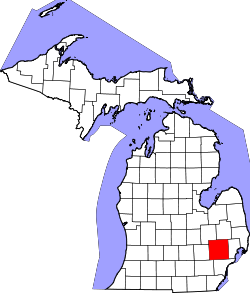
Farmington Public School District is located in Oakland County, Michigan. The county seat is Pontiac. Oakland County had a population of 1,231,640 residents, according to the United States Census Bureau in 2014.[2] In the 2011-2012 school year, Farmington Public School District was the 17th-largest school district in Michigan and served 11,288 students.[3]
Demographics
In 2012, Oakland County had a higher percentage of residents with a bachelor's degree compared to the state overall. The United States Census Bureau reported that 42.7 percent of residents aged 25 and older in Oakland County had earned a bachelor's degree, compared with 25.5 percent for Michigan. The county’s median household income was $65,637, above the state median of $48,471. The poverty rate in Oakland County was 9.9 percent, below the state rate of 16.3 percent.[2]
|
| ||||||||||||||||||||||||||||||||||||||||||||||
Note: Percentages for race and ethnicity may add up to more than 100 percent because respondents may report more than one race and the Hispanic/Latino ethnicity may be selected in conjunction with any race. Read more about race and ethnicity in the census here.
Voter and candidate information
As of the 2014 election, the Farmington Board of Education consisted of seven members elected at-large to six-year terms. There was no primary election and the general election was held on November 4, 2014. Two seats were up for election in 2014.[1]
School board candidates had to file with their county elections department during the candidate filing period, which ended on July 22, 2014. The deadline to withdraw was on July 25, 2014. Write-in candidates had to file by October 24, 2014. To vote in the 2014 general election, voters had to register by October 6, 2014.[5]
Elections
2014
Candidates
At-large
- Trisha L. Balazovic
- Incumbent
Election results
| Party | Candidate | Vote % | Votes | |
|---|---|---|---|---|
| Nonpartisan |  Jessica Cummings Jessica Cummings |
33.9% | 13,171 | |
| Nonpartisan | Terry L. Johnson |
25.3% | 9,806 | |
| Nonpartisan | Trisha L. Balazovic Incumbent | 23.1% | 8,948 | |
| Nonpartisan | William J. Lubaway | 17.4% | 6,740 | |
| Nonpartisan | Write-in votes | 0.3% | 133 | |
| Total Votes | 38,798 | |||
| Source: Oakland County Elections Division, "November 4, 2014 General Election," accessed December 29, 2014 | ||||
Endorsements
Incumbent Trisha L. Balazovic and challenger Jessica Cummings each received endorsements from The Farmington Observer and the local chapter of the Michigan Education Association.[6][7]
Campaign finance
Candidates reported $10,083.26 in contributions and $7,318.78 in expenditures during the election, according to the Oakland County Elections Division.[8]
In Michigan, candidates are prohibited from receiving contributions from corporations or labor organizations. Within 10 days of becoming a candidate, candidates must form a candidate committee. Following the creation of the committee, candidates have an additional 10 days to register the committee with the school district by filing a statement of organization. A candidate committee that does not expect to receive or spend more than $1,000 during the election cycle is eligible to receive a reporting waiver, which allows that committee not to file pre-election, post-election and annual campaign statements without legal penalty.[9]
| Candidate | Contributions | Expenditures | Cash on hand |
|---|---|---|---|
| Trisha L. Balazovic | $1,983.26 | $1,983.26 | $0.00 |
| Jessica Cummings | $1,280.00 | $715.42 | $564.58 |
| Terry L. Johnson | $4,075.00 | $3,603.31 | $471.69 |
| William J. Lubaway | $2,745.00 | $1,016.79 | $1,728.21 |
Past elections
Information about earlier elections can be found by clicking [show] at the right. | ||||||||||||||||||||||||||||||||||||||||||||||||||||||||||||||||||||||||||||||||||||||||||||||||||||||||||||||||||||
|---|---|---|---|---|---|---|---|---|---|---|---|---|---|---|---|---|---|---|---|---|---|---|---|---|---|---|---|---|---|---|---|---|---|---|---|---|---|---|---|---|---|---|---|---|---|---|---|---|---|---|---|---|---|---|---|---|---|---|---|---|---|---|---|---|---|---|---|---|---|---|---|---|---|---|---|---|---|---|---|---|---|---|---|---|---|---|---|---|---|---|---|---|---|---|---|---|---|---|---|---|---|---|---|---|---|---|---|---|---|---|---|---|---|---|---|---|
2011
| ||||||||||||||||||||||||||||||||||||||||||||||||||||||||||||||||||||||||||||||||||||||||||||||||||||||||||||||||||||
What was at stake?
Issues in the election
Candidate survey answers
The four candidates who ran for school board in 2014 provided the following answers to a survey conducted by The Farmington Observer:
| “ | Do you believe pensions provided to retirees of the public school system are fair and equitable? If not, what’s a solution for this growing burden of legacy costs that continue to drain school budgets in Farmington and throughout Michigan?
Trisha L. Balazovic: I believe that true reform is needed regarding the pension system in Michigan. The system is currently over $24 billion dollars underfunded for our teacher’s retirement. That number in itself shows how unstable this system is and the risk to our teachers’ pensions. I believe that Michigan should move to a cash balance plan similar to states such as Kansas, Kentucky and Nebraska. Under such a system, the state and school districts save money and the benefit to the teachers is secure, preventing future legislation from hurting their retirement savings. Jessica Cummings: The state of Michigan determines, without negotiation, what school districts must pay for employee retirement. Those costs on districts have nearly doubled in the last eight years. This is due to fewer workers paying into the fund because of districts across the state being financially forced to outsource jobs such as custodians, nutrition services and bus drivers. Even with a budget surplus in Lansing, school districts are being told to use more of their per pupil foundation allowance (a number set by Lansing) to fund legacy costs. The state determines how much our district receives per student and how much the district must pay in retirement for each teacher. The state is lowering the dollar amount per student and raising legacy costs per employee. We must call on Lansing to fix this problem, which poses serious financial challenges to the district. Terry L. Johnson: I would like to see a long-term a plan in which the public school districts allow each individual employee to individually manage their own plan. I think the district should contribute a portion to the plan but long term it’s up to the employee to manage, direct and be responsible for their own retirement. William J. Lubaway: A common sense guideline is to pay today for services today. That’s easy with paychecks but requires expert help to identify the current cost of future benefits such as pensions. Then it takes fiscal discipline to set aside the funds to pay for those future benefits now. Ignore this discipline and end up paying today for today’s services, last year’s services and 1980’s services. Some counties and cities have calculated the amount of unfunded pensions, frozen the liabilities and issued bonds. That still leaves the question of who pays — the state or the school district. There’s no pot of gold with which to pay down this liability. Detroit ignored pension liabilities until it tipped into bankruptcy and the pension liability was reduced by reducing future pension payments to retirees. Should the school district consider outsourcing more services as a cost-saving measure? Why or why not? Trisha L. Balazovic: It has been a number of years since the FPS Board has fully considered outsourcing more services. In order to balance our budget while continuing to provide the best classroom and school experience for our students, we need to consider every option that could provide significant savings, and then weigh the risk versus the reward. I have researched districts that have outsourced services and in some cases it was successful for the district and the employees and in others it didn’t have the expected savings impact for the district and the employees were hurt in the process. Jessica Cummings: Outsourcing is one reason why legacy costs are out of control. We should not outsource our workforce. With that said, if the lawmakers in Lansing continue to cut funding, we must make sure to keep those cuts as far from the classroom and extra district programing as we can. With cuts to funding, all options for cost savings must be considered. Terry L. Johnson: The school district is in financial crisis. We need to be competitive in every area. I believe we first give our employees the opportunity to compete on any service that they are currently performing. If our employees can perform the task at a competitive level then we should remain with our team. William J. Lubaway: Compared to other public schools in Macomb, Oakland and Wayne in 2012-13, costs in areas usually subject to outsourcing are fairly close to average. Instruction Staff Support is $772 (70 percent) above average. Two considerations apply here: (1) to the extent these costs should be reduced, the method is not germane; (2) these comparisons are two budget years old, which means that reductions may have already been made. If you could single-handedly change one thing about Farmington Public Schools, what would it be? Trisha L. Balazovic: I believe that Farmington Public Schools district is a fantastic place to live in and raise children. We have some the best teachers in the state. We offer incredible programs for our students and community. And as we move forward, we will only continue to improve upon all of these things. If I could change one thing about Farmington Public Schools, it would be the perception that people within our own district have of the school system. To do that we need to build trust back with the community and implement additional transparency throughout everything we do. Jessica Cummings: The one issue I will tackle first as a school board member will be improving, increasing, and building communication between the board and the community. In my conversations with residents, it has become apparent that the community wants open lines of communication with the board, and many residents do not think open lines of communication currently exist. Building the bridges of communication with the community is critical for the district's future success. Working together with the community, the board will be able to accomplish much more when handling difficult issues, which I anticipate will be presented to the board in the near future. The financial situation in the district, and other challenging issues, will test the board’s abilities when making decisions. Strong communication is crucial. I will work with my colleagues on the board to find and implement immediate solutions to this issue. Communication is the bedrock upon which all progress in this district will be built.I will request to be appointed to the board’s Community Relations Committee.I will investigate this issue by discussing with my colleagues past communication procedures. I want the committee to brainstorm solutions for this issue and present potential solutions to the board, the PTA Council, and the community. Community feedback and input will be imperative when building and strengthening the bridges of communication. Once solutions are identified, I will work with the Community Relations Committee to implement solutions. An important part of implementing solutions will be following up at later dates to ensure that solutions are working as anticipated. Every effort the board makes to provide a high quality of education, make difficult financial decisions, and improve the district will begin with the foundation of communication and understanding. Terry L. Johnson: I would like to make sure each and every student is successful with his or her test scores, and preparation for higher education. I would like to see our school district return to the exemplary level that we once were. There was a time when a student graduated from Farmington Public Schools and was prepared for the next level. Today that is not the case. I want our district to return to being one of the best districts in the state. William J. Lubaway: Balance the budget while achieving excellent educational quality.[10] |
” |
| —The Farmington Observer survey (2014)[11] | ||
Key deadlines
The following dates were key deadlines for the Farmington Public School District election in 2014:[5]
| Deadline | Event |
|---|---|
| July 22, 2014 | Last day for candidates to file nomination documents |
| July 25, 2014 | Last day for candidates to withdraw |
| October 6, 2014 | Last day to register to vote in the general election |
| October 24, 2014 | Last day for write-in candidates to file nomination documents |
| November 4, 2014 | General election day |
Additional elections on the ballot
This election shared the ballot with general elections for a U.S. House seat, U.S. Senate seat, Michigan state executive offices, Michigan House of Representatives seats, and Michigan State Senate seats. It also shared the ballot with county, municipal, and judicial elections.[12]
See also
- Michigan
- Farmington Public School District, Michigan
- Michigan school board elections, 2014
- List of school board elections in 2014
- School board elections, 2014
- Oakland County, Michigan ballot measures
- Local ballot measures, Michigan
External links

Footnotes
- ↑ 1.0 1.1 Farmington Public School District, "Board of Education: Board Members," accessed September 1, 2014
- ↑ 2.0 2.1 2.2 United States Census Bureau, "Oakland County, Michigan," accessed July 24, 2014
- ↑ National Center for Education Statistics, "ELSI Table Generator," accessed April 22, 2014
- ↑ Secretary of State - Department of State, "Previous Election Information," accessed August 1, 2014
- ↑ 5.0 5.1 Secretary of State - Department of State, "2014 Michigan Election Dates," accessed September 1, 2014
- ↑ Michigan Education Association, "MEA Recommended Candidates – Election 2014," October 16, 2014
- ↑ The Farmington Observer, "Vote Balazovic, Cummings for FPS board," October 19, 2014
- ↑ Oakland County Elections Division, "Campaign Finance - Oakland County Clerk," accessed October 24, 2014
- ↑ Genesee County, "Filing Requirements under Michigan's Campaign Finance Act," February 7, 2014
- ↑ Note: This text is quoted verbatim from the original source. Any inconsistencies are attributable to the original source.
- ↑ The Farmington Observer, "FPS candidates talk pensions, outsourcing," October 10, 2014
- ↑ Oakland County Elections Division, "November 4, 2014 General Election - Unofficial List of Candidates," accessed September 1, 2014
| 2014 Farmington Public School District Elections | |
| Oakland County, Michigan | |
| Election date: | November 4, 2014 |
| Candidates: | At-large: • Incumbent, Trisha L. Balazovic • Jessica Cummings • Terry L. Johnson • William J. Lubaway |
| Important information: | What was at stake? • Key deadlines • Additional elections on the ballot |