

Mark S. Massa
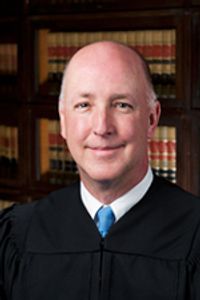
Mark S. Massa is a judge of the Indiana Supreme Court. He assumed office on April 2, 2012. His current term ends on December 31, 2034.
Massa ran for re-election for judge of the Indiana Supreme Court. He won in the retention election on November 5, 2024.
Massa first became a member of the court by appointment. He was appointed by Republican Governor Mitch Daniels on March 23, 2012, to fill the seat vacated by former Chief Justice Randall Shepard.[1] Massa was retained by voters on November 4, 2014. To read more about judicial selection in Indiana, click here.
In 2020, Ballotpedia published Ballotpedia Courts: State Partisanship, a study examining the partisan affiliation of all state supreme court justices in the country. As part of this study, we assigned each justice a Confidence Score describing our confidence in the degree of partisanship exhibited by the justices' past partisan behavior, before they joined the court.[2] Massa received a confidence score of Strong Republican.[3] Click here to read more about this study.
Biography
Massa earned his bachelor's degree from Indiana University in 1983 and his J.D. from the Indiana University at Indianapolis Robert H. McKinney School of Law in 1989.[1]
Before starting his legal career, Massa was a journalist with The Evansville Press. He worked as deputy press secretary and speechwriter for Gov. Robert Orr (R). Massa clerked for former Indiana Supreme Court Chief Justice Randall Shepard. He was then an attorney with the Marion County Prosecutor's Office and served as assistant U.S. attorney for the Southern District of Indiana. He then served as legal counsel to Gov. Mitch Daniels (R). Massa ran unsuccessfully for Marion County prosecutor in 2010.[4] Massa was then chairman of the Indiana Alcohol and Tobacco Commission and executive director of the Indiana Criminal Justice Institute before joining the Indiana Supreme Court in 2012.[1]
As of July 2021, Massa chaired the Supreme Court Records Management Committee and the St. Joseph County Judicial Nominating Committee. He also taught at the Indiana University McKinney School of Law. [1]
Elections
2024
See also: Indiana Supreme Court elections, 2024
Indiana Supreme Court, Mark S. Massa's seat
Mark S. Massa was retained to the Indiana Supreme Court on November 5, 2024 with 69.1% of the vote.
Retention Vote |
% |
Votes |
|||
| ✔ | Yes |
69.1
|
1,561,879 | ||
No |
30.9
|
697,445 | |||
Total Votes |
2,259,324 | ||||
|
|
Endorsements
Ballotpedia did not identify endorsements for Massa in this election.
2014
- See also: Indiana judicial elections, 2014
Massa was retained to the Indiana Supreme Court.
Campaign themes
2024
Ballotpedia survey responses
See also: Ballotpedia's Candidate Connection
Mark S. Massa did not complete Ballotpedia's 2024 Candidate Connection survey.
Campaign finance summary
Ballotpedia currently provides campaign finance data for all federal- and state-level candidates from 2020 and later. We are continuously working to expand our data to include prior elections. That information will be published here as we acquire it. If you would like to help us provide this data, please consider donating to Ballotpedia.
Analysis
Ballotpedia Courts: State Partisanship (2020)
Last updated: June 15, 2020
In 2020, Ballotpedia published Ballotpedia Courts: State Partisanship, a study examining the partisan affiliation of all state supreme court justices in the country as of June 15, 2020.
The study presented Confidence Scores that represented our confidence in each justice's degree of partisan affiliation. This was not a measure of where a justice fell on an ideological spectrum, but rather a measure of how much confidence we had that a justice was or had been affiliated with a political party. The scores were based on seven factors, including but not limited to party registration.[5]
The five resulting categories of Confidence Scores were:
- Strong Democrat
- Mild Democrat
- Indeterminate[6]
- Mild Republican
- Strong Republican
This justice's Confidence Score, as well as the factors contributing to that score, is presented below. The information below was current as of June 2020.
Mark
Massa
Indiana
- Partisan Confidence Score:
Strong Republican - Judicial Selection Method:
Assisted appointment through hybrid judicial nominating commission - Key Factors:
- Donated over $2,000 to Republican candidates
- Held political office as a Republican
- Was a registered Republican before 2020
Partisan Profile
Details:
Massa donated $3,787 to Republican candidates and organizations. He served as Legal Counsel to Governor Mitch Daniels (R). Massa was a registered Republican prior to 2020. He was appointed by Gov. Daniels in 2012. At the time of his appointment, Indiana was a Republican trifecta.
State supreme court judicial selection in Indiana
- See also: Judicial selection in Indiana
The five justices on the Indiana Supreme Court are selected through the assisted appointment method. The Indiana Judicial Nominating Commission is responsible for providing the names of three nominees to the governor, who must then select a justice from that list.[7][8] The commission is made up of six voting members from the three geographic districts covered by the Indiana Court of Appeals. Members include three attorneys, elected by attorneys in their respective geographic districts, and three non-attorneys, appointed by the governor. The chief justice or his or her designee serves as an ex officio member of the commission.[8]
Justices serve at least two years following their initial appointment. They must stand for retention at the first statewide general election to remain in office. If retained, justices serve a ten-year term and must stand for retention every ten years after that point to remain in office.[9]
Qualifications
To serve on this court, a judge must be:
- a U.S. citizen;
- an Indiana resident;
- admitted to practice law in the state for at least 10 years or have served as a trial court judge for at least five years; and
- under the age of 75 (retirement at 75 is mandatory).[7]
Chief Justice
The chief justice is selected by the Indiana Judicial Nominating Commission from the members of the supreme court and serves a five-year term.[8] In the event of a vacancy, the justice with the longest tenure on the supreme court serves as acting chief justice until the nominating commission fills the position.[8]
Vacancies
If a midterm vacancy occurs on the court, the position is filled as it normally would be had the vacancy occurred at the end of a justice's term. The Indiana Judicial Nominating Commission provides the names of three nominees to the governor, who must then select a justice from that list.[7][8] The new appointee serves at least two years following his or her initial appointment and must stand for retention at the first statewide general election to remain in office.[9] The map below highlights how vacancies are filled in state supreme courts across the country.
See also


External links
Footnotes
- ↑ 1.0 1.1 1.2 1.3 IN.gov, "Hon Mark S Massa," accessed July 9, 2021
- ↑ We calculated confidence scores by collecting several data points such as party registration, donations, and previous political campaigns.
- ↑ The five possible confidence scores were: Strong Democrat, Mild Democrat, Indeterminate, Mild Republican, and Strong Republican.
- ↑ Northwest Indiana, "Gov. Daniels selects Mark Massa for Supreme Court," March 23, 2012
- ↑ The seven factors were party registration, donations made to partisan candidates, donations made to political parties, donations received from political parties or bodies with clear political affiliation, participation in political campaigns, the partisanship of the body responsible for appointing the justice, and state trifecta status when the justice joined the court.
- ↑ An Indeterminate score indicates that there is either not enough information about the justice’s partisan affiliations or that our research found conflicting partisan affiliations.
- ↑ 7.0 7.1 7.2 National Center for State Courts, "Method of Judicial Selection: Indiana," accessed Aug. 23, 2021
- ↑ 8.0 8.1 8.2 8.3 8.4 State of Indiana, "Judicial Nominating Commission Fact Sheet," accessed Aug. 23, 2021
- ↑ 9.0 9.1 State of Indiana, "About the Court," accessed Aug. 23, 2021
Federal courts:
Seventh Circuit Court of Appeals • U.S. District Court: Northern District of Indiana, Southern District of Indiana • U.S. Bankruptcy Court: Northern District of Indiana, Southern District of Indiana
State courts:
Indiana Supreme Court • Indiana Court of Appeals • Indiana Tax Court • Indiana Superior Courts • Indiana Circuit Courts • Indiana City Courts • Indiana County Courts • Indiana Municipal Courts • Indiana Small Claims Courts • St. Joseph County Probate Court • Indiana Town Courts
State resources:
Courts in Indiana • Indiana judicial elections • Judicial selection in Indiana

| ||||||||||

 |
State of Indiana Indianapolis (capital) |
|---|---|
| Elections |
What's on my ballot? | Elections in 2025 | How to vote | How to run for office | Ballot measures |
| Government |
Who represents me? | U.S. President | U.S. Congress | Federal courts | State executives | State legislature | State and local courts | Counties | Cities | School districts | Public policy |

