Daily Brew: February 6, 2026

Welcome to the Friday, Feb. 6, Brew.
By: Briana Ryan
Here’s what’s in store for you as you start your day:
- How voting requirements related to citizenship vary across the U.S.
- Gubernatorial races to watch in 2026, by Leslie Graves, Ballotpedia Founder and CEO
- Three new measures have been certified for statewide ballots
How voting requirements related to citizenship vary across the U.S.
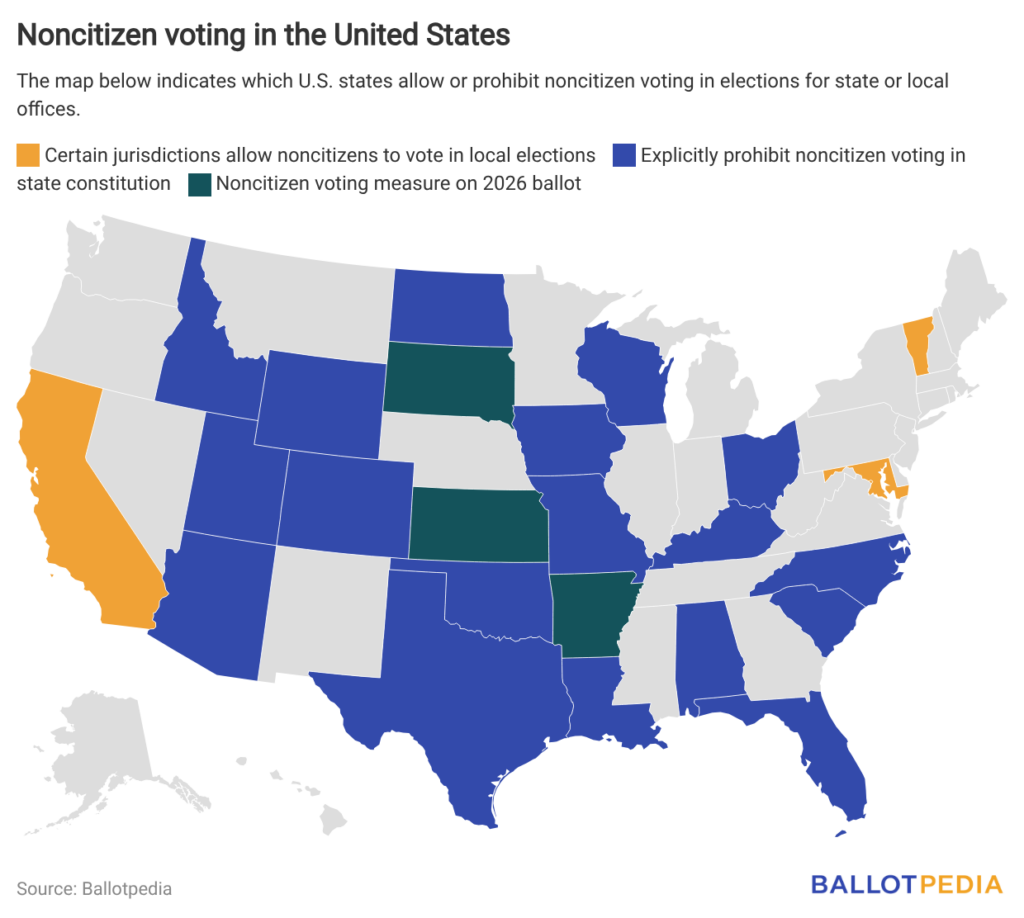
In November 2026, voters in at least three states will decide on constitutional amendments that would prohibit noncitizen voting, with a fourth state potentially joining them in the weeks ahead. Here's a look at how voting requirements related to citizenship vary across the U.S.
Voters in Arkansas, Kansas, and South Dakota will decide on constitutional amendments to prohibit noncitizen voting. Supporters of a proposed ballot initiative in Alaska have submitted signatures to the state Division of Elections for verification.
Eighteen states have language in their constitutions explicitly granting only U.S. citizens the right to vote in their elections. Fifteen of those states have added this language via ballot measure in the last eight years. The other 32 state constitutions specify who can vote (e.g., all citizens or every citizen), but do not explicitly prohibit noncitizen voting.
In 1996, President Bill Clinton (D) signed a law prohibiting noncitizens from voting in federal elections. This law does not apply to state or local elections.
No states currently allow noncitizens to vote in statewide or state legislative elections. All 49 states with voter registration require applicants to declare that they are U.S. citizens. North Dakota does not have voter registration, though voters in that state must be U.S. citizens.
California, Maryland, and Vermont have jurisdictions that allow noncitizens to vote in municipal or school board elections. Maryland has 16 jurisdictions that have passed ordinances allowing noncitizen voting, the most of any state. Washington, D.C., also allows noncitizens to vote in local elections.
So far this year, lawmakers in 12 states have introduced or carried over 26 bills on noncitizen voting. In seven states, lawmakers have introduced bills or constitutional amendments to prohibit noncitizen voting. In Massachusetts, legislators have proposed allowing some or all municipalities to give noncitizens the right to vote in local elections.
Seven states — Alabama, Arizona, Georgia, Kansas, Louisiana, New Hampshire, and Wyoming — have passed laws requiring all prospective voters to provide proof of citizenship at the time of voter registration. However, all of those laws are not in effect. A federal judge invalidated Kansas' proof of citizenship law in 2018, and Alabama, Georgia, and Louisiana have not implemented their laws.
Of the states with laws in effect, Arizona and New Hampshire require proof of citizenship only for people newly registering to vote in the state. Wyoming requires both new registrants and individuals updating their registration to provide proof of citizenship.
Ohio requires proof of citizenship only when registering to vote at a Bureau of Motor Vehicles facility.
While Georgia’s proof of citizenship law is not in effect, election officials compare the driver's license number or Social Security number of prospective voters who submit paper registration forms against state records to determine if that person has previously provided proof of citizenship. If not, the individual will be notified that they must provide such proof before they are registered to vote.
Each state has different requirements for which documents constitute proof of citizenship. Commonly accepted documents include birth certificates, passports, driver’s licenses, and naturalization documents.
Lawmakers in 15 states have introduced or carried over 28 bills related to proof of citizenship for voting so far this year. In at least 11 states, legislators have introduced bills requiring individuals to present documentary proof of citizenship when registering to vote.
In 2025, Wyoming enacted proof of citizenship legislation. In 2024, two states enacted two bills or resolutions related to documentary proof of citizenship. In 2023, two states enacted two proof-of-citizenship-related bills.
Click here to read more about state laws related to noncitizen voting, and here for more about proof of citizenship laws across the country.
Gubernatorial races to watch in 2026

As important as the 2026 congressional elections are for our national politics, 96% of the races voters will decide when they head to the polls in November will be for state and local offices.
Among those races are 36 gubernatorial elections.* This week, I asked Joel Williams, one of our managing editors, which gubernatorial races he thinks we should be watching closely this year and why these particular elections are so important. Here’s what he had to say:
"Governors wield enormous power in shaping their states, from appointing judges to state supreme courts and filling vacant U.S. Senate seats, to naming cabinet members and agency heads who oversee everything from education to environmental policy. The decisions a governor makes in these appointments can influence state policy for decades, long after they've left office."
These state races have ripple effects far beyond their borders. That’s why we pay such close attention to them, and hope you will too.
Of the 36 gubernatorial races in 2026, 15 incumbents are term-limited — six Democrats and nine Republicans — which means nearly half of this year's contests are open seats where no sitting governor has the advantage of incumbency. Joel noted the races where the current incumbent is term-limited and can’t run again. His list of gubernatorial races to watch this year includes:
- California: Incumbent Gavin Newsom (D) is stepping aside, and a long list of notable California politicians are running to replace him. California’s top-two primary system means one party could potentially get totally shut out of the general election.
- Colorado: Incumbent Gov. Jared Polis (D) is term-limited. Colorado is one of the few Mountain West states that currently has a Democratic trifecta.
- Florida: Incumbent Ron DeSantis (R) is stepping down after two terms. U.S. Rep. Byron Donalds (R) has long been the frontrunner for the state’s GOP nomination for governor, but there have been some recent entrants into the race that make the primary more than a formality.
- Georgia: Incumbent Brian Kemp (R) is term-limited, leaving a wide-open race in a state that has recently been a battleground at both the presidential and U.S. Senate levels.
- Michigan: Incumbent Gretchen Whitmer (D) is term-limited. The state has long been a battleground for both major parties at virtually every level of government.
- Oklahoma: Incumbent Kevin Stitt (R) is term-limited. Oklahoma is solidly Republican, which means the GOP primary will likely decide Stitt's successor.
Other gubernatorial races to watch include:
- Minnesota: Incumbent Tim Walz (D) is not seeking re-election in this closely contested state that has been in the national spotlight over immigration enforcement.
- New York: Incumbent Kathy Hochul (D) is running for another term and faces a primary challenge from Antonio Delgado, whom she appointed to serve as lieutenant governor in 2022.
- Rhode Island: Incumbent Daniel McKee (D) has a rematch with Helena Foulkes. In the 2022 Democratic primary, McKee defeated Foulkes 32.8% to 29.9% in a five-way race for the nomination.
- South Dakota: Current incumbent Larry Rhoden (R) faces the state’s at-large U.S. Representative, Dusty Johnson, in the GOP primary. Rhoden, the former lieutenant governor of South Dakota, assumed the governor’s office in January 2025 after former Gov. Kristi Noem (R) was confirmed as Secretary of the Department of Homeland Security.
- Wisconsin: Incumbent Tony Evers (D) is not running for re-election, setting up a wide-open race for a successor.
This is not the final list of 2026 gubernatorial races to watch, and it could change over the course of the next 10 months. To help you stay abreast of the latest developments in all 36 gubernatorial elections this year, make sure to follow our gubernatorial elections coverage here.
*On the etymology of "gubernatorial": Blame the Romans — it comes from the Latin gubernator, meaning helmsman or steerer. So technically, we're watching races for states' chief pilot — the person at the wheel.
Three new measures have been certified for statewide ballots
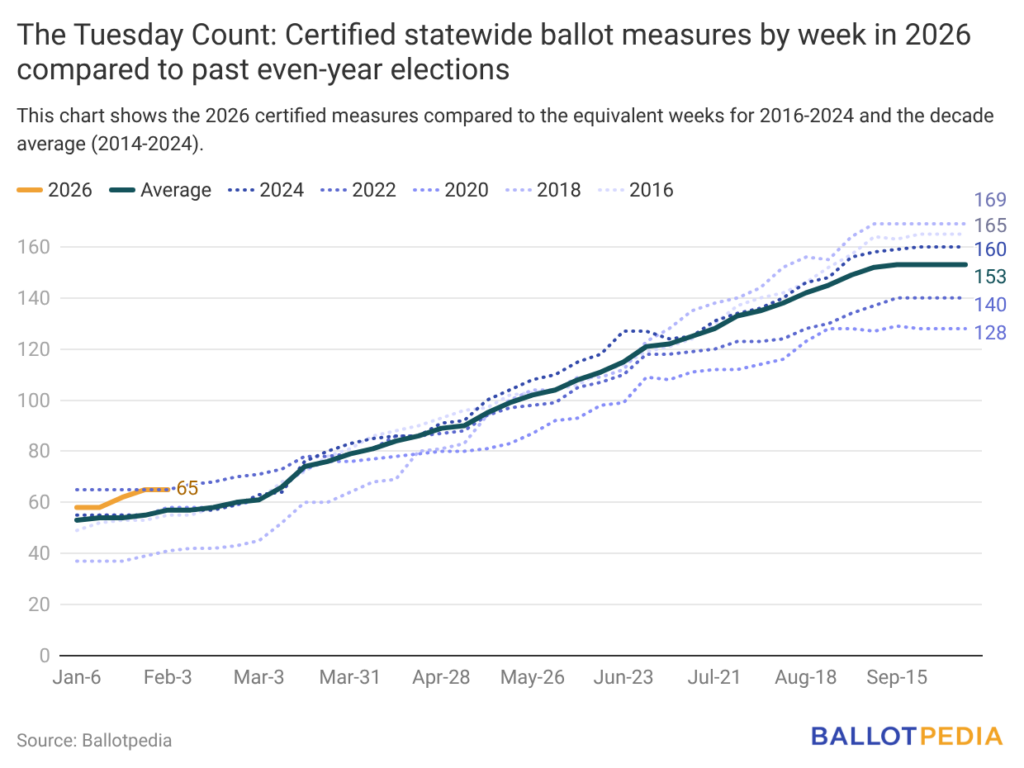
As of Feb. 4, the 65 measures certified for statewide ballots in 2026 are above the historical average for this point in the cycle across even-numbered years from 2014 through 2024.
In even-numbered years from 2014 through 2024, an average of 57 statewide measures had been certified for the ballot by this point in the year. Across those years, an average of 153 statewide measures were certified per even-numbered year.
Over the past two weeks, three new measures were certified for the ballot:
- Colorado Notification of U.S. Department of Homeland Security for Certain Criminal Charges and Immigration Status Initiative
- Wisconsin Prohibit Government Closure of Places of Worship During Emergencies Amendment
- Wisconsin Prohibit Government Discrimination or Preferential Treatment Amendment
Signatures have been submitted and are pending verification for four initiatives:
- Alaska Citizenship Requirement for Voting Initiative
- Maine Birth Certificate Sex Requirement for Public School Sports Initiative
- Missouri Congressional Map Referendum
- Oklahoma State Question 836, Top-Two Primary Elections Initiative
Enough signatures were verified for 13 indirect initiatives to certify them to the legislature:
- Massachusetts Change State Tax Revenue Limit Initiative
- Massachusetts Decrease State Income Tax Rate to 4% Initiative
- Massachusetts Eliminate Recreational Marijuana Sales and Allow Limited Possession Initiative
- Massachusetts Establish the Nature for All Fund Initiative
- Massachusetts Legislative Stipend Calculation and Payment Rules Initiative
- Massachusetts Limit on Required Lot Size for Single-Family Homes Initiative
- Massachusetts Permit Collective Bargaining for Committee for Public Counsel Services Employees Initiative
- Massachusetts Permit Same-Day Voter Registration Initiative
- Massachusetts Public Records Requirements for Legislature and Governor’s Office Initiative
- Massachusetts Rent Control Initiative
- Massachusetts Top-Two Primary Elections Initiative
- Washington Limit Participation in Female Sports to Students Verified as Biologically Female Initiative
- Washington Parental Right to Review Education Materials, Receive Notifications, and Opt Out of Sexual-Health Education Initiative
A Virginia circuit court has blocked a proposed constitutional amendment, the Virginia Use of Legislative Congressional Redistricting Map Amendment, from appearing on the ballot. Legislative leaders have appealed that ruling. We included this amendment in our count of 2026 certified statewide measures pending the outcome of the appeals process.
The next signature deadlines are Feb. 6 in Wyoming and Feb. 15 in Utah.
Click here for more information about the ballot measures that could be on the ballot this year.