The Federal Vacancy Count 3/29/2017
 | ||||||||||
| ||||||||||
March 29, 2017
This month's Federal Vacancy Count includes nominations, confirmations, and vacancies from March 1, 2017, to March 28, 2017.[1]
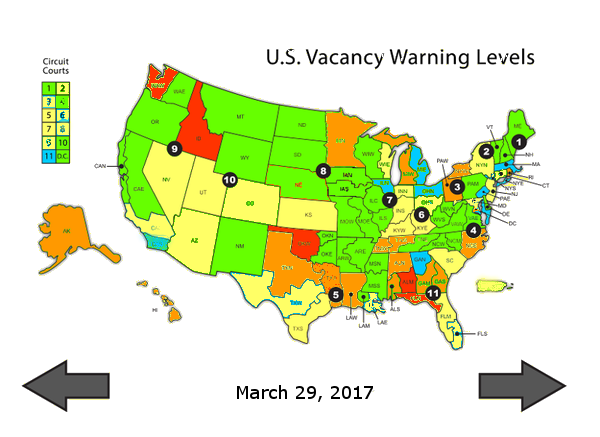
The vacancy warning level remained at yellow this month after five new vacancies were announced. The total vacancy percentage was 13.6 percent, and there were 134 vacancies out of 985 positions, including 118 vacancies in positions where a confirmed nominee is eligible to serve a life term. There were two new nominations this month.
SCOTUS Update: Neil Gorsuch, who was nominated to a seat on the U.S. Supreme Court on January 31, 2017, had confirmation hearings before the Senate Judiciary Committee from March 20-23, 2017. After four days of hearings, the committee chairman, Sen. Chuck Grassley (R-Iowa), scheduled a committee vote on whether to report the nomination. That vote was scheduled for March 27, 2017, however, under a committee rule, members of the minority held over the committee vote for one week. The committee vote is scheduled for April 3, 2017. If the committee votes to report the nomination, Gorsuch's nomination will go to the full Senate for a possible confirmation vote. Democratic Senate leader Chuck Schumer (D-N.Y.) has indicted the members of his party will filibuster the nomination. The Senate has a scheduled two-week recess beginning at the close of business on April 7, 2017. The Supreme Court's final argument session for this term begins on Monday, April 17, 2017. If Gorsuch is not confirmed by the beginning of that session, it is expected that he would first join the court for arguments at the start of the court's next term beginning Monday, October 2, 2017. If he is confirmed sometime during the April sitting, Gorsuch would be able to sit for any arguments during the two-week April session once he took his oath and received his judicial commission to the court.
- For more on the 2017 nomination, see Supreme Court vacancy, 2017: An overview
- For more on his confirmation hearings, see Neil Gorsuch confirmation hearings
A breakdown of the vacancies at each level can be found in the table below. For a more detailed look at the vacancies on the federal courts, see Ballotpedia's Federal Court Vacancy Warning System. The Federal Court Vacancy Warning System presents information on current Article III judicial vacancies in the federal court system, as well as the status of pending nominees to the federal bench.
- For more on vacancies during Trump's first term, see our special report
- See also: The Trump administration on federal courts
Vacancies by court
| Court | # of Seats | Vacancies |
| Supreme Court | 9 | 11.1% or 1 vacancy |
| Appeals Courts | 179 | 10.6% or 19 vacancies |
| District Courts | 677 | 14.2% or 96 vacancies |
| International Trade | 9 | 22.2% or 2 vacancies |
| Federal Claims | 16 | 37.5% or 6 vacancies |
| Tax Court | 19 | 10.5% or 2 vacancies |
| Armed Forces | 5 | 0% or 0 vacancies |
| D.C. Court of Appeals | 9 | 22.2% or 2 vacancies |
| D.C. Superior Court | 62 | 9.7% or 6 vacancies |
| All Judges | 985 | 13.6% or 134 vacancies |
New vacancies
The following judges vacated their active status, creating Article III judicial vacancies. As Article III judicial positions, these vacancies must be filled by a nomination from the president. That nomination is subject to confirmation on the advice and consent of the U.S. Senate.
United States District Court for the Southern District of New York
| Loretta Preska is a federal judge on senior status with the United States District Court for the Southern District of New York. A native of Albany, New York, Preska graduated from the College of St. Rose with her bachelor's degree in 1970 and from Fordham Law School with her J.D. in 1973. She graduated from New York University School of Law with her LL.M. in 1978. Preska was nominated to the Southern District of New York by President George H.W. Bush on March 31, 1992, to a seat vacated by Robert Ward. The American Bar Association rated Preska Unanimously Qualified for the nomination. Hearings on Preska's nomination were held before the United States Senate Committee on the Judiciary on June 4, 1992, and her nomination was reported by then-U.S. Sen. Joseph Biden (D-Del.) on June 11, 1992. Preska was confirmed by the unanimous consent of the U.S. Senate on August 11, 1992, and she received her commission the next day. From 2009 to 2016, she served as chief judge of the district court. Judge Preska elected to take senior status beginning March 1, 2017, creating a second vacancy on the court. The current vacancy warning level of this court is blue. Under current law, the court has a total of 28 active judicial positions.[2][3][4] | 
|
United States District Court for the Northern District of Illinois
| John Darrah was a senior federal judge with the United States District Court for the Northern District of Illinois. A native of Chicago, Illinois, Darrah graduated from Loyola University of Chicago with B.S. in 1965 and from Loyola University of Chicago's School of Law with his J.D. in 1969. Darrah was nominated to the Northern District of Illinois by President Bill Clinton on May 11, 2000, to a seat vacated by George Marovich. The American Bar Association rated Darrah Majority Qualified, Minority Well Qualified for the nomination. Hearings on Darrah's nomination were held before the Senate Judiciary Committee on June 15, 2000, and his nomination was reported by U.S. Sen. Orrin Hatch (R-Utah) on June 27, 2000. Darrah was confirmed on a voice vote of the U.S. Senate on June 30, 2000, and he received his commission on July 14, 2000. Darrah elected to take senior status beginning March 1, 2017. Darrah died on March 23, 2017. Darrah's decision to take senior status created a second vacancy on the court. The current vacancy warning level of this court is blue. Under current law, the court has a total of 22 active judicial positions.[5][6][7] |
|
United States District Court for the Western District of Tennessee
| J. Daniel Breen is a federal judge on senior status with the United States District Court for the Western District of Tennessee. Born in Jackson, Tennessee, Breen graduated from Spring Hill College with his bachelor's degree in 1972 and from the University of Tennessee Law School with his J.D. in 1975. Breen was first nominated to the Western District of Tennessee by President George W. Bush on October 10, 2002, to a seat vacated by Julia Gibbons as Gibbons was appointed to the Sixth Circuit Court of Appeals. Under Rule XXXI, paragraph six of the standing rules of the United States Senate, Breen's nomination was returned to the president on November 20, 2002. The president resubmitted Breen's nomination on January 7, 2003. The American Bar Association rated Breen Unanimously Well Qualified for the nomination. Hearings on Breen's nomination were held before the Senate Judiciary Committee on February 12, 2003, and his nomination was reported by U.S. Sen. Orrin Hatch (R-Utah) on March 6, 2003. Breen was confirmed on a recorded 92-0 vote of the U.S. Senate on March 13, 2003, and he received his commission the next day. On August 24, 2013, Breen was named chief judge of the district court. He served as chief judge until he elected to take senior status beginning on March 18, 2017. Breen's decision to take senior status created a second vacancy on the court. The current vacancy warning level of this court is orange. Under current law, the court has a total of five active judicial positions.[8][9][10][11] | 
|
District of Columbia Court of Appeals
| Eric T. Washington is a federal judge serving on senior status with the District of Columbia Court of Appeals. Washington graduated from Tufts University with his bachelor's degree in 1976 and from Columbia University School with Law his J.D. in 1979. Washington was nominated by President Bill Clinton to the appellate court on January 6, 1999, to a seat vacated by Warren King. Hearings on Washington's nomination were held before the Senate Governmental Affairs Committee on April 20, 1999, and his nomination was reported by U.S. Sen. Fred Thompson (R-Tenn.) on May 20, 1999. Washington was confirmed on a voice vote of the U.S. Senate on May 26, 1999. He served as chief judge of the court from July 1, 2005, until his retirement from active service on March 18, 2017. Upon his retirement, he was the longest-tenured chief judge in the history of the court. Prior to his service on the court of appeals, Judge Washington was an associate judge on the Superior Court of the District of Columbia. Washington's decision to leave active service created a second vacancy on the court. The current vacancy warning level of this court is yellow. Under current law, the court has a total of nine active judicial positions.[12][13][14][15] | 
|
Superior Court of the District of Columbia
| Jeanette Clark was an associate judge of the Superior Court of the District of Columbia. Judge Clark earned her undergraduate degree from Trinity College in 1970, her master's degree from Wheelock College in 1972, and her J.D. from Howard University Law School in 1983. Clark was nominated to the Superior Court of the District of Columbia by President George W. Bush on November 29, 2001, to a seat vacated by Judge George W. Mitchell. Hearings on her nomination were held before the U.S. Senate Committee on Governmental Affairs on March 5, 2002, and her nomination was reported by U.S. Sen. Joe Lieberman (D-Conn.) on March 12, 2002. Clark was confirmed on a voice vote of the U.S. Senate on March 13, 1992. Judge Clark retired from the court on March 18, 2017, creating a sixth vacancy on this court. The current vacancy warning level for this court is blue. Under current law, the court has 62 active judicial positions.[16][17] |
|
New nominations
Superior Court of the District of Columbia
| Jonathan Pittman is an assistant deputy attorney general in the civil litigation division of the office of the attorney general of the District of Columbia. He has served in this position since 2016. On March 9, 2017, President Donald Trump nominated Pittman to serve as an associate judge on the Superior Court of the District of Columbia to a seat vacated by Judge Jeanette Clark. Pittman earned his B.A. in economics from Vassar College in 1985 and his J.D. from the Vanderbilt University School of Law in 1990. The current vacancy warning level for this court is blue. Under current law, the court has 62 active judicial positions.[18][19] |
|
United States Court of Appeals for the 6th Circuit
| Amul Thapar is a federal judge for the United States District Court for the Eastern District of Kentucky. He joined the court in 2008 after being nominated by President George W. Bush. On March 21, 2017, President Donald Trump nominated Thapar to a seat on the United States Court of Appeals for the 6th Circuit.[20] Born in Detroit, Michigan, Thapar graduated from Boston College with his bachelor's degree in 1991. He earned his J.D. from the University of California at Berkeley School of Law in 1994. Thapar is President Trump’s first nomination to an Article III lower court in the federal judiciary. Judge Thapar was on Trump’s list of 21 potential candidates to succeed Justice Antonin Scalia on the U.S. Supreme Court. Trump has indicated that he would only select nominees to the Supreme Court from that list for the duration of his administration. If confirmed by the U.S. Senate, Thapar would succeed Judge Boyce Martin, who retired from judicial service on August 16, 2013. This court's current vacancy warning level is yellow. Under current law, the court has two vacancies out of 16 active judicial positions. |
|
New confirmations
There have been no new federal judicial confirmations by the U.S. Senate since our February 2017 update.
Monthly map
 |
See also
- Supreme Court vacancy, 2017: An overview
- Neil Gorsuch confirmation hearings
- United States federal courts
- Federal Court Vacancy Warning System
- Judicial vacancies during the Trump administration
- The Trump administration on federal courts
Footnotes
- ↑ As of December 2016, Ballotpedia's Federal Vacancy Count includes nominees to the United States Court of International Trade, United States Court of Federal Claims, the United States Tax Court, the United States Court of Appeals for the Armed Forces, the District of Columbia Court of Appeals, and the Superior Court of the District of Columbia. Vacancy, confirmation, and nomination totals will be changed accordingly. The map used in this report, however, does not include information from these courts at this time.
- ↑ Federal Judicial Center, "Biographical directory of federal judges," accessed March 1, 2017
- ↑ United States Congress, "PN 1003 — Loretta A. Preska — The Judiciary," accessed March 1, 2017
- ↑ American Bar Association, "Ratings of Article III judicial nominees, 102nd Congress," accessed March 1, 2017
- ↑ Federal Judicial Center, "Biographical directory of federal judges," accessed March 1, 2017
- ↑ United States Congress, "PN 1020 — John W. Darrah — The Judiciary," accessed March 1, 2017
- ↑ American Bar Association, "Ratings of Article III judicial nominees, 106th Congress," accessed March 1, 2017
- ↑ Federal Judicial Center, "Biographical directory of federal judges," accessed March 18, 2017
- ↑ American Bar Association, "Ratings of Article III judicial nominees," accessed March 18, 2017
- ↑ United States Congress, "PN 2255 — J. Daniel Breen — The Judiciary," accessed March 18, 2017
- ↑ United States Congress, "PN 18 — J. Daniel Breen — The Judiciary," accessed March 18, 2017
- ↑ The Washington Post, "DC appeals court chief judge elected as president of national organization," August 22, 2011
- ↑ Legal Times Blog, "D.C. Chief Judge Assumes Presidency of Judicial Leadership Group," August 23, 2011
- ↑ District of Columbia Bar Association, "D.C. Court of Appeals Chief Judge Washington to Step Down in March," December 16, 2016
- ↑ United States Congress, "PN 7— Eric T. Washington — The Judiciary," accessed March 29, 2017
- ↑ District of Columbia Courts, "Judge Jeanette Clark," accessed March 18, 2017
- ↑ United States Congress, "PN 1250 — Jeanette J. Clark — Superior Court of the District of Columbia," accessed March 29, 2017
- ↑ Washington D.C. Judicial Nominating Commission, "Jonathan H. Pittman - Biographical Summary," accessed March 24, 2017
- ↑ United States Congress, "PN 91— Jonathan H. Pittman — The Judiciary," accessed March 23, 2017
- ↑ United States Congress, "PN 105 — Amul R. Thapar — The Judiciary," March 21, 2017
| |||||