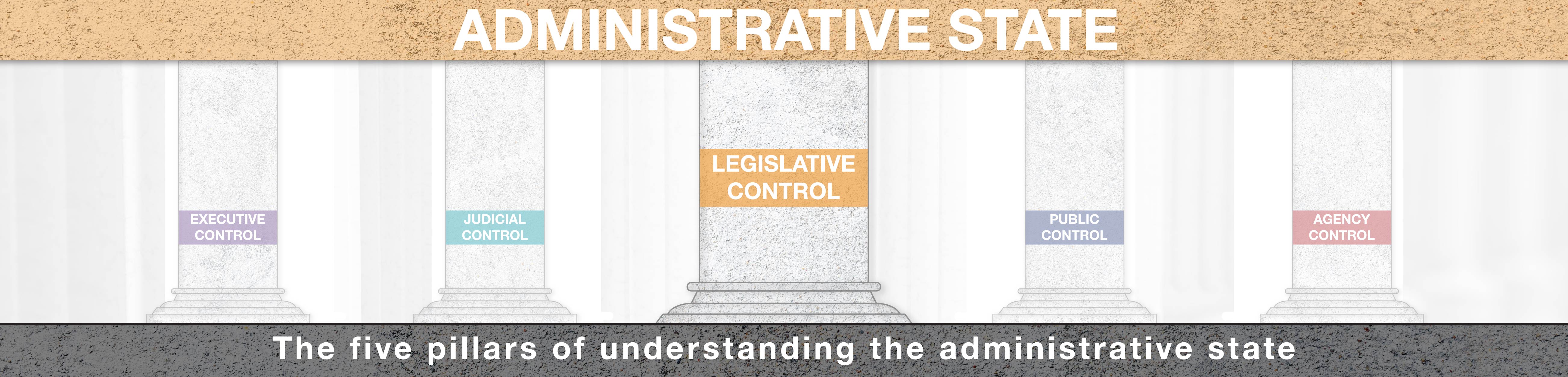
- See also: 50-state research: Legislative oversight of executive agency rulemaking, Five pillars of the administrative state: Legislative control
Legislatures oversee executive agency rulemaking through a variety of mechanisms, including reviewing regulations, holding hearings, approving regulations prior to their adoption, or disapproving of or nullifying regulations, among other procedures. State laws and constitutions establish these legislative oversight requirements or authorizations. This page summarizes the legislative oversight of agency rulemaking mechanisms in Delaware law.
This page contains the following sections:
Legislative oversight of agency rulemaking in Delaware
This section details the legislative oversight mechanism in Delaware.
How does Delaware compare to other states?
This section compares the legislative oversight policies in Delaware to those across the 50 states, specifically related to legislative oversight requirements, designated oversight entity, and scope of regulatory oversight.
Legislative oversight of agency rulemaking in Delaware
See also: Delaware Constitution and Delaware Administrative Procedure Act
The Joint Legislative Oversight and Sunset Committee reviews regulatory, administrative, advisory, executive, or legislative entities of the state on a scheduled basis, evaluating their policies, rules, regulations, programs, and enabling legislation. It can choose to conduct a focused review on agency rules or regulations. Review for the entities is required every four or six years. The committee may make recommendations to the legislature based on its findings.
§ 10212. Focused review.
(a) The Committee may conduct a focused review of an entity if the Committee determines that a full review of the entity is not appropriate or necessary. The purpose of a focused review is to evaluate a component within an entity, such as a specific statute, policy, rule, regulation, or program related to the entity. A focused review is in contrast to the broader evaluation of a full review under this chapter.
(b) A focused review is conducted as follows:
(1) The Committee may select an entity or component of an entity, such as a program or sub-entity, for a focused review in the same manner that it selects an entity for a full review under § 10213(c) of this title.
(2) The Committee may begin a focused review immediately and is not subject to the timeline under § 10210(a) of this title.
(3) Committee staff shall work with the Committee to establish the scope of the focused review.
(4) Committee staff shall conduct research based on the scope established under paragraph (b)(3) of this section and another issue, concern, defect, or problem that the Committee may request or as the research may indicate.
(5) The Committee shall set a deadline for completion of the committee staff's research, based on staff's estimation of the time needed to complete the research and the emergency nature, if any, of the focused review.
(6) In conducting research under this section, committee staff shall engage the general public and each appropriate entity or organization, including the entity under focused review, to request written testimony, comment, or other material to aid the Committee in the focused review.
(7) Committee staff shall prepare a staff report containing a summary of the staff's research and staff's findings, conclusions, and recommendations. Committee staff shall submit the report to the Committee not later than the deadline that the Committee sets under paragraph (b)(5) of this section, unless staff requests and the chair approves an extension of time.
(8) After committee staff has submitted the staff report under this section to the Committee, the Committee shall conduct the focused review by following § 10209(d) of this title.
(9) Committee staff shall make the staff report available to the public not later than the date of the Committee's initial public hearing under paragraph (b)(8) of this section.
(10) To conclude a focused review, the Committee shall publish each recommended change that the Committee may determine is necessary or appropriate.
[1]
§ 10213. Annual report; review selection.
(a) Annual report. —
The Committee shall submit an annual report, compiled by committee staff and approved by the Committee, to the General Assembly, the Governor, and the Director and Librarian of the Division of Research each year not later than July 31. The annual report must contain at least all of the following:
(1) A summary of the outcomes and Committee's actions relating to each full review or focused review that the Committee conducts since its previous annual report, including each of the recommendations the Committee makes under § 10214 of this title.
(2) A summary of the legislation that the Committee approves for introduction since the Committee's previous annual report.
(3) A list of the entities the Committee selects for full review or focused review the next year following the report.
(4) Other information that the Committee may wish to include.
(b) Review selection. —
The Committee must conduct at least 4 full reviews or focused reviews each year. Selection for full review or focused review may take into consideration all of the following:
(1) The number of entities whose full review or focused review is being continued to the following year. A continued full review or focused review may be counted as 1 of the 4 required reviews.
(2) The number of entities automatically scheduled for a full review or focused review.
(3) The number of entities that the General Assembly may add.
(4) The number of entities that the Committee adds under subsection (c) of this section.
(c) The Committee may, by 6 affirmative votes, add an entity to, remove an entity from, or replace an entity on the Committee's full review and focused review schedule.
[2]
§ 10214. Committee recommendations; authority to recall entity.
(a) For each entity under full review or focused review, the Committee may recommend 1 or more of the following:
(1) a. Continuance of the entity as is.
b. Termination of the entity.
c. Termination of a program within the entity or a rule or regulation adopted by the entity.
d. Consolidation, merger, or transfer of the entity or of a function of the entity.
e. Continuation, holdover, or termination of the entity unless or until certain conditions are met or modifications are made, by legislation or otherwise, within a specified period of time.
(2) Budget appropriation limits for an entity.
(3) In general or specific terms, legislation which the Committee considers necessary to carry out its decision as to whether an entity should be continued or terminated.
(4) Legislation to amend the entity's governing statute or a related statute.
(b) When the Committee has released an entity from full review or focused review, it may recall the entity to a public hearing before the Committee to consider making additional recommendations under subsection (a) of this section if either of the following circumstances apply:
(1) The entity has the ability to meet a certain condition or make a modification that the Committee recommends, but fails to do so.
(2) The Committee recommends legislation to amend the entity's governing statute or a related statute, but, for any reason, the legislation fails to be enacted into law.
(3) The entity fails to submit to the Committee a report that the Committee requests with a status update on the implementation of a recommendation, on a date that the Committee determines.
[3]
The legislature is authorized to conduct full reviews of agencies, boards, commissions, or departments.[4][5]
How does Delaware compare to other states?
Is legislative oversight optional, required, or both?
Because many states have more than one mechanism of legislative oversight of agency regulations, some states have both optional and required legislative oversight mechanisms.
- Thirty-four (34) states require legislative review of all or some agency regulations. Seven states include both optional and required legislative oversight mechanisms, and 27 states only have required legislative oversight mechanisms.
- Ten (10) states authorize, but do not require, legislative oversight of agency regulations.
- The law does not include provisions regarding legislative review of agency actions in six states.
Who reviews the regulations?
Generally, either the full legislature, legislative committees, legislative agencies, divisions, or offices, or any combination of these bodies, is authorized or required to review agency regulations. Thirty-three (33) states authorize or require more than one legislative entity to review agency regulations; therefore, the breakdown below exceeds 50.
- Thirty-one (31) states authorize or require full legislative review of agency regulations.
- Forty-one (41) states authorize or require legislative committees to review agency regulations.
- Thirteen (13) states authorize or require legislative agencies, divisions, or offices to review agency regulations.
What is reviewed?
In states that don't require the legislature to review rules, review is optional, while other states do not have laws relating to legislative oversight of agency rules.
- Thirty-two (32) states require legislative review of all rules. Some states require different levels of review for rules that meet different criteria.
- Six states require legislative review of some rules. Some states require legislatures to review rules that meet certain criteria, which are policies similar to REINS-style state laws. Other states require legislative review of rules that received a public complaint.
- Six states do not require, but explicitly authorize, legislative review of rules.
- Six states do not have laws regarding legislative review of agency rules.
Some states require legislatures to review rules that meet certain criteria, which are policies similar to REINS-style state laws.
See also
- ↑ Justia, "29 DE Code § 10212," accessed January 14, 2026
- ↑ Justia, "29 DE Code § 10213," accessed January 14, 2026
- ↑ Justia, "29 DE Code § 10214," accessed January 14, 2026
- ↑ Justia, "29 DE Code § 10209," accessed January 14, 2026
- ↑ Justia, "29 DE Code § 10211," accessed January 14, 2026