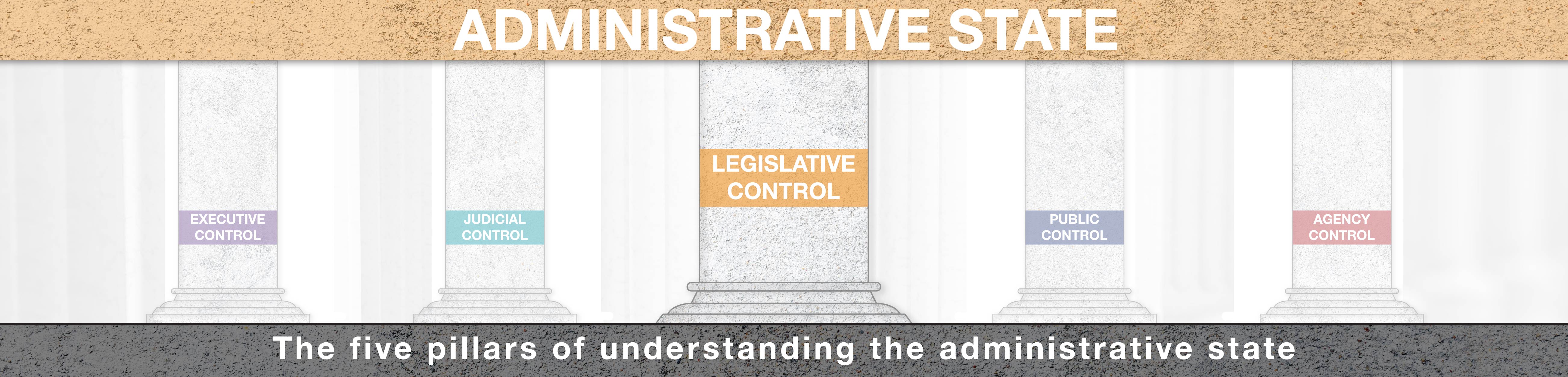
- See also: 50-state research: Legislative oversight of executive agency rulemaking, Five pillars of the administrative state: Legislative control
Legislatures oversee executive agency rulemaking through a variety of mechanisms, including reviewing regulations, holding hearings, approving regulations prior to their adoption, or disapproving of or nullifying regulations, among other procedures. State laws and constitutions establish these legislative oversight requirements or authorizations. This page summarizes the legislative oversight of agency rulemaking mechanisms in Idaho law.
This page contains the following sections:
Legislative oversight of agency rulemaking in Idaho
This section details the legislative oversight mechanism in Idaho.
How does Idaho compare to other states?
This section compares the legislative oversight policies in Idaho to those across the 50 states, specifically related to legislative oversight requirements, designated oversight entity, and scope of regulatory oversight.
Legislative oversight of agency rulemaking in Idaho
See also: Idaho Constitution and Idaho Administrative Procedure Act
Agencies submit all proposed rules to the Legislative Services Office. The LSO will send the proposed rules to joint legislative subcommittees for review. If the subcommittee disapproves of a rule, the objection must be filed with the agency, a standing committee in the legislature, and the full legislature for the next session. Standing legislative committees with jurisdiction over certain policy areas review proposed rules. They recommend to the full legislature whether to approve, reject in part, or fully reject the reviewed rules. The full legislature can pass concurrent resolutions (not requiring the governor's signature) to approve or disapprove rules. If the legislature does not vote on a rule, the rule expires at the end of the legislative session. Agency rules effective after July 1, 2026, must be reviewed by the legislature on an eight-year schedule.
Subcommittees for review of administrative rules — Meetings regarding rules.
For the purposes of review of proposed administrative rules pursuant to chapter 52, title 67, Idaho Code, germane joint subcommittees are hereby authorized and created. The speaker of the house of representatives and the president pro tempore of the senate shall designate a subcommittee of each germane committee of each house for the consideration of proposed rules of the respective state agencies. The respective germane subcommittee of each house thus designated shall meet with the germane subcommittee of the other house and shall constitute the germane joint subcommittee. A subcommittee of each standing committee of each house shall be composed of the chairman of the committee, one (1) member of the majority party from the committee, appointed by the president pro tempore in the case of senate members, and by the speaker in the case of house members, and one (1) member of the minority party from the committee, appointed by the minority leader of the senate in the case of senate members, and by the minority leader of the house in the case of house members. If vacancies occur or exist in the majority party membership of the subcommittees of the senate, the president pro tempore shall appoint a replacement member; if vacancies occur or exist in the minority party membership of the subcommittees of the senate, the minority leader shall appoint a replacement member. If vacancies occur or exist in the majority party membership of the subcommittees of the house, the speaker shall appoint a replacement member; if vacancies occur or exist in the minority party membership of the subcommittees of the house, the minority leader shall appoint a replacement member. Meetings of a joint germane subcommittee shall be governed by the joint rules of the legislature; the chairmen shall sit as cochairmen.
Upon notice of intended action as provided in sections 67-5221 and 67-5223, Idaho Code, and transmission of analysis from the director of legislative services, the subcommittees may hold a meeting, which shall be held within forty-two (42) days of receipt of the analysis. A meeting may be called by the cochairmen or by two (2) or more members of the subcommittees giving oral or written notice to the legislative services office within fourteen (14) days of receipt of the analysis from the legislative services office. Upon a finding of the same objection by a majority of the members of the subcommittee of each house voting separately, an objection to a rule shall be transmitted to the agency with a concise statement of the reasons for the objection. A report of the joint subcommittee on each rule transmitted to it, including a finding that there is no objection to the rule or that an objection has been filed, shall be filed with the agency, transmitted to the membership of the germane standing committees, and submitted to the next regular session of the legislature.
[1]
Interim legislative review — Statement of economic impact. (1) After notice of proposed rulemaking is filed with the coordinator, the coordinator, after making technical corrections as authorized in section 67-5202, Idaho Code, shall provide the notice, accompanied by the full text of the rule under consideration in legislative format, as well as a statement of the substance of the intended action, to the director of legislative services. If the proposed rulemaking is based upon a requirement of federal law or regulation, a copy of that specific federal law or regulation shall accompany the submission to the director of legislative services. The director of legislative services shall analyze and refer the material under consideration to the germane joint subcommittee created in section 67-454, Idaho Code.
(2) An agency shall prepare and deliver to the germane joint subcommittee a statement of economic impact with respect to a proposed rule if the germane joint subcommittee files a written request with the agency for such a statement. The statement shall contain an evaluation of the costs and benefits of the rule, including any health, safety, or welfare costs and benefits.
(3) An agency shall prepare for inclusion with the filing of the proposed rule change a statement of economic impact on all proposed rules in which a fee or charge is imposed or increased. The cost/benefit analysis shall include reasonably estimated costs to the agency to implement the rule and the reasonably estimated costs borne by citizens, or the private sector or both. The adequacy of the contents of the statement of economic impact in subsections (1) and (2) of this section is not subject to judicial review and the accuracy of a fiscal impact statement provided pursuant to this subsection shall not affect the validity or the enforceability of the rule.
(4) An agency proposing to adopt amendments to materials previously incorporated by reference in a rule shall prepare for inclusion with the filing of the proposed rule change a brief written synopsis that details the substantive differences between the previously incorporated material and the latest revised edition or version of the incorporated material being proposed for incorporation by reference. This synopsis shall accompany the submission to the director of legislative services and shall be provided to the germane joint subcommittee created in section 67-454, Idaho Code.
[2]
LEGISLATIVE REVIEW OF RULES.(1) A standing committee of the legislature shall review any temporary, pending, or final rule that is germane to its committee and has been published in the bulletin or in the administrative code to determine if the rule is consistent with the legislative intent of the statute that the rule was written to interpret, prescribe, implement, or enforce. If a reviewed rule is approved, the standing committee that approves the rule shall report its findings and recommendations to the body. If ordered by the presiding officer, the committee’s report shall be printed in the journal.
(2)
- (a) All temporary, pending, and final rules of any nature may be approved or rejected by a concurrent resolution of the legislature. The concurrent resolution shall state the effective date of the approval or rejection.
- (b) The legislature may reject a rule, in whole or in part, where the legislature determines that the rule, or part of the rule, is not consistent with the legislative intent of the statute that the rule was written to interpret, prescribe, implement, or enforce. When rejecting a rule, the legislature shall make a finding of facts as to why the rule does not meet the legislative intent of the enabling statute by identifying how the rule is inconsistent with the authority granted by or the requirements of the corresponding section of Idaho Code. For purposes of this section, "part of the rule" means a provision in a rule that is designated either numerically or alphabetically or the entirety of any new or amended language contained therein. The rejection of a rule in whole or in part shall terminate the rule, in whole or in part, as of the effective date of the rejection. An agency shall not, subsequent to the rejection, issue a proposed rule that is substantially similar to the rejected rule unless it is consistent with the legislative intent of the statute as expressed in the concurrent resolution.
- (c) The secretary of state shall immediately notify the affected agency of the filing and effective date of any concurrent resolution enacted to approve or reject, in whole or in part, an agency rule. When an agency rule has been partially rejected, the secretary of state shall transmit a copy of the concurrent resolution to the director of the agency for promulgation of the rule as amended.
- (d) The agency shall be responsible for implementing legislative intent as expressed in the concurrent resolution, including, as appropriate, the reinstatement of the prior rule in whole or in part, if any, in the case of a resolution rejecting a rule in whole or in part. The agency shall publish notice of rejection of a rule in whole or in part in the bulletin.
(3) A temporary rule that is not approved by a concurrent resolution shall expire by its own terms or at adjournment sine die of the next succeeding regular session of the legislature, whichever date is earlier.
(4) Except as set forth in sections 67-5226 and 67-5228, Idaho Code, a pending fee rule that is not approved by a concurrent resolution shall expire upon adjournment sine die of the legislative session during which the agency submits the pending fee rule to the legislature for review.
(5) Except as set forth in sections 67-5226 and 67-5228, Idaho Code, a pending non-fee rule that is not approved by a concurrent resolution shall expire upon adjournment sine die of the legislative session during which the agency submits the pending rule to the legislature for review.
(6) On and after January 1, 2024, pending fee and non-fee rules shall become effective on July 1 in the year of the legislative session in which the rule was approved by concurrent resolution unless otherwise specified in the concurrent resolution.
[3]
PERIODIC REVIEW of administrative rules.(1) Each rule chapter that is in effect on July 1, 2026, shall be reviewed by the legislature on a staggered, periodic schedule between July 1, 2026, and June 30, 2034, and on a similar schedule each eight (8) years thereafter. The review schedule shall be established by the office of the administrative rules coordinator, and the schedule shall be posted on its website no later than January 1, 2026.
(2) Prior to the review date for each rule chapter, as established in the review schedule pursuant to subsection (1) of this section, the promulgating agency shall prepare a report for the legislature that states whether the substantive content in the rule chapter is still necessary, and if it is determined to be necessary, the rationale for such determination. In addition, the agency shall report whether the necessary substantive content would be more appropriately integrated into Idaho Code as opposed to remaining as a separate administrative rule. In consideration of such report, the promulgating agency shall consider:
- (a) The benefit of having all related requirements in a single location in Idaho Code;
- (b) The frequency with which the substantive content of the administrative rule has been updated in the prior five (5) years and the anticipated frequency of updates in the near future; and
- (c) The cost of publishing and maintaining the administrative rule in the Idaho administrative code and bulletin.[4]
How does Idaho compare to other states?
Is legislative oversight optional, required, or both?
Because many states have more than one mechanism of legislative oversight of agency regulations, some states have both optional and required legislative oversight mechanisms.
- Thirty-four (34) states require legislative review of all or some agency regulations. Seven states include both optional and required legislative oversight mechanisms, and 27 states only have required legislative oversight mechanisms.
- Ten (10) states authorize, but do not require, legislative oversight of agency regulations.
- The law does not include provisions regarding legislative review of agency actions in six states.
Who reviews the regulations?
Generally, either the full legislature, legislative committees, legislative agencies, divisions, or offices, or any combination of these bodies, is authorized or required to review agency regulations. Thirty-three (33) states authorize or require more than one legislative entity to review agency regulations; therefore, the breakdown below exceeds 50.
- Thirty-one (31) states authorize or require full legislative review of agency regulations.
- Forty-one (41) states authorize or require legislative committees to review agency regulations.
- Thirteen (13) states authorize or require legislative agencies, divisions, or offices to review agency regulations.
What is reviewed?
In states that don't require the legislature to review rules, review is optional, while other states do not have laws relating to legislative oversight of agency rules.
- Thirty-two (32) states require legislative review of all rules. Some states require different levels of review for rules that meet different criteria.
- Six states require legislative review of some rules. Some states require legislatures to review rules that meet certain criteria, which are policies similar to REINS-style state laws. Other states require legislative review of rules that received a public complaint.
- Six states do not require, but explicitly authorize, legislative review of rules.
- Six states do not have laws regarding legislative review of agency rules.
Some states require legislatures to review rules that meet certain criteria, which are policies similar to REINS-style state laws.
See also