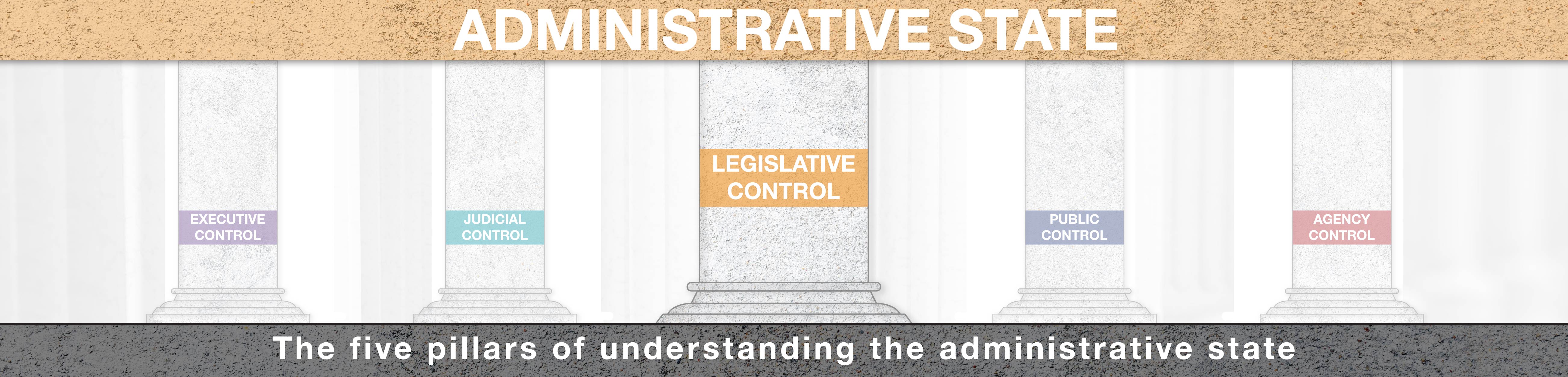
- See also: 50-state research: Legislative oversight of executive agency rulemaking, Five pillars of the administrative state: Legislative control
Legislatures oversee executive agency rulemaking through a variety of mechanisms, including reviewing regulations, holding hearings, approving regulations prior to their adoption, or disapproving of or nullifying regulations, among other procedures. State laws and constitutions establish these legislative oversight requirements or authorizations. This page summarizes the legislative oversight of agency rulemaking mechanisms in North Carolina law.
This page contains the following sections:
Legislative oversight of agency rulemaking in North Carolina
This section details the legislative oversight mechanism in North Carolina.
How does North Carolina compare to other states?
This section compares the legislative oversight policies in North Carolina to those across the 50 states, specifically related to legislative oversight requirements, designated oversight entity, and scope of regulatory oversight.
Legislative oversight of agency rulemaking in North Carolina
See also: North Carolina REINS-style state law, North Carolina Constitution, and North Carolina Administrative Procedure Act
The legislature can introduce bills to repeal any agency rule. If 10 or more people submit written objections to agency rules, the legislature must review them, though the rules can take effect if the legislature fails to pass a bill disapproving of them. All rules with aggregate financial cost to all persons affected equal to or greater than twenty million dollars ($20,000,000) during any five years must be approved by the legislature through a bill.
[1]
Effective date of rules
...
(b) Permanent Rule. – A permanent rule approved by the Commission becomes effective on the first day of the month following the month the rule is approved by the Commission, unless
(i) the Commission received written objections to the rule in accordance with subsection (b2) of this section, (ii) the rule would have an aggregate financial cost, as defined in G.S. 150B-19.4(d), on all persons affected of at least twenty million dollars ($20,000,000) in a five-year period and requires ratification by the General Assembly pursuant to subsection (b3) of this section, or unless (iii) the agency that adopted the rule specifies a later effective date.
(b1) Delayed Effective Dates. – Except as provided in G.S. 14‑4.1, if the Commission received written objections to the rule in accordance with subsection (b2) of this section, the rule becomes effective on the earlier of the thirty‑first legislative day or the day of adjournment of the next regular session of the General Assembly that begins at least 25 days after the date the Commission approved the rule, unless a different effective date applies under this section. If a bill that specifically disapproves the rule is introduced in either house of the General Assembly before the thirty‑first legislative day of that session, the rule becomes effective on the earlier of either the day an unfavorable final action is taken on the bill or the day that session of the General Assembly adjourns without ratifying a bill that specifically disapproves the rule. If the agency adopting the rule specifies a later effective date than the date that would otherwise apply under this subsection, the later date applies. A permanent rule that is not approved by the Commission or that is specifically disapproved by a bill enacted into law before it becomes effective does not become effective.
A bill specifically disapproves a rule if it contains a provision that refers to the rule by appropriate North Carolina Administrative Code citation and states that the rule is disapproved. Notwithstanding any rule of either house of the General Assembly, any member of the General Assembly may introduce a bill during the first 30 legislative days of any regular session to disapprove a rule that has been approved by the Commission and that either has not become effective or has become effective by executive order under subsection (c) of this section.
(b2) Objection. – Any person who objects to the adoption of a permanent rule may submit written comments to the agency. If the objection is not resolved prior to adoption of the rule, a person may submit written objections to the Commission. If the Commission receives written objections from 10 or more persons, no later than 5:00 P.M. of the day following the day the Commission approves the rule, clearly requesting review by the legislature in accordance with instructions posted on the agency's Web site pursuant to G.S. 150B-19.1(c)(4), and the Commission approves the rule, the rule will become effective as provided in subsection (b1) of this section. The Commission shall notify the agency that the rule is subject to legislative disapproval on the day following the day it receives 10 or more written objections. If the Commission receives objections from 10 or more persons clearly requesting review by the legislature, and the rule objected to is one of a group of related rules adopted by the agency at the same time, the agency that adopted the rule may cause any of the other rules in the group to become effective as provided in subsection (b1) of this section by submitting a written statement to that effect to the Codifier of Rules before the other rules become effective. A rule that requires ratification by the General Assembly pursuant to subsection (b3) of this section shall not be subject to this subsection.
(b3) A permanent rule that would have an aggregate financial cost, as defined in G.S. 150B-19.4(d), on all persons affected of at least twenty million dollars ($20,000,000) in a five-year period shall become effective only if the General Assembly ratifies a bill to approve the rule. If a bill that specifically approves the rule is ratified by the General Assembly, the rule shall become effective on the later of (i) the first day of the month following the month that the bill ratifying the rule becomes effective or (ii) the date specified by the agency adopting the rule.
If the General Assembly does not ratify a bill approving the rule, the Commission shall return the rule to the agency within 15 days of the General Assembly adjourning for a period of 30 days or more. This subsection shall not apply to a rule or set of rules that is required by federal law, including a rule or set of rules necessary to maintain compliance with a program delegated to the State from a federal agency.
[2]
Legislative review of regulatory crimes.
(a) Any rule adopted or amended pursuant to Article 2A of Chapter 150B of the General Statutes that creates a new criminal offense or otherwise subjects a person to criminal penalties is subject to G.S. 150B‑21.3(b1) regardless of whether the rule received written objections from 10 or more persons pursuant to G.S. 150B‑21.3(b2).
(b) This section applies to rules adopted on or after January 1, 2020.
[3]
Limitation on rules with substantial financial costs.
(a) If an agency determines that a proposed permanent rule or set of rules will have a projected aggregate financial cost to all persons affected equal to or greater than one million dollars ($1,000,000) during any five-year period and the agency is a board, a commission, a council, or other similar unit of government, the permanent rule or set of rules must be adopted by a vote of at least two-thirds of the board or commission members present and voting on the rule or set of rules.
(b) If an agency determines that a proposed permanent rule or set of rules will have a projected aggregate financial cost to all persons affected equal to or greater than ten million dollars ($10,000,000) during any five-year period and the agency is a board, a commission, a council, or other similar unit of government, the permanent rule or set of rules must be adopted by a unanimous vote of the board or commission members present and voting on the rule or set of rules.
(c) This section shall apply to all rules adopted pursuant to Article 2A of Chapter 150B of the General Statutes, including rules undergoing periodic review and readoption under G.S. 150B-21.3A; provided, however, this section shall not apply to rules required by federal law, including a rule or set of rules necessary to maintain compliance with a program delegated to the State from a federal agency.
(d) For purposes of this section, "aggregate financial cost" means the amount of costs to all persons affected identified in a substantial economic impact analysis conducted according to G.S. 150B-21.4(b1), not inclusive of benefits.
[4]
How does North Carolina compare to other states?
Is legislative oversight optional, required, or both?
Because many states have more than one mechanism of legislative oversight of agency regulations, some states have both optional and required legislative oversight mechanisms.
- Thirty-four (34) states require legislative review of all or some agency regulations. Seven states include both optional and required legislative oversight mechanisms, and 27 states only have required legislative oversight mechanisms.
- Ten (10) states authorize, but do not require, legislative oversight of agency regulations.
- The law does not include provisions regarding legislative review of agency actions in six states.
Who reviews the regulations?
Generally, either the full legislature, legislative committees, legislative agencies, divisions, or offices, or any combination of these bodies, is authorized or required to review agency regulations. Thirty-three (33) states authorize or require more than one legislative entity to review agency regulations; therefore, the breakdown below exceeds 50.
- Thirty-one (31) states authorize or require full legislative review of agency regulations.
- Forty-one (41) states authorize or require legislative committees to review agency regulations.
- Thirteen (13) states authorize or require legislative agencies, divisions, or offices to review agency regulations.
What is reviewed?
In states that don't require the legislature to review rules, review is optional, while other states do not have laws relating to legislative oversight of agency rules.
- Thirty-two (32) states require legislative review of all rules. Some states require different levels of review for rules that meet different criteria.
- Six states require legislative review of some rules. Some states require legislatures to review rules that meet certain criteria, which are policies similar to REINS-style state laws. Other states require legislative review of rules that received a public complaint.
- Six states do not require, but explicitly authorize, legislative review of rules.
- Six states do not have laws regarding legislative review of agency rules.
Some states require legislatures to review rules that meet certain criteria, which are policies similar to REINS-style state laws.
See also
- ↑ North Carolina passed this state-level REINS law in 2025, requiring legislative approval of regulatory actions above a cost threshold. For more information on this law, see Ballotpedia's North Carolina REINS-style state law page.
- ↑ North Carolina Legislature, "§ 150B‑21.3. Effective date of rules." Accessed January 28, 2026
- ↑ North Carolina Legislature, "G.S. 14-4.1," accessed January 28, 2026
- ↑ North Carolina Legislature, "SESSION LAW 2025-82 HOUSE BILL 402," accessed January 28, 2026