Daily Brew: July 22, 2024

Welcome to the Monday, July 22, Brew.
By: Briana Ryan
Here’s what’s in store for you as you start your day:
- Ballotpedia identifies 11 vulnerable state government trifectas in this year’s elections
- South Dakota voters to decide on veto referendum regarding carbon dioxide pipeline regulations
- Three candidates are running in the top-two primary for Washington Attorney General on Aug. 6
Ballotpedia identifies 11 vulnerable state government trifectas in this year’s elections
According to our annual trifecta vulnerability ratings, eleven state government trifectas could break up, and nine new ones could form in this year's elections. Our report looks at what is required for each individual component of a state government trifecta (the governorship and both chambers of the state legislature) to change party control. For more on our methodology, click here.
A trifecta occurs when one party holds the governorship and majorities in both state legislature chambers. There are currently 40 trifectas: 23 Republican and 17 Democratic. The remaining 10 states have divided governments.
Eleven states are holding gubernatorial elections this year. There will also be elections for 85 of the country's 99 state legislative chambers. Trifecta status is at stake in 44 states. Elections for one or more trifecta offices are taking place in:
- 20 of the 23 states with Republican trifectas
- 15 of the 17 states with Democratic trifectas
- 9 of the 10 states with divided governments
Changes in a state government's policies often follow changes in trifecta status, as trifecta control allows a political party to advance its agenda. Gaining or breaking trifectas—or, in some cases, maintaining divided government—often becomes a major priority for a party heading into each election.
Of the 11 vulnerable trifectas, seven are Democratic, and four are Republican.
Democratic state government trifectas
The Democratic trifecta in Oregon is highly vulnerable, based on the number of seats needed to change party control in the Legislature. Oregon will not hold a gubernatorial election this year, but Democrats have a 17-12-1 majority in the state Senate and a 35-24-1 majority in the state House. Republicans need to gain four seats to win a majority in the upper chamber and seven seats to win a majority in the lower chamber.
Democratic trifectas in Maine, Michigan, and Minnesota are moderately vulnerable. Democratic trifectas in Connecticut, Delaware, and Washington are considered somewhat vulnerable.
Republican state government trifectas
New Hampshire and Texas are highly vulnerable Republican trifectas this year. The New Hampshire governor's race is rated as a Toss-up, and Democrats need to win three seats to win the state Senate and seven seats to win the state House. There is also no gubernatorial election in Texas this year. However, Democrats need to win four seats to win the state Senate and 12 seats to win the state House. The Republican trifecta in Georgia is classified as moderately vulnerable, and the Republican trifecta in Iowa is rated somewhat vulnerable.

Divided state governments
We also assessed the chances of new trifectas forming in states currently with divided governments. Possible Democratic trifecta pickups are Arizona, Kansas, Kentucky, Pennsylvania, and Wisconsin. Possible Republican trifecta pickups include Alaska and Nevada. Either party could establish a trifecta in North Carolina and Vermont.
Recent changes in state government trifectas
Heading into this year's elections, Louisiana is the most recent state to become a trifecta after Republicans won the governorship in 2023. The 2022 elections resulted in Republicans losing a trifecta in Arizona, where Democrats won the governorship. Democrats gained four trifectas in 2022—Maryland, Massachusetts, Michigan, and Minnesota—and lost a trifecta in Nevada. Between 2010 and 2023, 80 state government trifectas were broken or gained.
As a result of the 2023 elections, there were 40 trifectas across the country. That was more trifectas than at any other point from 1992 to 2022. Between 1992 and 2024, the most trifectas for each party were 18 for Democrats (1993) and 26 for Republicans (2018).

South Dakota voters to decide on veto referendum regarding carbon dioxide pipeline regulations
On Nov. 5, South Dakota voters will decide on a veto referendum against Senate Bill 201 (SB 201), a law regarding carbon dioxide pipelines. A veto referendum is a citizen-initiated ballot measure that asks voters whether to uphold or repeal an enacted law.
Gov. Kristi Noem (R) signed SB 201 on March 26, 2024. Before signing the bill, Noem said, “I stand with South Dakota landowners and always will. I am looking forward to signing a Landowner Bill of Rights that will provide new protections for landowners and allow for economic growth to move forward through a transparent process.”
SB 201 establishes requirements for regulating carbon dioxide pipelines used in carbon capture and storage systems. These systems take carbon emissions from sources, such as oil and gas plants or factories, transport them through pipelines, and store them underground.
SB 201 would also allow counties to enact a $1 per linear foot surcharge on related pipeline companies. At least half of the surcharge revenue would be allocated toward property tax reductions for affected landowners. Additionally, SB 201 would preempt any local law or regulation regarding carbon pipeline policies and prevent local governments from enacting or enforcing local regulations regarding carbon pipelines.
On July 10, the secretary of state’s office announced that 92% of the 34,000 signatures submitted were valid, meaning around 31,432 signatures were valid. In order to qualify for the ballot, 17,509 valid signatures were needed.
State Rep. Will Mortenson (R-24) sponsored SB 201 in the South Dakota Legislature. Mortenson said a proposed carbon dioxide pipeline, the Summit Pipeline, would transport carbon dioxide from 57 ethanol plants in South Dakota and neighboring states to North Dakota, where it would be stored underground.
Mortensen said, “If you don’t think the pipeline should be held accountable, you should vote no. If you don’t think farmers deserve additional compensation, you should vote no. If you don’t think counties deserve additional compensation from these pipelines, you should vote no. But if you want farmers protected and counties benefited if these pipelines are built, you should vote yes like the Legislature did and the governor approved.”
South Dakota Property Rights and Local Control Alliance Chairman Jim Eschenbaum said that SB 201 set a precedent in allowing the Public Utilities Commission to automatically overrule local commissioners regarding local regulations: “It took the voice away from county commissioners and gave it to three people in Pierre. They basically say we’re not smart enough, that we don’t understand. I think it’s an awful precedent to set.”
The veto referendum will join six other measures on the Nov. 5 ballot in South Dakota. The veto referendum is also one of six energy-related measures that qualified for the ballot this year nationwide.
Three candidates are running in the top-two primary for Washington Attorney General on Aug. 6
Throughout the year, we'll bring you coverage of the most compelling elections—the battlegrounds we expect to have a meaningful effect on the balance of power in governments or to be particularly competitive. You can catch our previous coverage of other battleground races here.
Today, we're looking at the Aug. 6 top-two primary for Washington Attorney General between Nick Brown (D), Manka Dhingra (D), and Pete Serrano (R).
Incumbent Bob Ferguson (D) is running for governor, leaving the office open for the first time since 2012. Washington is one of 10 states holding elections for attorney general this year. There are currently 27 Republican attorneys general, 22 Democratic attorneys general, and one independent attorney general.
This is a top-two primary, meaning the two candidates who receive the most votes will advance to the general election in November, regardless of party. According to The Cascadia Advocate, Democratic support for Brown and Dhingra is split, while Republican support for Serrano is unified. Washington Gov. Jay Inslee (D) and former Washington Gov. Gary Locke (D) endorsed Brown, while Washington Secretary of State Steve Hobbs (D) and U.S. Rep. Pramila Jayapal (D-Wa.) endorsed Dhingra. The Washington State Republican Party endorsed Serrano.
Brown's experience and platform
Brown is a lawyer who served as an officer in the Judge Advocate General Corps of the U.S. Army. He was also an assistant U.S. Attorney for Western Washington from 2007 to 2013 and the U.S. Attorney for Western Washington from 2021 to 2023. Additionally, Brown served as general counsel to Inslee.
Brown said he would promote public safety by targeting gun violence, drug trafficking, and discrimination. Brown said he would also defend abortion access and protect voting rights.
Dhingra's experience and platform
Dhingra represents District 45 in the Washington Senate. Before being elected to the Legislature, she was a senior deputy prosecuting attorney for King County, Washington. Dhingra also co-founded an organization to help survivors of human trafficking.
Dhingra said that as a prosecuting attorney, she fought for public safety by defending survivors of human trafficking and prosecuting violent crimes. Dhingra said she would support workers' rights and would oppose efforts to change abortion access in the state.
Serrano's experience and platform
Serrano serves as director and general counsel for the Silent Majority Foundation, which "stands to support, protect and defend the constitution of our United States through education, advocacy and litigation." He is also the Mayor of Pasco, Washington. From 2015 to 2021, he was an environmental lawyer for the U.S. Department of Energy.
Serrano said he would support law enforcement to promote public safety and advocate for using clean energy in the state. Serrano said he would also "provide a much needed check on government overreach" and defend the Constitutional rights of Washington citizens.
Campaign finance
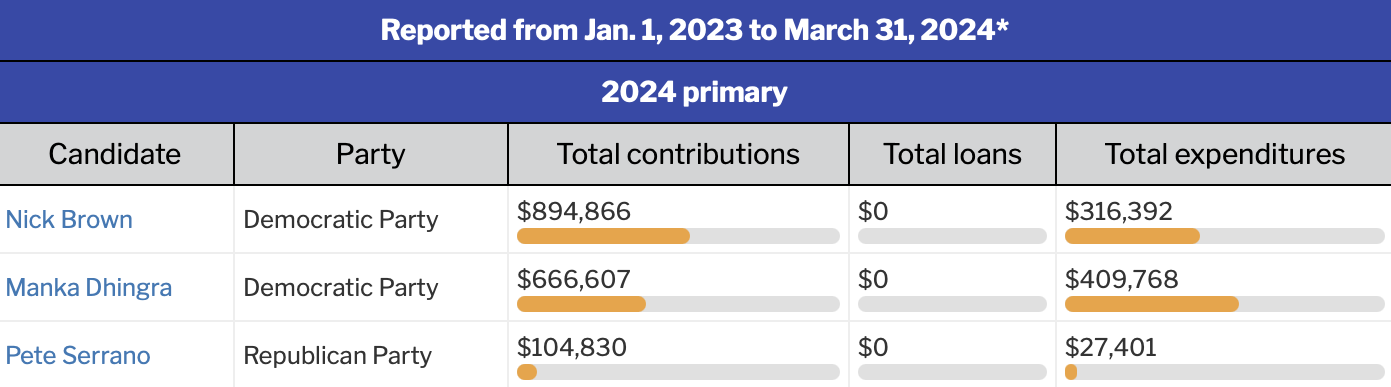
As of March 31, Brown had raised $894,866, Dhingra had raised $666,607, and Serrano had raised $104,830.
What’s next?
- The Washington Office of the Secretary of State and the Washington-based broadcast organization TVW produced video profiles for candidates in statewide elections as part of TVW's 2024 Video Voters' Guide. Click here to view video profiles for Brown, Dhingra, and Serrano.
- The primary election is Aug. 6.