

Presidential Elections: Difference between revisions
No edit summary |
No edit summary |
||
| Line 26: | Line 26: | ||
<h2 style="margin:0; background:#3149ab; color:white; font-size:120%; font-weight:bold; border:1px solid #C0C0C0; text-align:left; color: white; padding:0.2em 0.4em;"><font face=Helvetica>Election updates</font></h2><div style="padding:1.0em 0em;"> | <h2 style="margin:0; background:#3149ab; color:white; font-size:120%; font-weight:bold; border:1px solid #C0C0C0; text-align:left; color: white; padding:0.2em 0.4em;"><font face=Helvetica>Election updates</font></h2><div style="padding:1.0em 0em;"> | ||
*The [[Charlotte, North Carolina|Charlotte]] City Council voted by a 6 to 5 margin to approve contracts which will likely lead to that city being named the host of the 2020 Republican National Convention. The contracts which were approved specify the financial commitments and obligations of both Charlotte and the [[Republican National Committee]] (RNC) regarding the use of various facilities and security costs and are contingent on the RNC selecting Charlotte as the host city.<ref>[https://www.charlotteobserver.com/news/politics-government/rnc-2020/article214823895.html ''The Charlotte Observer'', "City Council narrowly supports bringing RNC to Charlotte in 6-5 vote," July 16, 2018]</ref><ref>[https://www.charlotteobserver.com/news/local/article214947395.html ''The Charlotte Observer'', "Charlotte City Council to vote today on RNC. Here’s what the contracts say," July 16, 2018]</ref> | *On July 18, the site selection committee of the [[Republican National Committee]] (RNC) unanimously approved [[Charlotte, North Carolina]] as the host city for the 2020 Republican National Convention. The exact dates of the convention are yet to be determined, but it is expected to take place in either July or August. Charlotte also hosted the Democratic National Convention in 2012.<ref>[https://www.charlotteobserver.com/news/politics-government/rnc-2020/article214845965.html ''The Charlotte Observer'', "GOP panel picks Charlotte for its 2020 convention, putting city in national spotlight," July 18, 2018[</ref> | ||
*On July 16, the [[Charlotte, North Carolina|Charlotte]] City Council voted by a 6 to 5 margin to approve contracts which will likely lead to that city being named the host of the 2020 Republican National Convention. The contracts which were approved specify the financial commitments and obligations of both Charlotte and the [[Republican National Committee]] (RNC) regarding the use of various facilities and security costs and are contingent on the RNC selecting Charlotte as the host city.<ref>[https://www.charlotteobserver.com/news/politics-government/rnc-2020/article214823895.html ''The Charlotte Observer'', "City Council narrowly supports bringing RNC to Charlotte in 6-5 vote," July 16, 2018]</ref><ref>[https://www.charlotteobserver.com/news/local/article214947395.html ''The Charlotte Observer'', "Charlotte City Council to vote today on RNC. Here’s what the contracts say," July 16, 2018]</ref> | |||
*Trump campaign manger [[Brad Parscale]] (R) planned to target Colorado and Minnesota as potential pick-ups in the 2020 presidential election and focus on digital innovation to guide the campaign, ''Axios'' reported on May 15, 2018.<ref>[https://www.axios.com/donald-trump-2020-presidential-campaign-startup-brad-parscale-data-ca0a653b-ac9b-469c-b311-d88301a60ad3.html ''Axios'', "Scoop: Inside Trump's 2020 startup," May 15, 2018]</ref> | *Trump campaign manger [[Brad Parscale]] (R) planned to target Colorado and Minnesota as potential pick-ups in the 2020 presidential election and focus on digital innovation to guide the campaign, ''Axios'' reported on May 15, 2018.<ref>[https://www.axios.com/donald-trump-2020-presidential-campaign-startup-brad-parscale-data-ca0a653b-ac9b-469c-b311-d88301a60ad3.html ''Axios'', "Scoop: Inside Trump's 2020 startup," May 15, 2018]</ref> | ||
Revision as of 18:57, 18 July 2018
Overview
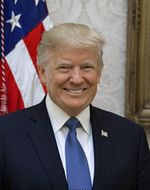
Americans will elect the next president of the United States on November 3, 2020. Incumbent President Donald Trump (R) is running for re-election and named Brad Parscale as his campaign manager in February 2018.[1]
Trump is expected to face a primary challenge, particularly if a significant number of seats are flipped from red to blue in the 2018 congressional midterms. "[T]he direction he's headed right now, just kind of drilling down on the base rather than trying to expand the base—I think he's inviting [a challenge]," U.S. Sen. Jeff Flake (R-Ariz.) said.[2]
The Democratic presidential primary field will likely be large in 2020, as established Democrats with national name recognition compete with up-and-coming members of the party.[3]
The New York Times reported that early Democratic interest in the race was not only "a reflection of the deep antipathy toward President Trump among Democrats, and the widespread belief that the right candidate could defeat him, but also of the likelihood that the contest for the nomination could be the longest, most crowded and most expensive in history."[4]
Election updates
- On July 18, the site selection committee of the Republican National Committee (RNC) unanimously approved Charlotte, North Carolina as the host city for the 2020 Republican National Convention. The exact dates of the convention are yet to be determined, but it is expected to take place in either July or August. Charlotte also hosted the Democratic National Convention in 2012.[5]
- On July 16, the Charlotte City Council voted by a 6 to 5 margin to approve contracts which will likely lead to that city being named the host of the 2020 Republican National Convention. The contracts which were approved specify the financial commitments and obligations of both Charlotte and the Republican National Committee (RNC) regarding the use of various facilities and security costs and are contingent on the RNC selecting Charlotte as the host city.[6][7]
- Trump campaign manger Brad Parscale (R) planned to target Colorado and Minnesota as potential pick-ups in the 2020 presidential election and focus on digital innovation to guide the campaign, Axios reported on May 15, 2018.[8]
- The Rules and Bylaws Committee of the Democratic National Committee convened to discuss the primary calendar in May 2018, tentatively setting Iowa, New Hampshire, Nevada, and South Carolina to be the first to vote again in February 2020.[9]
Looking back at 2016
 Hillary Clinton (D) |
 Donald Trump (R) |
 Jill Stein (G) |
 Gary Johnson (L) | |||
Donald Trump (R) defeated Hillary Clinton (D) in the 2016 presidential election, winning 304 electoral votes. Ballotpedia compiled the following information to help voters understand the election and the policy positions of the candidates:
- Presidential election, 2016
- Presidential candidates, 2016
- Vice presidential candidates, 2016
- 2016 presidential nominations: calendar and delegate rules
- 2016 presidential election polls
- 2016 presidential debates
- Super Tuesday presidential primaries, 2016
- Democratic National Convention, 2016
- Republican National Convention, 2016
- Ballotpedia's battleground poll, 2016
2016 presidential election by state
Potential 2020 presidential candidates
 Democrats
- Joe Biden, former vice president of the United States[10]
- Cory Booker, U.S. senator from New Jersey[10]
- Jerry Brown, governor of California[10]
- Sherrod Brown, U.S. senator from Ohio[10]
- Steve Bullock, governor of Montana[11]
- Pete Buttigieg, mayor of South Bend, Indiana[12]
- Julian Castro, former secretary of housing and urban development of the United States and mayor of San Antonio, Texas[13]
- Lincoln Chafee, former governor of and U.S. senator from Rhode Island[13]
- Roy Cooper, governor of North Carolina[14]
- Andrew Cuomo, governor of New York[10]
Click here for a complete list of potential Democratic presidential candidates.
 Republicans
- Bob Corker, U.S. senator from Tennessee[15]
- Tom Cotton, U.S. senator from Arkansas[16]
- Ted Cruz, U.S. senator from Texas[17]
- Jeff Flake, U.S. senator from Arizona[17]
- Nikki Haley, U.S. ambassador to the United Nations and former governor of South Carolina[18]
- John Kasich, governor of Ohio[17]
- Susana Martinez, governor of New Mexico[15]
- Mike Pence, vice president of the United States[18]
- Mitt Romney, former governor of Massachusetts[15]
- Ben Sasse, U.S. senator from Nebraska[17]
Click here for a complete list of potential Rebulican presidential candidates.
Declared 2020 presidential candidates
White House Twitter Feed
Wave elections (1918-2016)

- See also: Wave elections (1918-2016)
The term wave election is frequently used to describe an election cycle in which one party makes significant electoral gains. How many seats would Republicans have had to lose for the 2018 midterm election to be considered a wave election?
Ballotpedia examined the results of the 50 election cycles that occurred between 1918 and 2016—spanning from President Woodrow Wilson's (D) second midterm in 1918 to Donald Trump's (R) first presidential election in 2016. We define wave elections as the 20 percent of elections in that period resulting in the greatest seat swings against the president's party.
Applying this definition to four different election groups (U.S. Senate, U.S. House, governorships, and state legislatures) yields specific numbers of seats that Republicans needed to lose for 2018 to qualify as a wave election. Those are:
- 48 U.S. House seats,
- Seven U.S. Senate seats,
- Seven gubernatorial seats, or
- 494 state legislative seats.
The midterm election results in 2018 met those levels in one category, as Democrats gained seven governorships. In congressional elections, Democrats had a net gain of 40 U.S. House seats while Republicans actually gained a net total of two U.S. Senate seats. Democrats gained a net 309 state legislative seats.
Click here to read the full report.
Footnotes
- ↑ TIME, "What to Know About Brad Parscale, Donald Trump's 2020 Campaign Manager," February 27, 2018
- ↑ Fox News, "Moderate Republicans begin speculating about 2020 primary challenger to Trump," August 24, 2017
- ↑ Politico, "Dems' 2020 dilemma: Familiar 70-somethings vs. neophyte no-names," August 31, 2017
- ↑ The New York Times, "Long list of top Democrats have 2020, and money, on their minds," September 2, 2017
- ↑ [https://www.charlotteobserver.com/news/politics-government/rnc-2020/article214845965.html The Charlotte Observer, "GOP panel picks Charlotte for its 2020 convention, putting city in national spotlight," July 18, 2018[
- ↑ The Charlotte Observer, "City Council narrowly supports bringing RNC to Charlotte in 6-5 vote," July 16, 2018
- ↑ The Charlotte Observer, "Charlotte City Council to vote today on RNC. Here’s what the contracts say," July 16, 2018
- ↑ Axios, "Scoop: Inside Trump's 2020 startup," May 15, 2018
- ↑ Frontloading HQ, "Democrats Chart Out 2020 Pre-Window Primary Calendar in Draft Delegate Rules," May 13, 2018
- ↑ 10.0 10.1 10.2 10.3 10.4 The Washington Post, "The top 15 possible 2020 Democratic nominees, ranked," September 18, 2017
- ↑ Cite error: Invalid
<ref>tag; no text was provided for refs namedNR - ↑ CNN, "#2020Vision: Kander and Buttigieg make moves; Holder takes on a more public role," June 23, 2017
- ↑ 13.0 13.1 NBC News, "Everyone's running for president in 2020," August 28, 2017
- ↑ News & Observer, "Roy Cooper for president?" March 29, 2018
- ↑ 15.0 15.1 15.2 Newsweek, "Trump challengers: 10 Republicans who could run for president in 2020," December 27, 2017
- ↑ ABC News, "Trump could face GOP challengers in the 2020 election," August 9, 2017
- ↑ 17.0 17.1 17.2 17.3 CNN, "5 Republicans who could challenge Donald Trump in 2020," August 1, 2017
- ↑ 18.0 18.1 The New York Times, "Republican shadow campaign for 2020 takes shape as Trump doubts grow," August 5, 2017


