

North Carolina's 2nd Congressional District

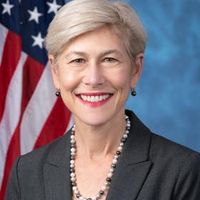
North Carolina's 2nd Congressional District in the United States House of Representatives is represented by Deborah Ross (D).
As of the 2020 Census, North Carolina representatives represented an average of 746,711 residents. After the 2010 Census, each member represented 735,829 residents.
Elections
See also: North Carolina's 2nd Congressional District election, 2030
There are no official candidates yet for this election.
See also: North Carolina's 2nd Congressional District election, 2028
There are no official candidates yet for this election.
See also: North Carolina's 2nd Congressional District election, 2026
General election
The primary will occur on March 3, 2026. The general election will occur on November 3, 2026. General election candidates will be added here following the primary.
Democratic primary
Democratic primary for U.S. House North Carolina District 2
Incumbent Deborah Ross (D) is running in the Democratic primary for U.S. House North Carolina District 2 on March 3, 2026.
Candidate | ||
 | Deborah Ross | |
| ||||
 = candidate completed the Ballotpedia Candidate Connection survey. = candidate completed the Ballotpedia Candidate Connection survey. | ||||
| If you are a candidate and would like to tell readers and voters more about why they should vote for you, complete the Ballotpedia Candidate Connection Survey. | ||||
Do you want a spreadsheet of this type of data? Contact our sales team. | ||||
Withdrawn or disqualified candidates
- Robert Bennett (D)
Republican primary
Republican primary for U.S. House North Carolina District 2
Eugene Douglass (R) is running in the Republican primary for U.S. House North Carolina District 2 on March 3, 2026.
Candidate | ||
 | Eugene Douglass | |
| ||||
| = candidate completed the Ballotpedia Candidate Connection survey. | ||||
| If you are a candidate and would like to tell readers and voters more about why they should vote for you, complete the Ballotpedia Candidate Connection Survey. | ||||
Do you want a spreadsheet of this type of data? Contact our sales team. | ||||
See also: North Carolina's 2nd Congressional District election, 2024
General election
General election for U.S. House North Carolina District 2
Incumbent Deborah Ross (D) defeated Alan Swain (R) and Michael Dublin (G) in the general election for U.S. House North Carolina District 2 on November 5, 2024.
Candidate | % | Votes | ||
| ✔ | | Deborah Ross (D) | 66.3 | 268,662 |
 | Alan Swain (R) | 31.6 | 128,164 | |
 | Michael Dublin (G) | 2.1 | 8,691 | |
| Total votes: 405,517 | |||
| = candidate completed the Ballotpedia Candidate Connection survey. | ||||
| If you are a candidate and would like to tell readers and voters more about why they should vote for you, complete the Ballotpedia Candidate Connection Survey. | ||||
Do you want a spreadsheet of this type of data? Contact our sales team. | ||||
Withdrawn or disqualified candidates
- Jon Bass (Independent)
Democratic primary
Democratic primary for U.S. House North Carolina District 2
Incumbent Deborah Ross (D) defeated Michael Camero (D) in the Democratic primary for U.S. House North Carolina District 2 on March 5, 2024.
Candidate | % | Votes | ||
| ✔ | | Deborah Ross | 93.6 | 69,564 |
 | Michael Camero | 6.4 | 4,761 | |
| Total votes: 74,325 | |||
| = candidate completed the Ballotpedia Candidate Connection survey. | ||||
| If you are a candidate and would like to tell readers and voters more about why they should vote for you, complete the Ballotpedia Candidate Connection Survey. | ||||
Do you want a spreadsheet of this type of data? Contact our sales team. | ||||
Republican primary
Republican primary for U.S. House North Carolina District 2
Alan Swain (R) defeated Eugene Douglass (R) and Robert Morales Vergara (R) in the Republican primary for U.S. House North Carolina District 2 on March 5, 2024.
Candidate | % | Votes | ||
| ✔ | | Alan Swain | 59.5 | 25,759 |
| | Eugene Douglass | 22.5 | 9,751 | |
 | Robert Morales Vergara | 17.9 | 7,747 | |
| Total votes: 43,257 | |||
| = candidate completed the Ballotpedia Candidate Connection survey. | ||||
| If you are a candidate and would like to tell readers and voters more about why they should vote for you, complete the Ballotpedia Candidate Connection Survey. | ||||
Do you want a spreadsheet of this type of data? Contact our sales team. | ||||
Withdrawn or disqualified candidates
- Sandy Roberson (R)
Green Party primary
The Green Party primary scheduled for March 5, 2024, was canceled. Michael Dublin (G) advanced from the Green Party primary for U.S. House North Carolina District 2 without appearing on the ballot.
See also: North Carolina's 2nd Congressional District election, 2022
General election
General election for U.S. House North Carolina District 2
Incumbent Deborah Ross (D) defeated Christine Villaverde (R) in the general election for U.S. House North Carolina District 2 on November 8, 2022.
Candidate | % | Votes | ||
| ✔ | | Deborah Ross (D) | 64.7 | 190,714 |
 | Christine Villaverde (R) | 35.3 | 104,155 | |
| Total votes: 294,869 | |||
| = candidate completed the Ballotpedia Candidate Connection survey. | ||||
| If you are a candidate and would like to tell readers and voters more about why they should vote for you, complete the Ballotpedia Candidate Connection Survey. | ||||
Do you want a spreadsheet of this type of data? Contact our sales team. | ||||
Democratic primary
The Democratic primary scheduled for May 17, 2022, was canceled. Incumbent Deborah Ross (D) advanced from the Democratic primary for U.S. House North Carolina District 2 without appearing on the ballot.
Withdrawn or disqualified candidates
- James Gailliard (D)
Republican primary
Republican primary for U.S. House North Carolina District 2
Christine Villaverde (R) defeated Mahesh Ganorkar (R) and Adina Safta (R) in the Republican primary for U.S. House North Carolina District 2 on May 17, 2022.
Candidate | % | Votes | ||
| ✔ | | Christine Villaverde | 55.1 | 19,650 |
 | Mahesh Ganorkar | 25.6 | 9,133 | |
 | Adina Safta | 19.3 | 6,872 | |
| Total votes: 35,655 | |||
| = candidate completed the Ballotpedia Candidate Connection survey. | ||||
| If you are a candidate and would like to tell readers and voters more about why they should vote for you, complete the Ballotpedia Candidate Connection Survey. | ||||
Do you want a spreadsheet of this type of data? Contact our sales team. | ||||
Withdrawn or disqualified candidates
- Richard Ahrens (R)
- Sid Sharma (R)
See also: North Carolina's 2nd Congressional District election, 2020
General election
General election for U.S. House North Carolina District 2
Deborah Ross (D) defeated Alan Swain (R) and Jeff Matemu (L) in the general election for U.S. House North Carolina District 2 on November 3, 2020.
Candidate | % | Votes | ||
| ✔ | | Deborah Ross (D) | 63.0 | 311,887 |
| | Alan Swain (R) | 34.8 | 172,544 | |
 | Jeff Matemu (L) | 2.2 | 10,914 | |
| Total votes: 495,345 | |||
| = candidate completed the Ballotpedia Candidate Connection survey. | ||||
| If you are a candidate and would like to tell readers and voters more about why they should vote for you, complete the Ballotpedia Candidate Connection Survey. | ||||
Do you want a spreadsheet of this type of data? Contact our sales team. | ||||
Democratic primary
Democratic primary for U.S. House North Carolina District 2
Deborah Ross (D) defeated Monika Johnson-Hostler (D), Andrew Terrell (D), and Ollie Nelson (D) in the Democratic primary for U.S. House North Carolina District 2 on March 3, 2020.
Candidate | % | Votes | ||
| ✔ | | Deborah Ross | 69.8 | 103,574 |
 | Monika Johnson-Hostler | 22.5 | 33,369 | |
 | Andrew Terrell | 5.8 | 8,666 | |
 | Ollie Nelson | 1.8 | 2,677 | |
| Total votes: 148,286 | |||
| = candidate completed the Ballotpedia Candidate Connection survey. | ||||
| If you are a candidate and would like to tell readers and voters more about why they should vote for you, complete the Ballotpedia Candidate Connection Survey. | ||||
Do you want a spreadsheet of this type of data? Contact our sales team. | ||||
Withdrawn or disqualified candidates
- Jason Butler (D)
- Scott Cooper (D)
Republican primary
The Republican primary scheduled for March 3, 2020, was canceled. Alan Swain (R) advanced from the Republican primary for U.S. House North Carolina District 2 without appearing on the ballot.
Withdrawn or disqualified candidates
- Michael Williams (R)
Libertarian Party primary
The Libertarian Party primary scheduled for March 3, 2020, was canceled. Jeff Matemu (L) advanced from the Libertarian Party primary for U.S. House North Carolina District 2 without appearing on the ballot.
See also: United States House of Representatives elections in North Carolina, 2018
General election
General election for U.S. House North Carolina District 2
Incumbent George E.B. Holding (R) defeated Linda Coleman (D) and Jeff Matemu (L) in the general election for U.S. House North Carolina District 2 on November 6, 2018.
Candidate | % | Votes | ||
| ✔ |  | George E.B. Holding (R) | 51.3 | 170,072 |
 | Linda Coleman (D) | 45.8 | 151,977 | |
| | Jeff Matemu (L) | 2.9 | 9,655 | |
| Total votes: 331,704 (100% precincts reporting) | |||
| = candidate completed the Ballotpedia Candidate Connection survey. | ||||
| If you are a candidate and would like to tell readers and voters more about why they should vote for you, complete the Ballotpedia Candidate Connection Survey. | ||||
Do you want a spreadsheet of this type of data? Contact our sales team. | ||||
Withdrawn or disqualified candidates
- Timmy Strickland (Independent)
Democratic primary
Democratic primary for U.S. House North Carolina District 2
Linda Coleman (D) defeated Ken Romley (D) and Wendy May (D) in the Democratic primary for U.S. House North Carolina District 2 on May 8, 2018.
Candidate | % | Votes | ||
| ✔ | | Linda Coleman | 56.0 | 18,650 |
 | Ken Romley | 32.3 | 10,742 | |
 | Wendy May | 11.7 | 3,895 | |
| Total votes: 33,287 | |||
| = candidate completed the Ballotpedia Candidate Connection survey. | ||||
| If you are a candidate and would like to tell readers and voters more about why they should vote for you, complete the Ballotpedia Candidate Connection Survey. | ||||
Do you want a spreadsheet of this type of data? Contact our sales team. | ||||
Withdrawn or disqualified candidates
- Sam Searcy (D)
Republican primary
Republican primary for U.S. House North Carolina District 2
Incumbent George E.B. Holding (R) defeated Allen Chesser II (R) in the Republican primary for U.S. House North Carolina District 2 on May 8, 2018.
Candidate | % | Votes | ||
| ✔ | | George E.B. Holding | 76.2 | 17,979 |
 | Allen Chesser II | 23.8 | 5,612 | |
| Total votes: 23,591 | |||
| = candidate completed the Ballotpedia Candidate Connection survey. | ||||
| If you are a candidate and would like to tell readers and voters more about why they should vote for you, complete the Ballotpedia Candidate Connection Survey. | ||||
Do you want a spreadsheet of this type of data? Contact our sales team. | ||||
Libertarian Party primary
Libertarian primary for U.S. House North Carolina District 2
Jeff Matemu (L) advanced from the Libertarian Party primary for U.S. House North Carolina District 2 on May 8, 2018.
Candidate | ||
| ✔ | | Jeff Matemu |
| ||||
| = candidate completed the Ballotpedia Candidate Connection survey. | ||||
| If you are a candidate and would like to tell readers and voters more about why they should vote for you, complete the Ballotpedia Candidate Connection Survey. | ||||
Do you want a spreadsheet of this type of data? Contact our sales team. | ||||

District map

Redistricting
2025-2026
North Carolina redrew its congressional map ahead of the 2026 elections. The state Senate approved a new congressional map on October 21, 2025, and the state House followed on October 22, 2025.[14][15] The New York Times' Eduardo Medina wrote, "Republicans already have control of 10 of the state’s 14 congressional seats. The new map could give them an extra seat in the First Congressional District, which previously included all eight of the state’s majority Black counties and has now been redrawn to include more conservative-leaning counties. The district is currently held by Representative Don Davis, a Democrat."[16]
2020-2023
On October 25, 2023, the North Carolina General Assembly adopted new congressional district boundaries.[17] The legislation adopting the new maps passed the state Senate by a vote of 28-18 and the State House by a vote of 64-40.[18] Both votes were strictly along party lines with all votes in favor by Republicans and all votes against by Democrats.[19][20]
The New York Times' Maggie Astor wrote, "The map creates 10 solidly Republican districts, three solidly Democratic districts and one competitive district. Currently, under the lines drawn by a court for the 2022 election, each party holds seven seats. The Democratic incumbents who have been essentially drawn off the map are Representatives Jeff Jackson in the Charlotte area, Kathy Manning in the Greensboro area and Wiley Nickel in the Raleigh area. A seat held by a fourth Democrat, Representative Don Davis, is expected to be competitive."[17]
How does redistricting in North Carolina work? In North Carolina, the state legislature is responsible for drawing both congressional and state legislative district lines. District maps cannot be vetoed by the governor. State legislative redistricting must take place in the first regular legislative session following the United States Census. There are no explicit deadlines in place for congressional redistricting.[21]
State law establishes the following requirements for state legislative districts:[21]
- Districts must be contiguous and compact.
- Districts "must cross county lines as little as possible." If counties are grouped together, the group should include as few counties as possible.
- Communities of interest should be taken into account.
There are no similar restrictions in place regarding congressional districts.[21]
Below are the congressional maps in effect before and after the 2020 redistricting cycle. The map on the right was in effect for North Carolina’s 2024 congressional elections.
Below are the congressional maps in effect before and after the 2020 redistricting cycle. The map on the right was in effect for North Carolina’s 2024 congressional elections.
Below are the congressional maps in effect before and after the 2020 redistricting cycle. The map on the right was in effect for North Carolina’s 2024 congressional elections.
2020
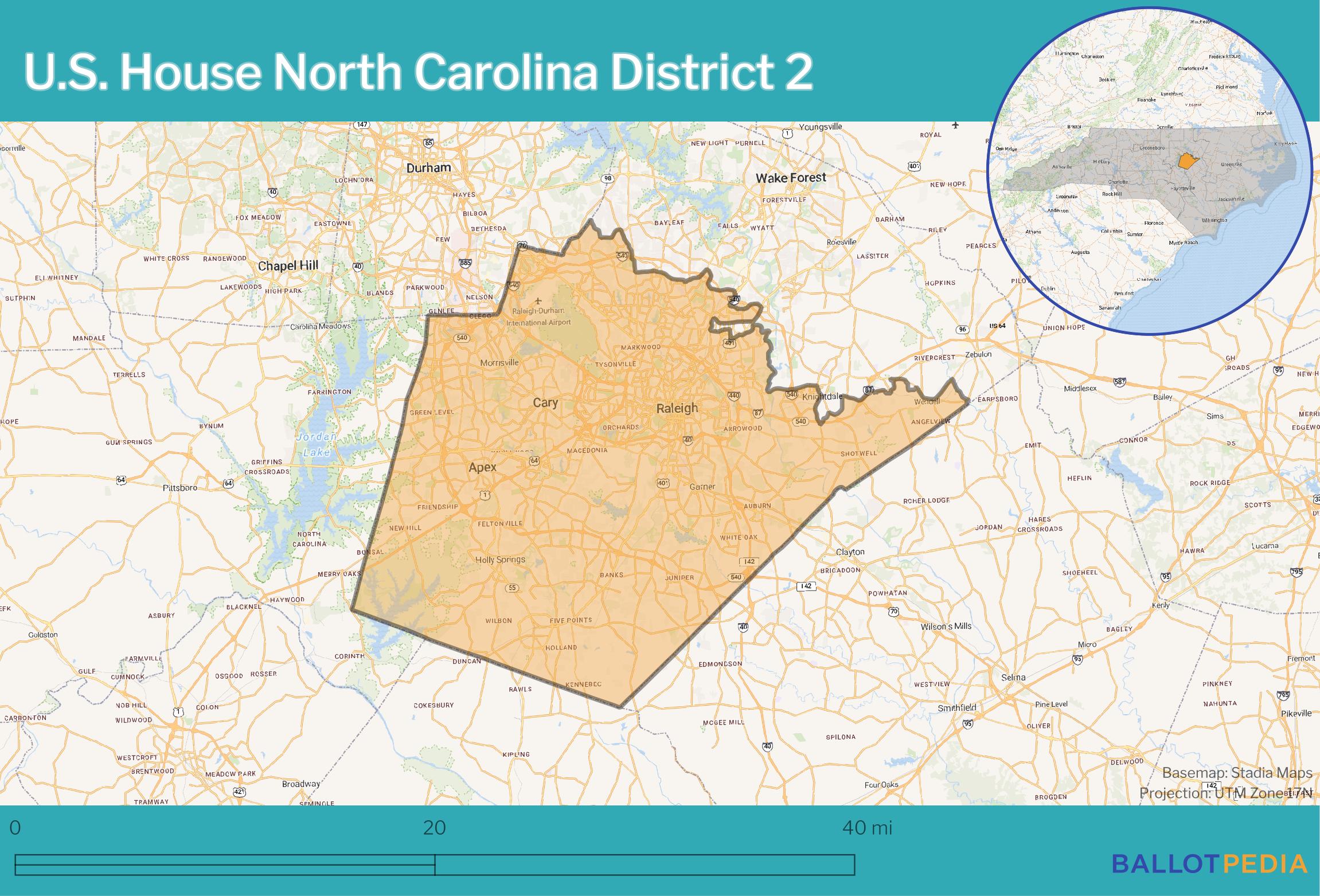
2024
North Carolina's congressional district plan was subject to litigation following its adoption in 2011. Two challenges to the plan were heard by the Supreme Court of the United States: Cooper v. Harris, which was decided in 2017, and Rucho v. Common Cause, which decided on June 27, 2019. As a result of Rucho, North Carolina's congressional district plan was upheld. For more complete information, see this article.
District analysis
- See also: The Cook Political Report's Partisan Voter Index
- See also: FiveThirtyEight's elasticity scores
2026
Heading into the 2026 elections, based on results from the 2024 and 2020 presidential elections, the Cook Partisan Voter Index for this district is D+17. This meant that in those two presidential elections, this district's results were 17 percentage points more Democratic than the national average. This made North Carolina's 2nd the 77th most Democratic district nationally.[22]
2024
Heading into the 2024 elections, based on results from the 2020 and 2016 presidential elections, the Cook Partisan Voter Index for this district was D+15. This meant that in those two presidential elections, this district's results were 15 percentage points more Democratic than the national average. This made North Carolina's 2nd the 93rd most Democratic district nationally.[23]
Daily Kos calculated what the results of the 2020 presidential election in this district would have been following redistricting. Joe Biden (D) would have defeated Donald Trump (R) 66.9%-31.5%.[24]
2022
Heading into the 2022 elections, based on results from the 2020 and 2016 presidential elections, the Cook Partisan Voter Index for this district was D+12. This meant that in those two presidential elections, this district's results were 12 percentage points more Democratic than the national average. This made North Carolina's 2nd the 115th most Democratic district nationally.[25]
Daily Kos calculated what the results of the 2020 presidential election in this district would have been following redistricting. Joe Biden (D) would have received 63.6% of the vote in this district and Donald Trump (R) would have received 34.8%.[26]
2018
Heading into the 2018 elections, based on results from the 2016 and 2012 presidential elections, the Cook Partisan Voter Index for this district was D+9. This meant that in those two presidential elections, this district's results were 9 percentage points more Democratic than the national average. This made North Carolina's 2nd Congressional District the 130th most Democratic nationally.[27]
FiveThirtyEight's September 2018 elasticity score for states and congressional districts measured "how sensitive it is to changes in the national political environment." This district's elasticity score was 1.01. This means that for every 1 point the national political mood moved toward a party, the district was expected to move 1.01 points toward that party.[28]
See also
- Redistricting in North Carolina
- North Carolina's 2nd Congressional District election, 2024
- North Carolina's 2nd Congressional District election, 2022
- North Carolina's 2nd Congressional District election, 2020
- North Carolina's 2nd Congressional District election, 2018
External links
Footnotes
- ↑ 1.0 1.1 North Carolina State Board of Elections, "June Primary Candidates," accessed March 27, 2016
- ↑ North Carolina State Board of Elections, "Candidate_Listing_20160315," December 21, 2015
- ↑ Twitter, "Colin Campbell," accessed February 22, 2016
- ↑ News Observer, "NC Sen. Andrew Brock to run for Congress under new map," February 22, 2016
- ↑ Statesville Record and Landmark, "As primary nears, candidates meet Thursday in Mooresville," February 23, 2016
- ↑ Rhino Times, "Greensboro State Rep. Blust announces run for Congress," March 2, 2016
- ↑ Politico, "2012 Election Map, North Carolina," accessed November 7, 2012
- ↑ U.S. Congress House Clerk, "Statistics of the Congressional Election of November 2, 2010," accessed March 28, 2013
- ↑ U.S. Congress House Clerk, "Statistics of the Congressional Election of November 4, 2008," accessed March 28, 2013
- ↑ U.S. Congress House Clerk, "Statistics of the Congressional Election of November 7, 2006," accessed March 28, 2013
- ↑ U.S. Congress House Clerk, "Statistics of the Congressional Election of November 2, 2004," accessed March 28, 2013
- ↑ U.S. Congress House Clerk, "Statistics of the Congressional Election of November 5, 2002," accessed March 28, 2013
- ↑ U.S. Congress House Clerk, "Statistics of the Congressional Election of November 7, 2000," accessed March 28, 2013
- ↑ Cite error: Invalid
<ref>tag; no text was provided for refs namedsenatepass - ↑ Cite error: Invalid
<ref>tag; no text was provided for refs namedhousepass - ↑ New York Times, "North Carolina State Senate Approves New Congressional Map in Effort to Add a Seat," October 21, 2025
- ↑ 17.0 17.1 The New York Times, "North Carolina Republicans Approve House Map That Flips at Least Three Seats," October 26, 2023
- ↑ North Caroliina General Assembly, "Senate Bill 757 / SL 2023-145," accessed October 26, 2023
- ↑ North Caroliina General Assembly, "House Roll Call Vote Transcript for Roll Call #613," accessed October 26, 2023
- ↑ North Caroliina General Assembly, "Senate Roll Call Vote Transcript for Roll Call #492," accessed October 26, 2023
- ↑ 21.0 21.1 21.2 All About Redistricting, "North Carolina," accessed April 20, 2015
- ↑ Cook Political Report, "2025 Cook PVI℠: District Map and List (119th Congress)," accessed July 1, 2025
- ↑ Cook Political Report, "The 2022 Cook Partisan Voting Index (Cook PVI℠)," accessed January 10, 2024
- ↑ Daily Kos, "Daily Kos Elections' 2020 presidential results by congressional district, for new and old districts," accessed September 15, 2022
- ↑ Cook Political Report, "The 2022 Cook Partisan Voting Index (Cook PVI℠)," accessed February 6, 2023
- ↑ Daily Kos, "Daily Kos Elections' 2020 presidential results by congressional district, for new and old districts," accessed September 15, 2022
- ↑ Cook Political Report, "Introducing the 2017 Cook Political Report Partisan Voter Index," April 7, 2017
- ↑ FiveThirtyEight, "Election Update: The Most (And Least) Elastic States And Districts," September 6, 2018

