

Ohio General Assembly: Difference between revisions
m (Text replacement - "from 1992-2013." to "from 1992 to 2013.") |
|||
| (23 intermediate revisions by 8 users not shown) | |||
| Line 6: | Line 6: | ||
|Type = [[State legislature]] | |Type = [[State legislature]] | ||
|Term limit = [[State legislatures with term limits|2 terms (8 years) in Senate, 4 terms (8 years) in House]] | |Term limit = [[State legislatures with term limits|2 terms (8 years) in Senate, 4 terms (8 years) in House]] | ||
|Next session = | |Next session = {{SLP sessions start dates|State= Ohio}} | ||
|Website = [http://www.legislature.state.oh.us/ Official Legislature Page] | |Website = [http://www.legislature.state.oh.us/ Official Legislature Page] | ||
<!--Level 3--> | <!--Level 3--> | ||
|Senate president = {{ | |Senate president = {{Current Senate President|Ohio|partyletter}} | ||
|House speaker = {{ | |House speaker = {{Current House Speaker|Ohio|partyletter}} | ||
|Majority leader = {{ | |Majority leader = Senate: {{Current Senate Majority Leader|Ohio|partyletter}} <br> House: {{Current House Majority Leader|Ohio|partyletter}} | ||
|Minority leader = {{ | |Minority leader = Senate: {{Current Senate Minority Leader|Ohio|partyletter}} <br> House: {{Current House Minority Leader|Ohio|partyletter}} | ||
<!-- Level 4--> | <!-- Level 4--> | ||
|Members = 33 ([[Ohio State Senate|Senate]]), 99 ([[Ohio House of Representatives|House]]) | |Members = 33 ([[Ohio State Senate|Senate]]), 99 ([[Ohio House of Representatives|House]]) | ||
| Line 19: | Line 19: | ||
|Salary = [[Comparison of state legislative salaries|$60,584/year ]] | |Salary = [[Comparison of state legislative salaries|$60,584/year ]] | ||
<!-- Level 5--> | <!-- Level 5--> | ||
|Next election = | |Next election = {{Next state legislative election dates|state=OhioAll}} | ||
|Last election = | |Last election = {{Last state legislative election dates|state=OhioAll}} | ||
|Redistricting = [[Redistricting in Ohio|Ohio Redistricting Commission has control]] | |Redistricting = [[Redistricting in Ohio|Ohio Redistricting Commission has control]] | ||
|Building = | |Building = | ||
}}{{TOCnestright}}The '''Ohio General Assembly''' is the [[state legislature]] of [[Ohio]]. It consists of the 99-member [[Ohio House of Representatives]] and the 33-member [[Ohio State Senate]]. Both houses of the General Assembly meet at the Ohio Statehouse in Columbus. | }}{{TOCnestright}}The '''Ohio General Assembly''' is the [[state legislature]] of [[Ohio]]. It consists of the 99-member [[Ohio House of Representatives]] and the 33-member [[Ohio State Senate]]. Both houses of the General Assembly meet at the Ohio Statehouse in Columbus. | ||
{{State trifecta status|state=Ohio|control=Republican}} | {{State trifecta status|state=Ohio|control=Republican|2017=Republican}} | ||
::''See also: [[Ohio House of Representatives]], [[Ohio State Senate]], [[Ohio Governor]]'' | ::''See also: [[Ohio House of Representatives]], [[Ohio State Senate]], [[Ohio Governor]]'' | ||
==Elections== | |||
===2020=== | |||
:: ''See also: [[Ohio State Senate elections, 2020]] and [[Ohio House of Representatives elections, 2020]]'' | |||
{{OH Senate 2020}} | |||
{{ | |||
{{OH House 2020}} | |||
==Sessions== | ==Sessions== | ||
| Line 69: | Line 40: | ||
Section 8 also contains rules for convening special sessions of the General Assembly. It empowers the [[Governor of Ohio]] or the presiding officers of the General Assembly to convene a special session. For the presiding officers to convene the session, they must act jointly. | Section 8 also contains rules for convening special sessions of the General Assembly. It empowers the [[Governor of Ohio]] or the presiding officers of the General Assembly to convene a special session. For the presiding officers to convene the session, they must act jointly. | ||
{{OHsession}} | |||
===Role in state budget=== | ===Role in state budget=== | ||
::''See also: [[Ohio state budget and finances]]'' | ::''See also: [[Ohio state budget and finances]]'' | ||
| Line 123: | Line 53: | ||
==Ethics and transparency== | ==Ethics and transparency== | ||
===Following the Money report=== | ===Following the Money report=== | ||
{{Following the Money | {{Following the Money 2015 Advancing States|State=Ohio|Grade=A+|Score=100|Level=Leading}} | ||
===Open States Transparency=== | ===Open States Transparency=== | ||
{{Transparency card|State=Ohio|Grade=B}} | {{Transparency card|State=Ohio|Grade=B}} | ||
| Line 145: | Line 76: | ||
===State Senate=== | ===State Senate=== | ||
The [[Ohio State Senate]] is the [[upper house]] in Ohio's legislature. Members of the Ohio Senate are limited to two consecutive four-year elected terms. Service to fill out another member's uncompleted term does not count against the state's term limits. There are 33 members elected from individual districts. The current party distribution is 21 Republicans and 12 Democrats. Each member | The [[Ohio State Senate]] is the [[upper house]] in Ohio's legislature. Members of the Ohio Senate are limited to two consecutive four-year elected terms. Service to fill out another member's uncompleted term does not count against the state's term limits. There are 33 members elected from individual districts. The current party distribution is 21 Republicans and 12 Democrats. Each member represented an average of [[Population represented by state legislators|349,591 residents]], as of the 2010 Census.<ref name=census1>[http://www.census.gov/prod/cen2010/briefs/c2010br-01.pdf ''census.gov'', "Population Distribution and Change: 2000 to 2010," accessed May 15, 2014]</ref> After the 2000 Census, each member represented [[Population represented by state legislators|344,035]].<ref name=census2>[http://www.census.gov/population/www/cen2000/briefs/phc-t2/tables/tab01.pdf ''U.S. Census Bureau,'' "States Ranked by Population: 2000," April 2, 2001]</ref> Each Senate district corresponds exactly to 3 of the 99 State House districts. | ||
{{ohsenatepartisan}} | {{ohsenatepartisan}} | ||
| Line 153: | Line 84: | ||
===State House=== | ===State House=== | ||
The [[Ohio House of Representatives]] is the [[lower house]] of Ohio's legislature. The House first met in Chillicothe on March 3 1803, under the later superseded constitution of that year. The 127th General Assembly convened in January 2007. There are 99 members of the house, elected from single-member districts. Every even-numbered year, all the seats are up for re-election. The current party distribution is 59 Republicans and 40 Democrats. Each member | The [[Ohio House of Representatives]] is the [[lower house]] of Ohio's legislature. The House first met in Chillicothe on March 3 1803, under the later superseded constitution of that year. The 127th General Assembly convened in January 2007. There are 99 members of the house, elected from single-member districts. Every even-numbered year, all the seats are up for re-election. The current party distribution is 59 Republicans and 40 Democrats. Each member represented an average of [[Population represented by state legislators|116,530 residents]], as of the 2010 Census.<ref name=census1/> After the 2000 Census, each member represented [[Population represented by state legislators|114,678]].<ref name=census2/> | ||
{{ohhousepartisan}} | {{ohhousepartisan}} | ||
The chart below shows the partisan composition of the Ohio State House of Representatives from 1992 to 2013.<br> | The chart below shows the partisan composition of the Ohio State House of Representatives from 1992 to 2013.<br> | ||
[[File:Partisan composition of the Ohio State House.PNG]] | [[File:Partisan composition of the Ohio State House.PNG]] | ||
==Veto overrides== | |||
{{Ohio veto override}} | |||
==Legislators== | ==Legislators== | ||
| Line 164: | Line 98: | ||
:: ''See also: [[Comparison of state legislative salaries]]'' | :: ''See also: [[Comparison of state legislative salaries]]'' | ||
{{State legislative salaries|State=Ohio}} | |||
===When sworn in=== | ===When sworn in=== | ||
| Line 171: | Line 105: | ||
Ohio legislators assume office January 1st. | Ohio legislators assume office January 1st. | ||
==History== | |||
The second [[Ohio Constitution]], effective in 1851, took away the power of the General Assembly to choose the state's executive's officers, granting that right to the voters. A complicated formula apportioned legislators to Ohio counties and the number of seats in the legislative houses varied from year-to-year. | |||
''The Ohio Politics Almanac'' by Michael F. Curtin (Kent State University Press) described apportionment thus: | |||
:''The new [1851] constitution ... contained a complicated formula for apportionment, the so-called "major fraction rule." Under it, the state's population was divided by 100, with the resulting quotient being the ratio of representation in the House of Representatives. Any county with a population equal to at least half the ratio was entitled to one representative; a county with a population of less than half the ratio was grouped with an adjacent county for districting; a county containing a population of at least one and three-fourths the ratio was entitled to two representatives; a county with a population equal to three times the ratio was entitled to three representatives. To determine Senate districts, a similar procedure was followed; the starting point, however was figured by dividing the state's population by 35. The ratios for the House and Senate and the resulting apportionment was determined by a board consisting of the governor, auditor, and secretary of state.'' | |||
In 1903, the apportionment system was modified by the Hanna amendment, which also gave the governor veto power over the assembly's acts, which could be overridden by a two-thirds vote of the assembly's houses. The last state constitutional convention, held in 1912, gave the governor a line-item veto, but reduced the supermajority required for overriding the veto to three-fifths. In 1956, a referendum increased the terms of state senators from two to four years. | |||
The Hanna amendment (which guaranteed each county at least one representative and all members elected at large) guaranteed that rural areas of Ohio would dominate the legislature by giving them disproportionate representation. Several decisions by the [[United States Supreme Court|U.S. Supreme Court]] in the 1960s, however, mandated apportionment proportional to population. Reapportionment was ordered in 1964. Starting with the 1966 election, the number of seats in the two chambers were fixed at their present numbers of 33 and 99. | |||
===Partisan balance 1992-2013=== | |||
{{who runs badge|align=left}} | |||
::''See also: [[Ballotpedia:Who Runs the States]] and [[Ballotpedia:Who Runs the States, Ohio]]'' | |||
[[File:Ohio legislature pie chart 1992-2013.png|thumb|Partisan breakdown of the Ohio legislature from 1992-2013]] | |||
'''Ohio State Senate:''' | |||
During every year from 1992-2013, the Republican Party was the majority in the Ohio State Senate. The Ohio State Senate is one of 13 state senates that was Republican for more than 80 percent of the years between 1992-2013. Ohio was under Republican [[trifectas]] for the final three years of the study period. | |||
Across the country, there were 541 Democratic and 517 Republican state senates from 1992 to 2013. | |||
'''Ohio State House of Representatives:''' | |||
From 1992-2013, the Republican Party was the majority in the Ohio State House of Representatives for 17 years while the Democrats were the majority for five years. Ohio was under Republican [[trifectas]] for the final three years of the study period. | |||
Across the country, there were 577 Democratic and 483 Republican State Houses of Representatives from 1992 to 2013. | |||
Over the course of the 22-year study, state governments became increasingly more partisan. At the outset of the study period (1992), 18 of the 49 states with partisan legislatures had single-party trifectas and 31 states had divided governments. In 2013, only 13 states had divided governments, while single-party trifectas held sway in 36 states, the most in the 22 years studied. | |||
The chart below shows the partisan composition of the [[Governor of Ohio|Office of the Governor of Ohio]], the [[Ohio State Senate]] and the [[Ohio House of Representatives]] from 1992 to 2013. | |||
[[File:Partisan composition of Ohio state government(1992-2013).PNG|thumb|center|950px]] | |||
====SQLI and partisanship==== | |||
::''To read the full report on the [[Ballotpedia:Who Runs the States, SQLI, About the Index|State Quality of Life Index]] (SQLI) in PDF form, click [[Media:WhoRunstheStates Part2 SQLI.pdf|here]]. | |||
The chart below depicts the partisanship of the Ohio state government and the state's SQLI ranking for the years studied. For the SQLI, the states were ranked from 1-50, with 1 being the best and 50 the worst. Ohio had Republican trifectas during most of the years of the study, from 1995-2006 and from 2011-2013. The state's highest SQLI ranking, finishing 20th, occurred in 1997 during a Republican trifecta. Its lowest ranking, finishing 38th, occurred from 2008-2010 during a divided government. | |||
[[File:Ohio SQLI visualization.PNG|thumb|center|950px|Chart displaying the partisanship of Ohio government from 1992-2013 and the State Quality of Life Index (SQLI).]] | |||
==Joint legislative committees== | ==Joint legislative committees== | ||
::''See also: [[Ohio|Public policy in Ohio]]'' | ::''See also: [[Ohio|Public policy in Ohio]]'' | ||
There are | There are eight joint legislative committees in the Ohio State Legislature. | ||
*[[Correctional Institution Inspection Committee, Ohio State Legislature|Correctional Institution Inspection Committee]] | *[[Correctional Institution Inspection Committee, Ohio State Legislature|Correctional Institution Inspection Committee]] | ||
*[[Joint Committee on Agency Rule Review, Ohio State Legislature|Joint Committee on Agency Rule Review]] | *[[Joint Committee on Agency Rule Review, Ohio State Legislature|Joint Committee on Agency Rule Review]] | ||
*[[Joint Education Oversight Committee, Ohio State Legislature|Joint Education Oversight Committee]] | |||
*[[Joint Legislative Ethics Committee, Ohio State Legislature|Joint Legislative Ethics Committee]] | *[[Joint Legislative Ethics Committee, Ohio State Legislature|Joint Legislative Ethics Committee]] | ||
*[[Joint Medicaid Oversight Committee, Ohio State Legislature|Joint Medicaid Oversight Committee]] | *[[Joint Medicaid Oversight Committee, Ohio State Legislature|Joint Medicaid Oversight Committee]] | ||
| Line 196: | Line 167: | ||
*[http://en.wikipedia.org/wiki/Ohio_State_Legislature Wikipedia: Ohio State Legislature] | *[http://en.wikipedia.org/wiki/Ohio_State_Legislature Wikipedia: Ohio State Legislature] | ||
== | ==Footnotes== | ||
{{reflist}} | {{reflist}} | ||
{{state legislatures}} | {{state legislatures}} | ||
Revision as of 18:25, 12 April 2019
| Ohio General Assembly | |
 | |
| General information | |
| Type: | State legislature |
| Term limits: | 2 terms (8 years) in Senate, 4 terms (8 years) in House |
| Session start: | January 6, 2025 |
| Website: | Official Legislature Page |
| Leadership | |
| Senate President: | Robert McColley (R) |
| House Speaker: | Matt Huffman (R) |
| Majority Leader: | Senate: Theresa Gavarone (R) House: Marilyn John (R) |
| Minority Leader: | Senate: Nickie Antonio (D) House: Dani Isaacsohn (D) |
| Structure | |
| Members: | 33 (Senate), 99 (House) |
| Length of term: | 4 years (Senate), 2 years (House) |
| Authority: | Art II, Ohio Constitution |
| Salary: | $60,584/year |
| Elections | |
| Last election: | November 5, 2024 |
| Next election: | November 3, 2026 |
| Redistricting: | Ohio Redistricting Commission has control |
The Ohio General Assembly is the state legislature of Ohio. It consists of the 99-member Ohio House of Representatives and the 33-member Ohio State Senate. Both houses of the General Assembly meet at the Ohio Statehouse in Columbus.
Ohio has a Republican state government trifecta. A trifecta exists when one political party simultaneously holds the governor’s office and majorities in both state legislative chambers. As of December 16, 2025, there are 23 Republican trifectas, 14 Democratic trifectas, and 13 divided governments where neither party holds trifecta control.
In the 2020 election, Republicans had a net gain of two trifectas and two states under divided government became trifectas. Prior to that election, Ohio had a Republican trifecta. There were 21 Republican trifectas, 15 Democratic trifectas, and 14 divided governments.
Elections
2020
Elections for the office of Ohio State Senate took place in 2020. The general election was held on November 3, 2020. A primary was scheduled for April 28, 2020. The filing deadline was December 18, 2019.
Elections for the office of Ohio House of Representatives took place in 2020. The general election was held on November 3, 2020. A primary was scheduled for April 28, 2020. The filing deadline was December 18, 2019.
Sessions
Article II of the Ohio Constitution establishes when the General Assembly is to meet. Section 8 of Article II states that the regular session is to convene on the first Monday in January of each year, or the following day if that Monday is a legal holiday.
Section 8 also contains rules for convening special sessions of the General Assembly. It empowers the Governor of Ohio or the presiding officers of the General Assembly to convene a special session. For the presiding officers to convene the session, they must act jointly.
2025
In 2025, the legislature was scheduled to convene on January 6, 2025, and adjourn on December 31, 2025.
| Click [show] for past years' session dates. | |||
|---|---|---|---|
2024In 2024, the legislature was scheduled to convene on January 2, 2024, and adjourn on December 19, 2024. 2023In 2023, the legislature was scheduled to convene on January 2, 2023, and adjourn on December 31, 2024. 2022In 2022, the legislature was scheduled to convene on January 19, 2022, and adjourn on December 15, 2022. 2021In 2021, the legislature was scheduled to convene on January 4, 2021, and adjourn on December 31, 2021. 2020In 2020, the legislature was scheduled to convene on January 6, 2020, and adjourn on December 31, 2020.
Several state legislatures had their sessions impacted as a result of the 2020 coronavirus pandemic. The Ohio State Legislature suspended legislative activity on an uncertain date. The House reconvened on May 6, 2020. The Senate reconvened on May 13, 2020.[1][2] 2019In 2019, the legislature was in session from January 7, 2019, through December 31, 2019. 2018In 2018, the legislature was in session from January 2, 2018, through December 31, 2018. To read about notable events and legislation from this session, click here. 2017
In 2017, the legislature was in session from January 2, 2017, through December 31, 2017. 2016
In 2016, the legislature was in session from January 5 through December 31. Major issues in 2016Major issues during the 2016 legislative session included legalizing marijuana for medical and recreational use, anti-abortion legislation, renewable-energy mandates, congressional redistricting, and right-to-work bills.[3] 2015
In 2015, the legislature was in session from January 5 through December 16.[4] Major issues in 2015Major issues during the 2015 legislative session included raising the minimum wage, expanding Medicaid eligibility, and increase accountability for charter schools.[5] 2014
In 2014, the legislature was in session from January 7 through December 31. Major issues in 2014Major issues during the 2014 legislative session included raising taxes on gas and oil drilling, reforming Ohio’s municipal income tax system, changing the state's election and concealed-weapons laws, and reforming Medicaid and other health-care issues. Both chambers also looked to reduce the state's energy efficiency and renewable energy mandates.[6] 2013
In 2013, the legislature was in session from January 7 to December 31. Major issues in 2013Keith Faber (R) took over as president of the Senate and the main focus of the legislature was adopting a new biennial state budget. Additionally, lawmakers addressed casino regulation, state collective-bargaining laws, Medicare expansion, and prison overcrowding.[7] 2012
In 2012, the legislature was in session from January 3 to December 31. 2011
In 2011, the legislature was in session from January 3 through December 31.[8] 2010
In 2010, the legislature was in session from January 4 through December 31.[9] |

Role in state budget
- See also: Ohio state budget and finances
Ohio on 
|
The state operates on a biennial budget cycle. The sequence of key events in the budget process is as follows:[10]
- Budget instructions are sent to state agencies in July of the year preceding the start of the new biennium.
- State agencies submit their requests to the governor between September and October.
- The governor submits his or her proposed budget to the state legislature in February (the deadline is extended to March 15 for a newly elected governor).
- The legislature typically adopts a budget in June. A simple majority is required to pass a budget. The biennium begins July 1 of odd-numbered years.
Ohio is one of 44 states in which the governor has line item veto authority.[10][11]
The governor is legally required to submit a balanced budget proposal. Likewise, the state legislature is legally required to pass a balanced budget.[10]
Cost-benefit analyses
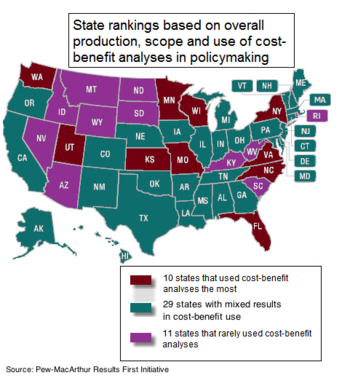
The Pew-MacArthur Results First Initiative is a joint project of the Pew Charitable Trusts and the John D. and Catherine T. MacArthur Foundation that works to partner with states in implementing cost-benefit analysis models.[12]. The initiative released a report in July 2013 concluding that cost-benefit analysis in policymaking led to more effective uses of public funds. Looking at data from 2008 through 2011, the study's authors found that some states were more likely to use cost-benefit analysis, while others were facing challenges and lagging behind the rest of the nation. The challenges states faced included a lack of time, money, and technical skills needed to conduct comprehensive cost-benefit analyses. Ohio was one of 29 states with mixed results regarding the frequency and effectiveness of its use of cost-benefit analysis.[13]
Ethics and transparency
Following the Money report
- See also: "Following the Money" report, 2015
The U.S. Public Interest Research Group, a consumer-focused nonprofit organization based in Washington, D.C., released its annual report on state transparency websites in March 2015. The report, entitled "Following the Money," measured how transparent and accountable state websites were with regard to state government spending.[14] According to the report, Ohio received a grade of A+ and a numerical score of 100, indicating that Ohio was "Leading" in terms of transparency regarding state spending.[14]
Open States Transparency
The Sunlight Foundation released an "Open Legislative Data Report Card" in March 2013. Ohio was given a grade of B in the report. The report card evaluated how adequate, complete, and accessible legislative data was to the general public. A total of 10 states received an A: Arkansas, Connecticut, Georgia, Kansas, New Hampshire, New York, North Carolina, Texas, Virginia, and Washington.[15]
Dual employment and financial disclosure requirements
State ethics regulations regarding dual public employment and income disclosure for legislators vary across the United States. A January 2015 report by the National Council of State Legislatures (NCSL) concluded that legislators in 33 states are not permitted to maintain additional paid government employment during their terms in office.[16] The NCSL published a report in June 2014 that counted 47 states with disclosure requirements for outside income, business associations, and property holdings. The exceptions to these disclosure categories were Idaho, Michigan, and Vermont.[17] Click show on the right side of the table below to compare state policies:
| Ethics regulations for state legislators | ||
|---|---|---|
| State | Allows additional paid public employment? | Requires disclosure of financial interests? |
| Alabama | ||
| Alaska | ||
| Arizona | ||
| Arkansas | ||
| California | ||
| Colorado | ||
| Connecticut | ||
| Delaware | ||
| Florida | ||
| Georgia | ||
| Hawaii | ||
| Idaho | ||
| Illinois | ||
| Indiana | ||
| Iowa | ||
| Kansas | ||
| Kentucky | ||
| Louisiana | ||
| Maine | ||
| Maryland | ||
| Massachusetts | ||
| Michigan | ||
| Minnesota | ||
| Mississippi | ||
| Missouri | ||
| Montana | ||
| Nebraska | ||
| Nevada | ||
| New Hampshire | ||
| New Jersey | ||
| New Mexico | ||
| New York | ||
| North Carolina | ||
| North Dakota | ||
| Ohio | ||
| Oklahoma | ||
| Oregon | ||
| Pennsylvania | ||
| Rhode Island | ||
| South Carolina | ||
| South Dakota | ||
| Tennessee | ||
| Texas | ||
| Utah | ||
| Vermont | ||
| Virginia | ||
| Washington | ||
| West Virginia | ||
| Wisconsin | ||
| Wyoming | ||
Redistricting
- See also: Redistricting in Ohio
The Ohio Apportionment Board is responsible for legislative redistricting. It is composed of 5 members: the Governor, State Auditor, Secretary of State, and two members selected by the legislative leaders of the two major parties.
2010 census
Ohio received its 2010 local census data in early March 2011. Although the state population showed net growth, Ohio's large cities recorded significant population loss. Of the state's five largest cities only Columbus showed population growth. Cleveland suffered the sharpest decline, losing 17.1% of its population.[18]
The Ohio Legislative Task Force on Redistricting, Reapportionment, and Demographic Research assisted the General Assembly and Ohio Apportionment Board in drafting new maps. Four of the five members of the Board were Republicans. By a vote of 4-1 they gave final approval to new maps on September 28, 2011 - two days after posting them online. The lone Democrat on the Board, Rep. Armond Budish, opposed the maps, saying the plan "quarantines" Democrats in 1/3 of the legislative districts.[19]
On January 4, 2012, Democrats filed suit against the legislative maps, saying they violated constitutional requirements for compactness and preservation of county and municipal boundaries. The Ohio Supreme Court took the case but, due to the time factor, ruled the new maps would stand for the 2012 elections, with possible revisions to apply starting in 2014.[20]
Term limits
Republican activists, led by Fred A. Lennon, began pursuing term limits in the 1980s. In 1992, a referendum set term limits of eight consecutive years -- four consecutive terms in the house and two consecutive terms in the senate. Terms are considered consecutive if they are separated by less than four years.
Chambers
State Senate
The Ohio State Senate is the upper house in Ohio's legislature. Members of the Ohio Senate are limited to two consecutive four-year elected terms. Service to fill out another member's uncompleted term does not count against the state's term limits. There are 33 members elected from individual districts. The current party distribution is 21 Republicans and 12 Democrats. Each member represented an average of 349,591 residents, as of the 2010 Census.[21] After the 2000 Census, each member represented 344,035.[22] Each Senate district corresponds exactly to 3 of the 99 State House districts.
| As of December 2025 | ||
|---|---|---|
| Party | Members | |
| Democratic | 9 | |
| Republican | 24 | |
| Other | 0 | |
| Vacancies | 0 | |
| Total | 33 | |
The chart below shows the partisan composition of the Ohio State Senate from 1992 to 2013.

State House
The Ohio House of Representatives is the lower house of Ohio's legislature. The House first met in Chillicothe on March 3 1803, under the later superseded constitution of that year. The 127th General Assembly convened in January 2007. There are 99 members of the house, elected from single-member districts. Every even-numbered year, all the seats are up for re-election. The current party distribution is 59 Republicans and 40 Democrats. Each member represented an average of 116,530 residents, as of the 2010 Census.[21] After the 2000 Census, each member represented 114,678.[22]
| As of December 2025 | ||
|---|---|---|
| Party | Members | |
| Democratic | 34 | |
| Republican | 65 | |
| Other | 0 | |
| Vacancies | 0 | |
| Total | 99 | |
The chart below shows the partisan composition of the Ohio State House of Representatives from 1992 to 2013.

Veto overrides

- See also: Veto overrides in state legislatures
State legislatures can override governors' vetoes. Depending on the state, this can be done during the regular legislative session, in a special session following the adjournment of the regular session, or during the next legislative session. The rules for legislative overrides of gubernatorial vetoes in Ohio are listed below.
How many legislators are required to vote for an override? Three-fifths of members in both chambers.
| Three-fifths of members in both chambers must vote to override a veto, which is 60 of the 99 members in the Ohio House of Representatives and 20 of the 33 members in the Ohio State Senate. Ohio is one of seven states that requires a three-fifths vote from both of its legislative chambers to override a veto. |
Are there other special rules?
| If the governor vetoes an emergency measure, two-thirds of the members in both chambers are required to override the veto, which is 66 of the 99 state representatives and 22 of the 33 state senators.[23] |
Authority: Article II, Section 16 of the Ohio Constitution.
| "If the governor approves an act, he shall sign it, it becomes law and he shall file it with the secretary of state. If he does not approve it, he shall return it with his objections in writing, to the house in which it originated, which shall enter the objections at large upon its journal, and may then reconsider the vote on its passage. If three-fifths of the members elected to the house of origin vote to repass the bill, it shall be sent, with the objections of the governor, to the other house, which may also reconsider the vote on its passage. If three fifths of the members elected to the second house vote to repass it, it becomes law notwithstanding the objections of the governor, and the presiding officer of the second house shall file it with the secretary of state." |
Legislators
Salaries
- See also: Comparison of state legislative salaries
| State legislative salaries, 2025[24] | |
|---|---|
| Salary | Per diem |
| $72,343/year | No per diem is paid during session. |
When sworn in
Ohio legislators assume office January 1st.
History
The second Ohio Constitution, effective in 1851, took away the power of the General Assembly to choose the state's executive's officers, granting that right to the voters. A complicated formula apportioned legislators to Ohio counties and the number of seats in the legislative houses varied from year-to-year.
The Ohio Politics Almanac by Michael F. Curtin (Kent State University Press) described apportionment thus:
- The new [1851] constitution ... contained a complicated formula for apportionment, the so-called "major fraction rule." Under it, the state's population was divided by 100, with the resulting quotient being the ratio of representation in the House of Representatives. Any county with a population equal to at least half the ratio was entitled to one representative; a county with a population of less than half the ratio was grouped with an adjacent county for districting; a county containing a population of at least one and three-fourths the ratio was entitled to two representatives; a county with a population equal to three times the ratio was entitled to three representatives. To determine Senate districts, a similar procedure was followed; the starting point, however was figured by dividing the state's population by 35. The ratios for the House and Senate and the resulting apportionment was determined by a board consisting of the governor, auditor, and secretary of state.
In 1903, the apportionment system was modified by the Hanna amendment, which also gave the governor veto power over the assembly's acts, which could be overridden by a two-thirds vote of the assembly's houses. The last state constitutional convention, held in 1912, gave the governor a line-item veto, but reduced the supermajority required for overriding the veto to three-fifths. In 1956, a referendum increased the terms of state senators from two to four years.
The Hanna amendment (which guaranteed each county at least one representative and all members elected at large) guaranteed that rural areas of Ohio would dominate the legislature by giving them disproportionate representation. Several decisions by the U.S. Supreme Court in the 1960s, however, mandated apportionment proportional to population. Reapportionment was ordered in 1964. Starting with the 1966 election, the number of seats in the two chambers were fixed at their present numbers of 33 and 99.
Partisan balance 1992-2013


Ohio State Senate: During every year from 1992-2013, the Republican Party was the majority in the Ohio State Senate. The Ohio State Senate is one of 13 state senates that was Republican for more than 80 percent of the years between 1992-2013. Ohio was under Republican trifectas for the final three years of the study period.
Across the country, there were 541 Democratic and 517 Republican state senates from 1992 to 2013.
Ohio State House of Representatives: From 1992-2013, the Republican Party was the majority in the Ohio State House of Representatives for 17 years while the Democrats were the majority for five years. Ohio was under Republican trifectas for the final three years of the study period.
Across the country, there were 577 Democratic and 483 Republican State Houses of Representatives from 1992 to 2013.
Over the course of the 22-year study, state governments became increasingly more partisan. At the outset of the study period (1992), 18 of the 49 states with partisan legislatures had single-party trifectas and 31 states had divided governments. In 2013, only 13 states had divided governments, while single-party trifectas held sway in 36 states, the most in the 22 years studied.
The chart below shows the partisan composition of the Office of the Governor of Ohio, the Ohio State Senate and the Ohio House of Representatives from 1992 to 2013.
.PNG)
SQLI and partisanship
- To read the full report on the State Quality of Life Index (SQLI) in PDF form, click here.
The chart below depicts the partisanship of the Ohio state government and the state's SQLI ranking for the years studied. For the SQLI, the states were ranked from 1-50, with 1 being the best and 50 the worst. Ohio had Republican trifectas during most of the years of the study, from 1995-2006 and from 2011-2013. The state's highest SQLI ranking, finishing 20th, occurred in 1997 during a Republican trifecta. Its lowest ranking, finishing 38th, occurred from 2008-2010 during a divided government.

Joint legislative committees
- See also: Public policy in Ohio
There are eight joint legislative committees in the Ohio State Legislature.
- Correctional Institution Inspection Committee
- Joint Committee on Agency Rule Review
- Joint Education Oversight Committee
- Joint Legislative Ethics Committee
- Joint Medicaid Oversight Committee
- Legislative Service Commission
- Ohio Constitutional Modernization Commission
- State Controlling Board
See also
- Ohio
- Ohio House of Representatives
- Ohio State Senate
- Ohio state legislative districts
- State legislative scorecards in Ohio
- Governor of Ohio
- Ohio Constitution
External links
Footnotes
- ↑ Multistate, "2020 Legislative Session Dates," accessed March 20, 2020
- ↑ The Ohio Legislature, "Session Schedule," accessed April 28, 2020
- ↑ News-Herald, "Anti-abortion bills, medical pot on Ohio lawmakers’ 2016 agenda," accessed January 6, 2016
- ↑ Cleveland.com, "Fireworks bill extinguished on last day of Ohio legislative session," accessed January 5, 2016
- ↑ www.stowsentry.com, "Minimum wage, Medicaid among priorities for Ohio Senate Democrats," January 21, 2015
- ↑ www.cleveland.com, "Ohio lawmakers' 2014 agenda includes budget changes, tax overhauls," accessed January 10, 2014
- ↑ The Columbus Dispatch, "Ohio Senate’s new leader brings aggressive style," January 6, 2013
- ↑ National Conference of State Legislatures, "2011 Legislative Sessions Calendar," accessed June 6, 2014(Archived)
- ↑ National Conference of State Legislatures, "2010 Legislative Sessions Calendar," accessed June 19, 2014(Archived)
- ↑ 10.0 10.1 10.2 National Association of State Budget Officers, "Budget Processes in the States, Spring 2021," accessed January 24, 2023
- ↑ National Conference of State Legislatures, "Separation of Powers: Executive Veto Powers," accessed January 26, 2024
- ↑ Pew Charitable Trusts, "State Work," accessed June 6, 2014
- ↑ Pew Charitable Trusts, "States’ Use of Cost-Benefit Analysis," July 29, 2013
- ↑ 14.0 14.1 U.S. Public Interest Research Group, "Following the Money 2015 Report," accessed April 4, 2016
- ↑ Sunlight Foundation, "Ten Principles for Opening Up Government Information," accessed June 16, 2013
- ↑ National Council of State Legislatures, "Dual employment: regulating public jobs for legislators - 50 state table," January 2015
- ↑ National Council of State Legislatures, "Ethics: personal financial disclosure for state legislators: income requirements," June 2014
- ↑ Examiner.com, "4 of 5 big Ohio cities, counties lose people, Whites still dominate, Census says," March 10, 2011
- ↑ The Columbus Dispatch, "Reapportionment: Maps tilt Ohio more to GOP," September 24, 2011
- ↑ Daily Jeffersonian, "No Ohio Redistricting Decision Before Election," February 19, 2012
- ↑ 21.0 21.1 census.gov, "Population Distribution and Change: 2000 to 2010," accessed May 15, 2014
- ↑ 22.0 22.1 U.S. Census Bureau, "States Ranked by Population: 2000," April 2, 2001
- ↑ National Conference of State Legislatures, "The Veto Process," accessed June 22, 2017
- ↑ National Conference of State Legislatures, "2025 Legislator Compensation," December 2, 2025

 |
State of Ohio Columbus (capital) |
|---|---|
| Elections |
What's on my ballot? | Elections in 2025 | How to vote | How to run for office | Ballot measures |
| Government |
Who represents me? | U.S. President | U.S. Congress | Federal courts | State executives | State legislature | State and local courts | Counties | Cities | School districts | Public policy |


