

New Mexico State Legislature
| New Mexico State Legislature | |
 | |
| General information | |
| Type: | State legislature |
| Term limits: | None |
| Session start: | January 20, 2026 |
| Website: | Official Legislature Page |
| Leadership | |
| Senate President: | Howie Morales (D) |
| House Speaker: | Javier I. Martínez (D) |
| Majority Leader: | Senate: Peter Wirth (D) House: Reena Szczepanski (D) |
| Minority Leader: | Senate: William Sharer (R) House: Gail Armstrong (R) |
| Structure | |
| Members: | 42 (Senate), 70 (House) |
| Length of term: | 4 years (Senate), 2 years (House) |
| Authority: | Art IV, Section 3, New Mexico Constitution |
| Salary: | $0/year + per diem |
| Elections | |
| Last election: | November 5, 2024 |
| Next election: | November 3, 2026 |
| Redistricting: | New Mexico Legislature has control |
The New Mexico Legislature is the legislative branch of New Mexico. It is a bicameral body made up of the New Mexico House of Representatives and the New Mexico Senate.
The legislature consists of 70 representatives and 42 senators. Senators are elected to four-year terms and representatives are elected to two-year terms.
New Mexico has a Democratic state government trifecta. A trifecta exists when one political party simultaneously holds the governor’s office and majorities in both state legislative chambers. As of January 30, 2026, there are 23 Republican trifectas, 14 Democratic trifectas, and 13 divided governments where neither party holds trifecta control.
In the 2020 election, Republicans had a net gain of two trifectas and two states under divided government became trifectas. Prior to that election, New Mexico had a Democratic trifecta. There were 21 Republican trifectas, 15 Democratic trifectas, and 14 divided governments.
Elections
2020
Elections for the office of New Mexico State Senate took place in 2020. The general election was held on November 3, 2020. A primary was scheduled for June 2, 2020. The filing deadline was March 10, 2020.
Elections for the office of New Mexico House of Representatives took place in 2020. The general election was held on November 3, 2020. A primary was scheduled for June 2, 2020. The filing deadline was March 10, 2020.
Sessions
Article IV of the New Mexico Constitution establishes when the Legislature is to be in session. Section 5 of Article IV states that the Legislature is to convene its annual regular session on the third Tuesday of January. In odd-numbered years, the Legislature is to be in session for no longer than sixty days. In even-numbered years, the Legislature is to be in session for no longer than thirty days. In even-numbered years, the Legislature is limited to dealing with budgetary matters, bills that deal with issues raised by special messages of the Governor of New Mexico, and bills vetoed in the previous session by the Governor.
Section 6 of Article IV allows the Governor of New Mexico to call special sessions of the Legislature. Section 6 also allows the Legislature to meet in special session when three-fifths of each house petition the Governor with a request for a special session. Special sessions are not to exceed thirty days in length.
2025
In 2025, the legislature was scheduled to convene on January 21, 2025, and adjourn on March 22, 2025.
| Click [show] for past years' session dates. | |||||
|---|---|---|---|---|---|
2024In 2024, the legislature was scheduled to convene on January 16, 2024, and adjourn on February 15, 2024. 2023In 2023, the legislature was scheduled to convene on January 17, 2023, and adjourn on March 18, 2023. 2022In 2022, the legislature was scheduled to convene on January 18, 2022, and adjourn on February 17, 2022. 2021In 2021, the legislature was scheduled to convene on January 19, 2021, and adjourn on March 20, 2021. 2020In 2020, the legislature was scheduled to convene on January 21, 2020, and adjourn on February 20, 2020.
Several state legislatures had their sessions impacted as a result of the 2020 coronavirus pandemic. 2019In 2019, the legislature was in session from January 15, 2019, through March 16, 2019. 2018In 2018, the legislature was in session from January 16, 2018, through February 15, 2018. To read about notable events and legislation from this session, click here. 2017
In 2017, the legislature was in session from January 17, 2017, through March 18, 2017. A special session was held from May 24 to May 30 to address the budget dispute between Gov. Susana Martinez (R) and the legislature.
2016
In 2016, the legislature was in session from January 19 through February 18. 2015
In 2015, the legislature was in session from January 20 through March 21. A one-day special session took place on June 8.[3] Major issues in 2015Major issues during the 2015 legislative session included making New Mexico a right-to-work state, repeal of drivers licenses for the undocumented, and an increase in the minimum wage.[4] 2014
In 2014, the legislature was in session from January 21 through February 20. Major issues in 2014Major issues during the 2014 legislative session included the economy, the budget, infrastructure, and education.[5] 2013
In 2013, the legislature was in session from January 15 to March 16. Major issues in 2013Major issues in the 2013 legislative session included education, solvency of the state's public retirement system, tax cuts for state businesses, and tougher anti-DWI laws.[6] 2012
In 2012, the legislature was in session from January 17 through February 16. Major issues in 2012In their 30-day session the legislature considered drivers licenses for illegal immigrants, voter identification, business income tax, ethics reform, and defining homeowner rights in foreclosure proceedings.[7] Gov. Susana Martinez (R) watched as the state legislature ended its session by rejecting a bill that would have repealed the law allowing drivers licenses to be issued to people without Social Security numbers. It was the third time she tried to undo the law. The bill was initially passed by the House but defeated in the Senate. The Senate instead passed a measure shortening how long the licenses are valid and imposing harsher penalties on those committing fraud.[8] 2011In 2011, the legislature was in session from January 18 through March 19.[9] 2010In 2010, the legislature was in session from January 19 to February 18. Additionally, the legislature convened a special session from March 1 to March 4.[10] |

Role in state budget
- See also: New Mexico state budget and finances
New Mexico on 
|
New Mexico operates on an annual budget cycle, with each fiscal year beginning in July. The sequence of key events in the budget process is as follows:[11]
- Budget instructions are sent to state agencies by June 15.
- State agencies submit their budget requests by September 1.
- Public hearings are held from September through December.
- The governor submits his or her budget proposal to the New Mexico State Legislature on January 5 or January 10.
- The legislature adopts a budget in February or March. A simple majority is required to pass a budget.
New Mexico is one of 44 states in which the governor has line item veto authority.[11][12]
The governor is statutorily required to submit a balanced budget. Likewise, the legislature is statutorily required to pass a balanced budget.[11]
Cost-benefit analyses
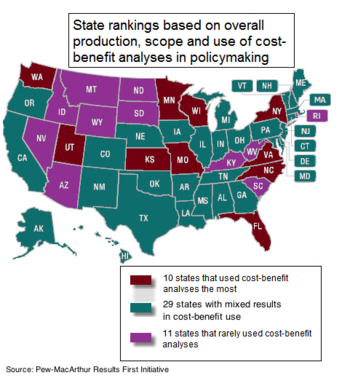
The Pew-MacArthur Results First Initiative is a joint project of the Pew Charitable Trusts and the John D. and Catherine T. MacArthur Foundation that works to partner with states in implementing cost-benefit analysis models.[13]. The initiative released a report in July 2013 concluding that cost-benefit analysis in policymaking led to more effective uses of public funds. Looking at data from 2008 through 2011, the study's authors found that some states were more likely to use cost-benefit analysis, while others were facing challenges and lagging behind the rest of the nation. The challenges states faced included a lack of time, money, and technical skills needed to conduct comprehensive cost-benefit analyses. New Mexico was one of 29 states with mixed results regarding the frequency and effectiveness of its use of cost-benefit analysis.[14]
Ethics and transparency
Following the Money report
- See also: "Following the Money" report, 2015
The U.S. Public Interest Research Group, a consumer-focused nonprofit organization based in Washington, D.C., released its annual report on state transparency websites in March 2015. The report, entitled "Following the Money," measured how transparent and accountable state websites were with regard to state government spending.[15] According to the report, New Mexico received a grade of C+ and a numerical score of 77, indicating that New Mexico was "Middling" in terms of transparency regarding state spending.[15]
Open States Transparency
The Sunlight Foundation released an "Open Legislative Data Report Card" in March 2013. New Mexico was given a grade of C in the report. The report card evaluated how adequate, complete, and accessible legislative data was to the general public. A total of 10 states received an A: Arkansas, Connecticut, Georgia, Kansas, New Hampshire, New York, North Carolina, Texas, Virginia, and Washington.[16]
Dual employment and financial disclosure requirements
State ethics regulations regarding dual public employment and income disclosure for legislators vary across the United States. A January 2015 report by the National Council of State Legislatures (NCSL) concluded that legislators in 33 states are not permitted to maintain additional paid government employment during their terms in office.[17] The NCSL published a report in June 2014 that counted 47 states with disclosure requirements for outside income, business associations, and property holdings. The exceptions to these disclosure categories were Idaho, Michigan, and Vermont.[18] Click show on the right side of the table below to compare state policies:
| Ethics regulations for state legislators | ||
|---|---|---|
| State | Allows additional paid public employment? | Requires disclosure of financial interests? |
| Alabama | ||
| Alaska | ||
| Arizona | ||
| Arkansas | ||
| California | ||
| Colorado | ||
| Connecticut | ||
| Delaware | ||
| Florida | ||
| Georgia | ||
| Hawaii | ||
| Idaho | ||
| Illinois | ||
| Indiana | ||
| Iowa | ||
| Kansas | ||
| Kentucky | ||
| Louisiana | ||
| Maine | ||
| Maryland | ||
| Massachusetts | ||
| Michigan | ||
| Minnesota | ||
| Mississippi | ||
| Missouri | ||
| Montana | ||
| Nebraska | ||
| Nevada | ||
| New Hampshire | ||
| New Jersey | ||
| New Mexico | ||
| New York | ||
| North Carolina | ||
| North Dakota | ||
| Ohio | ||
| Oklahoma | ||
| Oregon | ||
| Pennsylvania | ||
| Rhode Island | ||
| South Carolina | ||
| South Dakota | ||
| Tennessee | ||
| Texas | ||
| Utah | ||
| Vermont | ||
| Virginia | ||
| Washington | ||
| West Virginia | ||
| Wisconsin | ||
| Wyoming | ||
Senate
The New Mexico Senate is the upper house of the New Mexico State Legislature. There are 42 members of the Senate. Each member represented an average of 49,028 residents, as of the 2010 Census.[19] After the 2000 Census, each member represented 43,311.[20] All 42 seats are up for election every four years.
| As of January 2026 | ||
|---|---|---|
| Party | Members | |
| Democratic | 26 | |
| Republican | 16 | |
| Other | 0 | |
| Vacancies | 0 | |
| Total | 42 | |
The chart below shows the partisan composition of the New Mexico State Senate from 1992 to 2013.

House of Representatives
The New Mexico House of Representatives is the lower house of the New Mexico State Legislature. There are 70 members of the House. Each member represented an average of 29,417 residents, as of the 2010 Census.[19] After the 2000 Census, each member represented 25,986.[20]
| As of January 2026 | ||
|---|---|---|
| Party | Members | |
| Democratic | 44 | |
| Republican | 26 | |
| Other | 0 | |
| Vacancies | 0 | |
| Total | 70 | |
The chart below shows the partisan composition of the New Mexico State House of Representatives from 1992 to 2013.

Veto overrides

- See also: Veto overrides in state legislatures
State legislatures can override governors' vetoes. Depending on the state, this can be done during the regular legislative session, in a special session following the adjournment of the regular session, or during the next legislative session. The rules for legislative overrides of gubernatorial vetoes in New Mexico are listed below.
How many legislators are required to vote for an override? Two-thirds of members present in both chambers.
| Two-thirds of members present in both chambers must vote to override a veto. If all members are in attendance, this is 47 of the 70 members in the New Mexico House of Representatives and 28 of the 42 members in the New Mexico State Senate. New Mexico is one of 36 states that requires a two-thirds vote from both of its legislative chambers to override a veto. |
How can vetoes be overridden after the legislature has adjourned?
| Vetoes can be overridden in a special session or when the next regular session convenes, even if an election has occurred. Two-thirds of members in both chambers must agree to call for a special session.[21] |
Authority: Article IV, Section 22 of the New Mexico Constitution.
| "Every bill passed by the legislature shall, before it becomes a law, be presented to the governor for approval. If he approves, he shall sign it, and deposit it with the secretary of state; otherwise, he shall return it to the house in which it originated, with his objections, which shall be entered at large upon the journal; and such bill shall not become a law unless thereafter approved by two-thirds of the members present and voting in each house by yea and nay vote entered upon its journal." |
History
Partisan balance 1992-2013


New Mexico State Senate: During every year from 1992-2013, the Democratic Party was the majority in the New Mexico State Senate. The New Mexico State Senate is 1 of 16 state senates that was Democratic for more than 80 percent of the years between 1992-2013.
Across the country, there were 541 Democratic and 517 Republican state senates from 1992 to 2013.
New Mexico State House of Representatives: During every year from 1992-2013, the Democratic Party was the majority in the New Mexico State House of Representatives. The New Mexico State House of Representatives is one of 18 state Houses that was Democratic for more than 80 percent of the years between 1992-2013.
Across the country, there were 577 Democratic and 483 Republican State Houses of Representatives from 1992 to 2013.
Over the course of the 22-year study, state governments became increasingly more partisan. At the outset of the study period (1992), 18 of the 49 states with partisan legislatures had single-party trifectas and 31 states had divided governments. In 2013, only 13 states had divided governments, while single-party trifectas held sway in 36 states, the most in the 22 years studied.
The chart below shows the partisan composition of the Office of the Governor of New Mexico, the New Mexico State Senate and the New Mexico House of Representatives from 1992 to 2013.
.PNG)
SQLI and partisanship
- To read the full report on the State Quality of Life Index (SQLI) in PDF form, click here.
The chart below depicts the partisanship of the New Mexico state government and the state's SQLI ranking for the years studied. For the SQLI, the states were ranked from 1-50, with 1 being the best and 50 the worst. New Mexico experienced two Democratic trifectas during the years of the study, from 1992-1994 and from 2003-2010. The state finished in the bottom-10 during every year of the study. Its worst ranking, finishing 50th, occurred from 1999-2000, during a divided government. Its best ranking, finishing 41st, occurred in 2008, during a Democratic trifecta.

Redistricting
- See also: Redistricting in New Mexico
The New Mexico Legislature is responsible for redistricting. In 2011, it formed an 18-member interim redistricting committee to make recommendations for the actual redistricting process in the Legislature.
2010 census
New Mexico received its local census data on March 15, 2011. The state grew 13.2 percent from 2000 to 2010, with notable growth in its most populous cities; Albuquerque grew by 21.7 percent, Las Cruces grew by 31.4 percent, Rio Rancho grew by 69.1 percent, Santa Fe grew by 9.2 percent and Roswell grew by 6.8 percent.[22]
At the time of redistricting, Democrats controlled the Legislature while the Governor, Susana Martinez was a Republican. The interim committee reviewed eight House maps and nine Senate maps before the special redistricting session of the Legislature began on September 6, 2011. On September 21, the Senate passed a map on party lines, with the House following the next day. Gov. Martinez vetoed the maps on October 7, leaving a court to resolve the process. By the time new maps were passed, $8 million had been spent.[23]
Legislators
Salaries
- See also: Comparison of state legislative salaries
| State legislative salaries, 2025[24] | |
|---|---|
| Salary | Per diem |
| $0/year | $202/day |
When sworn in
New Mexico legislators assume office January 1st.
Constitutional amendments
The New Mexico legislature has the authority to vote to place proposed constitutional amendments to the New Mexico Constitution on the statewide ballot for approval or rejection by the state's voters. There are five such legislative referrals on the November 4, 2008 ballot in the state.
See also
- New Mexico
- New Mexico House of Representatives
- New Mexico State Senate
- New Mexico state legislative districts
- State legislative scorecards in New Mexico
- Governor of New Mexico
- New Mexico Constitution
External links
Footnotes
- ↑ NY Times, "New Mexico Supreme Court Won't Restore Funds to Legislature," May 11, 2017
- ↑ The Albuquerque Journal, "Lawmakers keep ‘fingers crossed’ as session ends," May 30, 2017
- ↑ timesunion.com, "New Mexico special session ends with capital-spending deal," accessed June 9, 2015
- ↑ University of New Mexico, "New Mexico 2015 Legislative session opens," accessed January 21, 2014
- ↑ www.santafenewmexican.com/, "Issues facing the New Mexico Legislature ," accessed January 21, 2014
- ↑ ABQ Journal, "Legislature: New Members, Old Issues," January 13, 2013
- ↑ Santa Fe New Mexican, "Election-year tension and redrawn districts set stage for political dramas at the Capitol," January 15, 2012(Archived)
- ↑ Latin American Herald Tribune, "Undocumented New Mexicans Can Still Get Driver’s Licenses," February 19, 2012
- ↑ National Conference of State Legislatures, "2011 Legislative Sessions Calendar," accessed June 6, 2014(Archived)
- ↑ New Mexico Legislature, "Session Dates," accessed August 12, 2014
- ↑ 11.0 11.1 11.2 National Association of State Budget Officers, "Budget Processes in the States, Spring 2021," accessed January 24, 2023
- ↑ National Conference of State Legislatures, "Separation of Powers: Executive Veto Powers," accessed January 26, 2024
- ↑ Pew Charitable Trusts, "State Work," accessed June 6, 2014
- ↑ Pew Charitable Trusts, "States’ Use of Cost-Benefit Analysis," July 29, 2013
- ↑ 15.0 15.1 U.S. Public Interest Research Group, "Following the Money 2015 Report," accessed April 4, 2016
- ↑ Sunlight Foundation, "Ten Principles for Opening Up Government Information," accessed June 16, 2013
- ↑ National Council of State Legislatures, "Dual employment: regulating public jobs for legislators - 50 state table," January 2015
- ↑ National Council of State Legislatures, "Ethics: personal financial disclosure for state legislators: income requirements," June 2014
- ↑ 19.0 19.1 census.gov, "Population Distribution and Change: 2000 to 2010," accessed May 15, 2014
- ↑ 20.0 20.1 census.gov, "Census 2000 PHC-T-2. Ranking Tables for States: 1990 and 2000," accessed May 15, 2014
- ↑ Newmexicopolitics.net "New Mexico’s veto problem," June 26, 2017
- ↑ U.S. Census Bureau, "U.S. Census Bureau Delivers New Mexico's 2010 Census Population Totals, Including First Look at Race and Hispanic Origin Data for Legislative Redistricting," accessed August 12, 2014
- ↑ The Republic, "New Mexico's redistricting costs total nearly $8M, exceeding expenses a decade ago," August 2, 2012(Archived)
- ↑ National Conference of State Legislatures, "2025 Legislator Compensation," December 2, 2025


