

U.S. Senate battlegrounds, 2016-present


This page covers U.S. Senate battleground elections since 2016. It includes background information on battlegrounds and how they are selected as well as summaries from each election's analysis.
Click a year below to read analysis from that year:
Background
Battlegrounds are elections that Ballotpedia expects to have a meaningful effect on the balance of power in governments or to be particularly competitive or compelling. These races receive additional coverage and emphasis on Ballotpedia. This page explains how we define battlegrounds and lists those we have identified since 2017.
Factors for determining the competitiveness of a race include the following:
- Electoral history of the jurisdiction (be it a school district, city, congressional district, or state)
- Whether it is an open-seat race (if the incumbent is not seeking re-election)
- If a notable challenger enters a race
- Race ratings (for U.S. House, U.S. Senate, and gubernatorial elections)
- Polling results
Many factors in addition to and beyond competitiveness may make a race particularly compelling or meaningful to the balance of power in governments. These include the following:
- For primary elections, whether the race features significant intra-party conflict
- Whether the result may have an effect on redistricting
- Whether the result stands to influence trifecta or triplex status for state-level races (state executives and state legislatures)
- If the election occurs alongside a noteworthy event, such as changes to district lines or campaign finance laws
- Whether the race stands to influence which faction or party controls a city council, school board, mayorship, state executive office, state legislature, chamber of Congress, or other governing body/office
- If the race has attracted significant levels of satellite spending or endorsements from influencers
2024
- See also: U.S. Senate battlegrounds, 2024
Elections for 34 U.S. Senate seats took place in 2024. Thirty-three of those seats were up for regular election, and one[1] was up for a special election. Ahead of the November election, Democrats had a majority in the U.S. Senate, controlling 51 seats[2] to Republicans' 49.
Ballotpedia identified 12 races as general election battlegrounds in 2024.
The following map displays all states that held U.S. Senate elections in 2024 shaded by the incumbent's or most recent incumbent's political affiliation. Battleground races are highlighted in lighter colors. Hover over a state for more information.
| Battleground U.S. Senate elections, 2024 | |||||
|---|---|---|---|---|---|
| State | Incumbent | Open seat? | 2018 margin | 2024 margin | 2020 presidential margin |
| Arizona |  Kyrsten Sinema Kyrsten Sinema |
Yes | D+2.4[3] | D+2.2 | D+0.3 |
| California |  Laphonza Butler Laphonza Butler |
Yes | N/A[4] | D+19.6 | D+29.2 |
| Florida |  Rick Scott Rick Scott |
No | R+0.2 | R+12.8 | R+3.3 |
| Maryland | Ben Cardin |
Yes | D+34.6 | D+7.8 | D+33.2 |
| Michigan | Debbie Stabenow |
Yes | D+6.5 | D+0.3 | D+2.8 |
| Montana | Jon Tester |
No | D+3.5 | R+8.4 | R+16.4 |
| Nebraska | Deb Fischer |
No | R+19.1 | R+4.6 | R+19 |
| Nevada | Jacky Rosen |
No | D+5 | D+1.3 | D+2.4 |
| New Jersey | Bob Menendez Sr. |
Yes | D+11.2 | D+9.9 | D+15.9 |
| New Mexico | Martin Heinrich |
No | D+10.8 | D+8.8 | D+15.9 |
| Ohio | Sherrod Brown |
No | D+6.8 | R+3.8 | R+8.1 |
| Pennsylvania | Bob Casey |
No | D+13.1 | R+0.2 | D+1.2 |
| Texas | Ted Cruz |
No | R+2.6 | R+9.8 | R+5.6 |
| Virginia | Tim Kaine |
No | D+16 | D+7.6 | 10.1 |
| Wisconsin | Tammy Baldwin |
No | D+10.8 | D+0.9 | D+0.7 |
Click here to read more about 2024 U.S. Senate battleground elections.
2022
- See also: U.S. Senate battlegrounds, 2022
Elections for 34 U.S. Senate seats took place in 2022.[5]
Following the 2020 Senate elections and the January 2021 runoffs in Georgia, Democrats and Republicans split the chamber 50-50. This gave Vice President Kamala Harris (D) a tie-breaking vote, and Democrats control of the U.S. Senate via a power-sharing agreement.
Ballotpedia identified 12 races as general election battlegrounds. Of the 12 seats, four had Democratic incumbents and eight had Republican incumbents heading into the election.
The following map displays all states that held U.S. Senate elections in 2022 shaded by the incumbent's or most recent incumbent's political affiliation. Battleground races are highlighted in brighter colors. Hover over a state for more information.
| Battleground U.S. Senate elections, 2022 | |||||
|---|---|---|---|---|---|
| State | Incumbent | Open seat? | 2016 margin | 2020 presidential margin | |
| Alaska | Lisa Murkowski |
No | R+15.2 | R+10.0 | |
| Arizona | Mark Kelly |
No | D+2.4 | D+0.3 | |
| Florida | Marco Rubio |
No | R+7.7 | R+3.3 | |
| Georgia | Raphael Warnock |
No | D+2.1 | D+0.2 | |
| Missouri | Roy Blunt |
Yes | R+2.8 | R+15.4 | |
| Nevada | Catherine Cortez Masto |
No | D+2.4 | D+2.4 | |
| New Hampshire | Maggie Hassan |
No | D+0.1 | D+7.3 | |
| North Carolina | Richard Burr |
Yes | R+5.7 | R+1.3 | |
| Ohio | Rob Portman |
Yes | R+20.8 | R+8.1 | |
| Pennsylvania | Pat Toomey |
Yes | R+1.5 | D+1.2 | |
| Utah | Mike Lee |
No | R+41.0 | R+20.5 | |
| Wisconsin | Ron Johnson |
No | R+3.4 | D+0.7 | |
Click here to read more about 2022 U.S. Senate battleground elections.
2020
- See also: U.S. Senate battlegrounds, 2020
Elections for 35 U.S. Senate seats took place in 2020.[6] Democrats won control of the U.S. Senate in the 2020 elections, winning a net three seats.
Ballotpedia identified 16 races as general election battlegrounds. Of the 16 seats, four had Democratic incumbents and 12 had Republican incumbents heading into the election.
The following map displays the 2020 Senate battlegrounds shaded by the incumbent's or most recent incumbent's political affiliation. Hover over a state for more information.
| Battleground U.S. Senate elections, 2020 | ||||||
|---|---|---|---|---|---|---|
| State | Incumbent | Open seat? | 2014 margin | 2016 presidential margin | 2020 election result | |
| Alabama | Doug Jones |
No | R+94.5 | R+27.7 | R+20.4 | |
| Arizona (special) | Martha McSally |
No | R+13.0[7] | R+3.5 | D+2.4 | |
| Colorado | Cory Gardner |
No | R+1.9 | D+4.9 | D+9.3 | |
| Georgia | David Perdue |
No | R+7.7 | R+5.2 | D+1.2 | |
| Georgia (special) | Kelly Loeffler |
No | R+13.8[8] | R+5.2 | D+2.0 | |
| Iowa | Joni Ernst |
No | R+8.3 | R+9.4 | R+6.5 | |
| Kansas | Pat Roberts |
Yes | R+10.6 | R+20.6 | R+11.4 | |
| Kentucky | Mitch McConnell |
No | R+15.5 | R+29.8 | R+19.6 | |
| Maine | Susan Collins |
No | R+36.2 | D+3.0 | R+8.6 | |
| Michigan | Gary Peters |
No | D+13.3 | R+0.2 | D+1.7 | |
| Minnesota | Tina Smith |
No | D+10.2 | D+1.5 | D+5.2 | |
| Montana | Steve Daines |
No | R+17.7 | R+20.5 | R+10.0 | |
| New Hampshire | Jeanne Shaheen |
No | D+3.2 | D+0.4 | D+15.6 | |
| North Carolina | Thom Tillis |
No | R+1.6 | R+3.7 | R+1.8 | |
| South Carolina | Lindsey Graham |
No | R+17.7 | R+14.2 | R+10.2 | |
| Texas | John Cornyn |
No | R+27.2 | R+9.0 | R+9.6 | |
Click here to read more about 2020 U.S. Senate battleground elections.
2018
- See also: U.S. Senate battlegrounds, 2018
Thirty-five U.S. Senate seats, including two in special elections, were up for election on November 6, 2018.
Ballotpedia designated 16 of these 35 races as general election battlegrounds. The primary factors for determining which states were likely to be competitive were the vote margins from previous statewide elections as well as how the state voted in the most recent presidential elections. Other factors were also considered, such as whether a seat was open or if a particularly strong challenger had entered the race.
Democrats won nine of the battleground races and Republicans won seven. Following the 2018 midterm elections, the Republican Party expanded their majority by two and controlled 53 seats in the chamber, Democrats controlled 45 seats, and independents in Maine and Vermont who caucus with the Democrats held two seats.
Click here for more of Ballotpedia's coverage of U.S. Senate battleground races in 2018. The following map displays which Senate seats were up for election in 2018 and identifies those races that were considered battleground elections. Mouse over a state for more detailed information.
| Results of United States Senate battlegrounds, 2018 | ||||
|---|---|---|---|---|
| State | Incumbent | Winner | Partisan change | Incumbent status |
| Arizona | Jeff Flake |
Kyrsten Sinema |
Yes | Incumbent didn't seek re-election |
| California | Dianne Feinstein |
Dianne Feinstein |
No | Won |
| Florida | Bill Nelson |
Rick Scott |
Yes | Lost |
| Indiana | Joe Donnelly |
Mike Braun |
Yes | Lost |
| Minnesota (special) | Tina Smith |
Tina Smith |
No | Won |
| Missouri | Claire McCaskill |
Josh Hawley |
Yes | Lost |
| Mississippi (special) | Cindy Hyde-Smith |
Cindy Hyde-Smith |
No | Won |
| Montana | Jon Tester |
Jon Tester |
No | Won |
| North Dakota | Heidi Heitkamp |
Kevin Cramer |
Yes | Lost |
| New Jersey | Bob Menendez |
Bob Menendez |
No | Won |
| New Mexico | Martin Heinrich |
Martin Heinrich |
No | Won |
| Nevada | Dean Heller |
Jacky Rosen |
Yes | Lost |
| Ohio | Sherrod Brown |
Sherrod Brown |
No | Won |
| Tennessee | Bob Corker |
Marsha Blackburn |
No | Incumbent didn't seek re-election |
| Texas | Ted Cruz |
Ted Cruz |
No | Won |
| West Virginia | Joe Manchin |
Joe Manchin |
No | Won |
Click here to read more about 2018 U.S. Senate battleground elections.
2016
- See also: U.S. Senate battlegrounds, 2016
Elections were held for 34 of the 100 U.S. Senate seats in 2016. However, in most of those races, the party of the winning candidate was all but decided before anyone even filed to run. Ballotpedia predicted that only nine of those 34 races would be competitive in the general election.
The following map displays which Senate seats were up for election in 2016 and our competitiveness rating for each state.
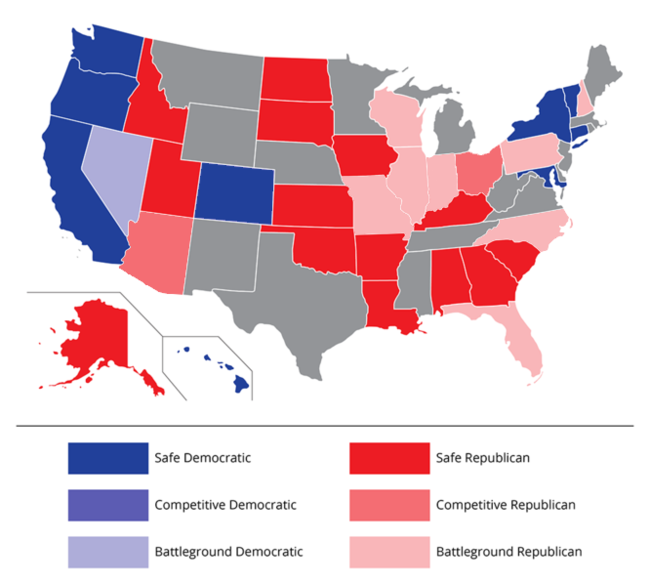
The following table displays the results of the election in each battleground district.
| United States Senate Battleground Results | ||||
|---|---|---|---|---|
| State | Incumbent | Winner | Partisan switch? | Margin of victory |
| Florida | Marco Rubio |
Marco Rubio |
No | 7.7% |
| Illinois | Mark Kirk |
Tammy Duckworth |
Yes | 15.1% |
| Indiana | Dan Coats |
Todd Young |
No | 9.7% |
| Missouri | Roy Blunt |
Roy Blunt |
No | 2.8% |
| Nevada | Harry Reid |
Catherine Cortez Masto |
No | 2.4% |
| New Hampshire | Kelly Ayotte |
Maggie Hassan |
Yes | 0.1% |
| North Carolina | Richard Burr |
Richard Burr |
No | 5.7% |
| Pennsylvania | Pat Toomey |
Pat Toomey |
No | 1.4% |
| Wisconsin | Ron Johnson |
Ron Johnson |
No | 3.4% |
Click here to read more about 2016 U.S. Senate battleground elections.
See also
- Congressional Analysis Archive
- Ballotpedia's Election Analysis Hub, 2024
- ↑ This number does not include the special election for a Senate seat in California, as that seat was also up for regular election.
- ↑ This number includes three independents
- ↑ Sinema won in 2018 as a Democrat.
- ↑ Democratic incumbent Sen. Dianne Feinstein defeated Democrat Kevin De Leon in the general election by a margin of 8.4%.
- ↑ This did not include the special election for the remainder of Kamala Harris' term, which included the final weeks of the 117th Congress.
- ↑ This figure includes 33 seats up for regular election and two seats up for special election.
- ↑ This seat was last up for regular election in 2016. Incumbent John McCain (R) won re-election by a margin of 13.0 percent.
- ↑ This seat was last up for regular election in 2016. Incumbent Johnny Isakson (R) won re-election by a margin of 13.8 percent.

