Mississippi State Senate
| Mississippi State Senate | |
 | |
| General information | |
| Type: | Upper house |
| Term limits: | None |
| Session start: | January 6, 2015 |
| Website: | Official Senate Page |
| Leadership | |
| Senate President: | Tate Reeves (R) |
| Structure | |
| Members: | 52 |
| Democratic Party (13) Republican Party (20) | |
| Length of term: | 4 years |
| Authority: | Art V, Mississippi Constitution |
| Salary: | $10,000./year + per diem |
| Elections | |
| Last election: | November 8, 2011 (52 seats) |
| Next election: | November 3, 2015 (52 seats) |
| Redistricting: | Mississippi Legislature has control |
The Mississippi Senate is the upper house of the Mississippi Legislature. Each member represents an average of 57,063 residents, as of the 2010 Census.[1] After the 2000 Census, each member represented 54,705 residents.[2] There are 52 senators, each serving a district indicated by number. Senators serve four-year terms, without term limits.
Mississippi has a Republican state government trifecta. A trifecta exists when one political party simultaneously holds the governor’s office and majorities in both state legislative chambers. As of February 17, 2026, there are 23 Republican trifectas, 14 Democratic trifectas, and 13 divided governments where neither party holds trifecta control.
In the 2020 election, Republicans had a net gain of two trifectas and two states under divided government became trifectas. Prior to that election, Mississippi had a Republican trifecta. There were 21 Republican trifectas, 15 Democratic trifectas, and 14 divided governments.
Sessions
Article IV of the Mississippi Constitution establishes when the Mississippi State Legislature, of which the Senate is a part, is to meet. Section 36 of Article IV states that the legislature is to convene in regular session on the Tuesday following the first Monday in January of each year. Section 36 limits the length of regular sessions to ninety calendar days, except for once every four years when the regular session can last up to one hundred twenty-five calendar days. The most recent one hundred twenty-five day session was in 2008, and the next session of this kind was in 2012.
Section 36 also allows the Legislature to extend its sessions for thirty days by a two-thirds vote of both legislative houses. There is no limit on the number of times a session can be extended in this way. In 2010, the Legislature extended its session once, moving the date of adjournment from April 3 to May 3.
Article V of the Mississippi Constitution gives the Governor of Mississippi the power to call the Legislature into extraordinary session. Section 121 of Article V enumerates this power.
2015
- See also: Dates of 2015 state legislative sessions
In 2015, the Legislature is projected to be in session from January 6 through April 5.
Major issues
Major issues in the 2015 legislative session include education funding, tax relief and contract reform.[3]
2014
- See also: Dates of 2014 state legislative sessions
In 2014, the Legislature was in session from January 7 through April 2.[4]
Major issues
Major issues in the 2014 legislative session included Common Core, Medicaid expansion, teachers' pay and prison sentences.[5][6][7]
2013
- See also: Dates of 2013 state legislative sessions
In 2013, the Legislature was in session from January 8 through April 4.[8]
Major issues
Major issues in the 2013 legislative session included creating a budget, charter schools and Medicaid expansion.[9]
2012
- See also: Dates of 2012 state legislative sessions
In 2012, the Senate was in session from January 3 through May 3.[10]
2011
In 2011, the Senate was in session from January 4 through April 7.[11]
2010
In 2010, the Senate was originally scheduled to be in session from January 5th to April 3rd. However, the session was extended to May 3rd. Additionally, a special session was held that convened on April 22nd and adjourned on April 23rd.[12]
Role in state budget
- See also: Mississippi state budget and finances
Mississippi on 
|
The state operates on an annual budget cycle. The sequence of key events in the budget process is as follows:[13]
- Budget instructions are sent to state agencies in June of the year preceding the start of the new fiscal year.
- State agencies submit their budget requests to the governor in August.
- The governor submits his or her proposed budget to the state legislature by November 15. This deadline is extended to January 31 for a newly elected governor.
- The legislature typically adopts a budget in March or April. The fiscal year begins July 1.
Mississippi is one of 44 states in which the governor has line item veto authority.[13][14]
The governor is legally required to submit a balanced budget proposal. Likewise, the legislature is legally required to pass a balanced budget.[13]
Cost-benefit analyses
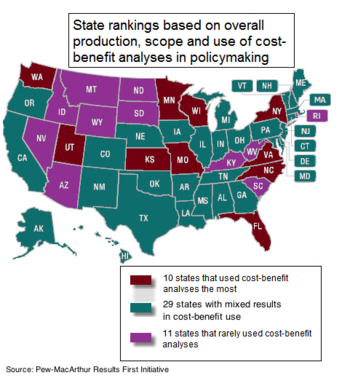
The Pew-MacArthur Results First Initiative is a joint project of the Pew Charitable Trusts and the John D. and Catherine T. MacArthur Foundation that works to partner with states in implementing cost-benefit analysis models.[15]. The initiative released a report in July 2013 concluding that cost-benefit analysis in policymaking led to more effective uses of public funds. Looking at data from 2008 through 2011, the study's authors found that some states were more likely to use cost-benefit analysis, while others were facing challenges and lagging behind the rest of the nation. The challenges states faced included a lack of time, money, and technical skills needed to conduct comprehensive cost-benefit analyses. Mississippi was one of 29 states with mixed results regarding the frequency and effectiveness of its use of cost-benefit analysis.[16]
Ethics and transparency
Following the Money report
- See also: "Following the Money" report, 2014
The U.S. Public Interest Research Group, a consumer-focused nonprofit organization based in Washington, D.C., released its annual report on state transparency websites in April 2014. The report, entitled "Following the Money," measured the transparency and accountability of state websites with regard to state government spending.[17] According to the report, Mississippi received a grade of C+ and a numerical score of 79, indicating that Mississippi was middling in terms of transparency regarding state spending.[17]
Open States Transparency
The Sunlight Foundation released an "Open Legislative Data Report Card" in March 2013. Mississippi was given a grade of B in the report. The report card evaluated how adequate, complete, and accessible legislative data was to the general public. A total of 10 states received an A: Arkansas, Connecticut, Georgia, Kansas, New Hampshire, New York, North Carolina, Texas, Virginia, and Washington.[18]
Elections
All 52 state senate seats come up for re-election every four years in the year that immediately precedes a U.S. Presidential election.[19] Mississippi is one of only four states to hold elections during odd years. While the three other states -- Louisiana, New Jersey and Virginia -- have specific instances that triggered the shift to off-year elections, a reason remains unclear in Mississippi.[20]
To run for the office of state senator, a person must have been a qualified elector of the state for four years, be at least 25 years old, and have been an actual resident of the senate district he or she will represent for at least two years prior to the election. § 42 of Article IV of the Mississippi Constitution governs eligibility.
2011
Elections for the office of Mississippi State Senate consisted of a primary election on August 2, 2011 and a general election on November 2, 2011. All 52 seats were up for election.
During the 2011 election, the total value of contributions to Senate candidates was $4,706,378. The top 10 contributors were:[21]
| 2011 Donors, Mississippi State Senate | |
|---|---|
| Donor | Amount |
| Ross, Knox | $122,706 |
| Mississippi Republican Party | $120,222 |
| Mississippi Hospital Association | $107,000 |
| Mississippi Medical Association | $78,272 |
| Improve Mississippi | $65,436 |
| Mississippi Association Of Realtors | $52,500 |
| Home Builders Association Of Mississippi | $46,000 |
| Mississippi Bankers Association | $45,000 |
| Mississippi Association For Justice | $42,292 |
| W.T. Broistar Trust | $40,000 |
2007
- See also: Mississippi State Senate elections, 2007
Elections for the office of Mississippi State Senate consisted of a primary election on August 7, 2007 and a general election on November 6, 2007. All 52 seats were up for election.
During the 2007 election, the total value of contributions to Senate candidates was $5,740,791. The top 10 contributors were:[22]
| 2007 Donors, Mississippi State Senate | |
|---|---|
| Donor | Amount |
| Lawyers Involved for Mississippi Betterment | $242,696 |
| Mississippi Republican Party | $175,000 |
| Billy Hudson | $120,000 |
| Mississippi Bankers Association | $96,170 |
| Improve Mississippi | $94,540 |
| Mississippi Hospital Association | $94,500 |
| Home Builders Association of Mississippi | $75,700 |
| Mississippi Medical Association | $74,000 |
| Mississippi Association of Realtors | $69,950 |
| AT&T | $53,400 |
2003
- See also: Mississippi State Senate elections, 2003
Elections for the office of Mississippi State Senate consisted of a primary election on August 5, 2003 and a general election on November 4, 2003. All 52 seats were up for election.
During the 2003 election, the total value of contributions to Senate candidates was $3,676,844. The top 10 contributors were:[23]
| 2003 Donors, Mississippi State Senate | |
|---|---|
| Donor | Amount |
| Thomas, J. Dewayne | $107,034 |
| Mississippi Bankers Association | $100,400 |
| Mississippi Medical Association | $86,939 |
| Institute For Consumers & The Environment | $71,998 |
| Dawkins, Craig A. | $58,800 |
| Home Builders Association Of Mississippi | $53,150 |
| Mississippi Association Of Realtors | $51,850 |
| Electric Power Associates Of Mississippi | $48,500 |
| BellSouth | $41,750 |
| Mississippi Power Co. | $38,900 |
Qualifications
In order to run for the Mississippi State Senate, a candidate must:[24]
- Be 25 years of age or older.
- Be a qualified elector and resident of the State of Mississippi for four years.
- Be a resident of the county or district a candidate plans to represent for two years.
- If running as a Republican or Democrat, pay a $15 filing fee to the State Executive Committee of the party with which the candidate is affiliated.
- If running as an independent, submit 50 signatures to the Circuit Clerk or the Secretary of State.
Vacancies
| How vacancies are filled in state legislatures |
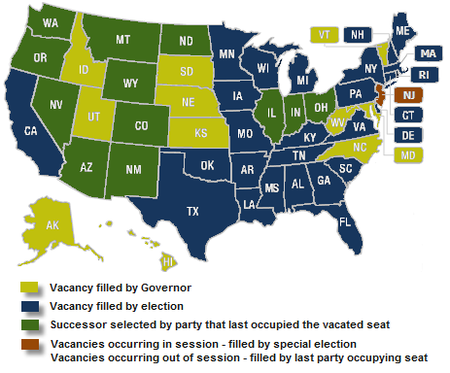 |
If there is a vacancy in the senate, a special election is required to fill the vacant seat. The Governor must call for an election no later than 30 days after the vacancy happened. After the Governor sets the election date, the counties conducting the election must give no less than 45 days public notice. All qualifying deadlines are 30 days before the election.[25]
No special election is held if the vacancy happens after June 1st in an election year.[26]
Constitutional basis
According to the current Mississippi Constitution, the Senate is to be composed of no more than 52 members elected for four-year terms. Elections to the Senate are held on the first Tuesday after the first Monday in November during the state general elections.
The Senate is composed of 52 Senators representing an equal amount of constituent districts, with 54,704 people per district (2000 figures). Like other upper houses of state and territorial legislatures and the U.S. Senate, the Senate can confirm or reject gubernatorial appointments.
Redistricting
- See also: Redistricting in Mississippi
The five-member Standing Joint Reapportionment Committee handles redistricting, with no veto power afforded to the Governor. Should it fail to finalize a plan on time, a backup commission -- composed of the Chief Justice of the Mississippi Supreme Court, the Attorney General, the Secretary of State, and the Majority Leaders of both legislative chambers -- would take over the process. Mississippi is required to have its maps pre-cleared by the Justice Department under the Voting Rights Act.
2010 census
Mississippi received its local census data on February 3, 2011. The state's population grew 4.3 percent, with several of its well-known cities (Jackson, Gulfport, Biloxi) losing as much as 13 percent. Most of the state's population loss was in the north-central region and along the western edge.
Republicans controlled the Legislature and governorship at the time of redistricting. Because Mississippi holds legislative elections in odd-numbered years, the legislature was given a tight deadline -- June 1, 2011 -- for redistricting in time for the 2011 elections while allowing 60 days of review by the DOJ. The deadline passed without a plan, meaning any new maps would not take effect until 2015. Elections were held with the previous maps, and the House passed a new map in April 2012, with the Senate following in May.[27] The House plan included five two-incumbent races.
Senators
Salaries
- See also: Comparison of state legislative salaries
As of 2013, members of the Mississippi legislature are paid $10,000/year. Per diem is $109/day tied to the federal rate.[28]
Partisan composition
- See also: Partisan composition of state senates
| As of February 2026 | ||
|---|---|---|
| Party | Members | |
| Democratic | 18 | |
| Republican | 34 | |
| Other | 0 | |
| Vacancies | 0 | |
| Total | 52 | |
The chart below shows the partisan composition of the Mississippi State Senate from 1992-2013.

When sworn in
Mississippi legislators assume office the first day of the regular session of the year following election. The Constitution requires the Legislature to convene yearly on the Tuesday after the first Monday in January.
Leadership
The Lieutenant Governor of Mississippi acts as President of the Senate and is given the right to cast a vote in the 52 member State Senate in case of a tie.[29]
There are no majority or minority leaders in the Senate.
Current leadership
| Current Leadership, Mississippi State Senate | ||
|---|---|---|
| Office | Representative | Party |
| President of the Senate | Tate Reeves |  Republican Republican
|
| State Senate President Pro Tempore | Terry Burton | Republican
|
Current members

Standing committees
The Mississippi State Senate has thirty-three (33) standing committees:
- Accountability, Efficiency and Transparency Committee, Mississippi State Senate
- Agriculture Committee, Mississippi State Senate
- Appropriations Committee, Mississippi State Senate
- Business and Financial Institutions Committee, Mississippi State Senate
- Constitution Committee, Mississippi State Senate
- Corrections Committee, Mississippi State Senate
- County Affairs Committee, Mississippi State Senate
- Drug Policy Committee, Mississippi State Senate
- Economic Development Committee, Mississippi State Senate
- Education Committee, Mississippi State Senate
- Elections Committee, Mississippi State Senate
- Energy Committee, Mississippi State Senate
- Environmental Protection, Conservation and Water Resources Committee, Mississippi State Senate
- Ethics Committee, Mississippi State Senate
- Finance Committee, Mississippi State Senate
- Forestry Committee, Mississippi State Senate
- Highways and Transportation Committee, Mississippi State Senate
- Housing Committee, Mississippi State Senate
- Insurance Committee, Mississippi State Senate
- Interstate and Federal Cooperation Committee, Mississippi State Senate
- Judiciary, Division A Committee, Mississippi State Senate
- Judiciary, Division B Committee, Mississippi State Senate
- Labor Committee, Mississippi State Senate
- Local and Private Committee, Mississippi State Senate
- Municipalities Committee, Mississippi State Senate
- Ports and Marine Resources Committee, Mississippi State Senate
- Public Health and Welfare Committee, Mississippi State Senate
- Public Property Committee, Mississippi State Senate
- Rules Committee, Mississippi State Senate
- Tourism Committee, Mississippi State Senate
- Universities and Colleges Committee, Mississippi State Senate
- Veterans and Military Affairs Committee, Mississippi State Senate
- Wildlife, Fisheries and Parks Committee, Mississippi State Senate
History
Partisan balance 1992-2013


From 1992-2013, the Democratic Party was the majority in the Mississippi State Senate for 18 years while the Republicans were the majority for four years. The Mississippi State Senate is 1 of 16 state senates that was Democratic for more than 80 percent of the years between 1992-2013. The final three years of the study depicted a shift in the Mississippi senate to the Republican party with the last two years being Republican trifectas.
Across the country, there were 541 Democratic and 517 Republican state senates from 1992 to 2013.
Over the course of the 22-year study, state governments became increasingly more partisan. At the outset of the study period (1992), 18 of the 49 states with partisan legislatures had single-party trifectas and 31 states had divided governments. In 2013, only 13 states had divided governments, while single-party trifectas held sway in 36 states, the most in the 22 years studied.
The chart below shows the partisan composition of the Office of the Governor of Mississippi, the Mississippi State Senate and the Mississippi House of Representatives from 1992-2013.
.PNG)
SQLI and partisanship
The chart below depicts the partisanship of the Mississippi state government and the state's SQLI ranking for the years studied. For the SQLI, the states were ranked from 1-50, with 1 being the best and 50 the worst. Mississippi has consistently ranked in the bottom-2 of the SQLI ranking regardless of a trifecta or a divided government. The state has been ranked in the last place for fifteen separate years and ranked 49th six separate years. Mississippi had two trifecta, both Democratic and Republican, between 2000 and 2004 and in 2012, respectively.
- SQLI average with Democratic trifecta: 49.75
- SQLI average with Republican trifecta: 50
- SQLI average with divided government: 49.69

See also
- Mississippi
- Mississippi House of Representatives
- Governor of Mississippi
- Mississippi State Legislature
- Mississippi Constitution
External links
- Mississippi Legislature official website
- Official list of Mississippi State Senators
- Wikipedia: Mississippi Legislature
References
- ↑ U.S. Census Bureau, "Population Distribution and Change: 2000 to 2010," April 2011
- ↑ U.S. Census Bureau, "States Ranked by Population," April 2, 2001
- ↑ Mississippi Watchdog, "Plenty of issues for Mississippi Legislature to tackle in 2015," January 2, 2015
- ↑ StateScape, "Session Schedules," accessed July 29, 2014
- ↑ WDAM, "Mississippi legislature begins 2014 session," January 7, 2014
- ↑ GulfLive.com, "13 things to watch in the 2014 Mississippi Legislature," January 3, 2014
- ↑ The Associated Press, "Mississippi lawmakers face demands from citizens even as they seek to hold down spending," January 7, 2014
- ↑ StateScape, "Session Schedules," accessed July 29, 2014
- ↑ Sun Herald, "Mississippi legislative session sets off at saunter, not trot," January 8, 2013
- ↑ StateScape, "Session Schedules," accessed July 29, 2014 (Archived)
- ↑ Mississippi State Legislature, "2011 Daily Action Reports," accessed July 29, 2014
- ↑ National Conference of State Legislatures, "2010 Legislative Session Calendar," accessed July 29, 2014
- ↑ 13.0 13.1 13.2 National Association of State Budget Officers, "Budget Processes in the States, Spring 2021," accessed January 24, 2023
- ↑ National Conference of State Legislatures, "Separation of Powers: Executive Veto Powers," accessed January 26, 2024
- ↑ Pew Charitable Trusts, "State Work," accessed June 6, 2014
- ↑ Pew Charitable Trusts, "States’ Use of Cost-Benefit Analysis," July 29, 2013
- ↑ 17.0 17.1 U.S. Public Interest Research Group, "Following the Money 2014 Report," accessed April 15, 2014
- ↑ Sunlight Foundation, "Ten Principles for Opening Up Government Information," accessed June 16, 2013
- ↑ Mississippi Secretary of State, "Mississippi's Official and Statistical Register 2008-2012," accessed July 29, 2014 (Referenced p. 254)
- ↑ The Thicket, "Why do four states have odd-year elections?" August 25, 2011
- ↑ Follow the Money, "Mississippi 2011 - Candidates," accessed July 29, 2014
- ↑ Follow the Money, "Mississippi 2007 - Candidates," accessed July 29, 2014
- ↑ Follow the Money, "Mississippi 2003 - Candidates," accessed July 29, 2014
- ↑ Mississippi Secretary of State, "Filing Fees and Qualifications," accessed December 17, 2013
- ↑ mscode.com, "Code of Mississippi," accessed December 17, 2013 (Referenced Statute 23-15-851 (1))
- ↑ mscode.com, "Code of Mississippi," accessed December 17, 2013 (Referenced Statute 23-15-851 (2))
- ↑ The Associated Press, "Mississippi House adopts Senate redistricting plan," May 3, 2012
- ↑ NCSL.org, "2012 State Legislator Compensation and Per Diem Table," accessed March 18, 2013
- ↑ Mississippi State Senate 2008-2011