

This Giving Tuesday, help ensure voters have the information they need to make confident, informed decisions. Donate now!
Louisiana House of Representatives
 |
Presidential • U.S. Senate • U.S. House • State executive offices • State judges • Local judges • State ballot measures • School boards • Municipal • Recalls • Candidate ballot access |
 |
| Louisiana House of Representatives | |
 | |
| General information | |
| Type: | Lower house |
| Partisan control: | Republican Party |
| Term limits: | 3 terms (12 years) |
| Session start: | March 14, 2016 |
| Website: | Official House Page |
| Leadership | |
| House Speaker: | Taylor Barras (R) |
| Structure | |
| Members: | 105 |
| Democratic Party (34) Republican Party (73) Independent (2) | |
| Length of term: | 4 years |
| Authority: | Art III, Louisiana Constitution |
| Salary: | $16,800/year + per diem |
| Elections | |
| Last election: | November 21, 2015 (105 seats) |
| Next election: | November 2019 (105 seats) |
| Redistricting: | Louisiana legislature has control |
The Louisiana House of Representatives is the lower body of the Louisiana State Legislature. The House consists of 105 members and meets at the State Capitol in Baton Rouge. Members of the House serve four-year terms with term limits, limiting representatives to three terms (a total of twelve years).[1] Each member represents an average of 43,175 residents as of the 2010 Census.[2] After the 2000 Census, each member represented approximately 42,562 residents.[3]
The Louisiana House of Representatives is one of the five state legislative lower houses whose members are elected to four-year terms, as opposed to the more common two-year term.
- See also: Partisan composition and Partisan balance 1992-2013
Louisiana has a divided government, and no political party holds a state government trifecta. A trifecta exists when one political party simultaneously holds the governor’s office and majorities in both state legislative chambers. As of December 8, 2025, there are 23 Republican trifectas, 14 Democratic trifectas, and 13 divided governments where neither party holds trifecta control.
In the 2020 election, Republicans had a net gain of two trifectas and two states under divided government became trifectas. Prior to that election, Louisiana had a divided government. There were 21 Republican trifectas, 15 Democratic trifectas, and 14 divided governments. According to a Ballotpedia analysis of partisan balance from 1992 to 2013, the Louisiana House of Representatives shifted to a Republican majority in the early 2010s after being held by the Democrats for the entire period prior. The partisan shift, which was the first in the House since the Reconstruction era following the Civil War, was a result of a series of mostly rural Democratic incumbents changing their party affiliation to Republican. On December 17, 2010, Noble Ellington switched affiliations, giving the Republicans the majority, which has continued since.[4]
Sessions
Article III of the Louisiana Constitution establishes when the Louisiana State Legislature is to be in session. Section 2 of Article III states that, in even-numbered years, the Legislature shall convene on the last Monday in March and meet for no more than sixty legislative days during a period of eighty-five calendar days. In odd-numbered years, the Legislature is to convene on the last Monday in April and meet for no more than forty-five legislative days during a period of sixty calendar days. During regular sessions in odd-numbered years, the Legislature can only consider measures regarding the state budget, revenues and appropriations.
Section 2 of Article III also allows the Legislature to be called into a special session by the Governor of Louisiana or by a majority of the members of each legislative house. During special sessions, the Legislature can only legislate on matters related to the proclaimed purposes of the session.
Section 2 of Article III also authorizes the Governor of Louisiana to call an emergency session without prior notice in the event of a public emergency.
2016
- See also: Dates of 2016 state legislative sessions
In 2016, the Legislature was in session from March 14 through June 6. A special session was held from February 14 to March 9 to address the state's budget gap.[5] A second special session was held from June 6 to June 23.
2015
- See also: Dates of 2015 state legislative sessions
In 2015, the Legislature was in session from April 13 through June 11.
Major issues
Major issues in the 2015 legislative session included a $1.6 billion deficit, increases in the cigarette and gasoline taxes, the Common Core education standards, marijuana legislation and religious freedom legislation.[6][7][8][9]
2014
- See also: Dates of 2014 state legislative sessions
In 2014, the House was in session from March 10 through June 3.
Major issues
Major issues in the 2014 legislative session included the implementation of Common Core, education funding, Medicaid expansion, the coastal erosion lawsuit filed by the South Louisiana Flood Protection Authority-East and the legalization of medical marijuana.[10][11]
Thirteen members of the House were among the charter members of the Louisiana Legislative Conservative Coalition. The Coalition, under the chair of Rep. Alan Seabaugh (R), was formed due to a perceived shift away from conservatism in the Louisiana Republican legislative delegation. Seabaugh cited the trend of Democrats defecting to the Republican Party in the six years prior to the group's formation; during that time, the Republicans took control of the House for the first time since the Reconstruction era. Another influential event came at the end of the 2013 regular legislative session, when Democrats and a Republican coalition known as the "Fiscal Hawks" struck a controversial deal to make cuts to business tax exemptions. Although it primarily focuses on policy as a House faction, the Coalition is also registered as a 527 organization called the Louisiana Conservative Coalition. Rep. Kirk Talbot (R) confirmed that the group would "raise money and be politically active" in advocating the election of conservative candidates.[12][4] The 527 group's statement of purpose is as follows:
| “ | The Louisiana Conservative Coalition is organized to provide continuity in the adoption of conservative legislation in the State of Louisiana and to promote the economic and cultural advancement of Louisiana through the bipartisan, conservative principles of limited government, free enterprise, individual liberties, and strong traditional families, at all times consistent with the progress of our State and with the well being of the people of Louisiana.[13][14] | ” |
The charter members, apart from Seabaugh and Talbot, include:
2013
- See also: Dates of 2013 state legislative sessions
In 2013, the House was in session from April 8 through June 6.[15]
Major issues
Major issues during the 2013 legislative session included the state budget, an overhaul of public education, increasing the retirement age of public workers, gun control and abortion.[16]
2012
- See also: Dates of 2012 state legislative sessions
In 2012, the House was in session from March 12 through June 4.[17]
Major issues
Major issues during the 2012 legislative session included the state budget, state capital construction budget, construction and repairs, sex offenders and the protection of minors.[18]
2011
- See also: Dates of 2011 state legislative sessions
In 2011, the House was in regular session from April 25 through June 23. The Legislature undertook a special session from March 20 to April 13, focusing on redistricting following the 2010 census.[19][20]
2010
- See also: Dates of 2010 state legislative sessions
In 2010, the House was in session from March 29 through June 21.[21]
Major issues
Major issues during the 2010 legislative session included the state budget, elementary and secondary education, public pension reform and the Deepwater Horizon oil spill.[22]
Role in state budget
- See also: Louisiana state budget and finances
Louisiana on 
|
The state operates on an annual budget cycle. The sequence of key events in the budget process is:[23]
- Budget instructions are sent to state agencies by September 20.
- State agencies submit their budget requests by November 15.
- The governor submits his or her proposed budget to the state legislature 45 days before the legislature convenes. (Newly elected governors have until 30 days before the legislature convenes.)
- The legislature typically adopts a budget in June. A simple majority is required to pass a budget.[24] The fiscal year begins July 1.
Louisiana is one of 44 states in which the governor has line item veto authority.[23][25]
The governor is constitutionally required to submit a balanced budget proposal. Likewise, the legislature must pass a balanced budget.[23]
Cost-benefit analyses
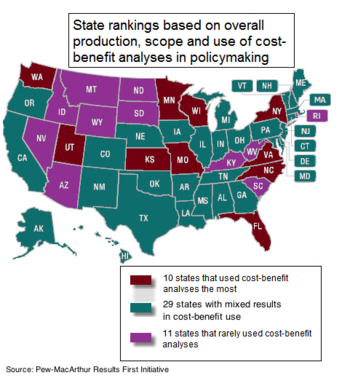
The Pew-MacArthur Results First Initiative is a joint project of the Pew Charitable Trusts and the John D. and Catherine T. MacArthur Foundation that works to partner with states in implementing cost-benefit analysis models.[26]. The initiative released a report in July 2013 concluding that cost-benefit analysis in policymaking led to more effective uses of public funds. Looking at data from 2008 through 2011, the study's authors found that some states were more likely to use cost-benefit analysis, while others were facing challenges and lagging behind the rest of the nation. The challenges states faced included a lack of time, money, and technical skills needed to conduct comprehensive cost-benefit analyses. Louisiana was one of 29 states with mixed results regarding the frequency and effectiveness of its use of cost-benefit analysis.[27]
Ethics and transparency
Following the Money report
- See also: "Following the Money" report, 2015
The U.S. Public Interest Research Group, a consumer-focused nonprofit organization based in Washington, D.C., released its annual report on state transparency websites in March 2015. The report, entitled "Following the Money," measured how transparent and accountable state websites were with regard to state government spending.[28] According to the report, Louisiana received a grade of A and a numerical score of 96, indicating that Louisiana was "Leading" in terms of transparency regarding state spending.[28]
Open States Transparency
The Sunlight Foundation released an "Open Legislative Data Report Card" in March 2013. Louisiana was given a grade of D in the report. The report card evaluated how adequate, complete, and accessible legislative data was to the general public. A total of 10 states received an A: Arkansas, Connecticut, Georgia, Kansas, New Hampshire, New York, North Carolina, Texas, Virginia, and Washington.[29]
Elections
Louisiana is one of only four states that hold state elections in odd-numbered years, as well as one of three to use a nonpartisan blanket primary in regular elections. In 2011, House Clerk Alfred "Butch" Speer was quoted as explaining:
| “ | For scores of years we conducted our party primaries in the winter of the odd numbered years, with any necessary 2d primary held in January. Because Republican voter registration was so miniscule from 1877 until 1980, the general elections were mere irritants to the Democrat primary victor. Once we scrapped the partisan primary system [1975] we set the entire system up to run in the fall of the odd numbered year, our traditional election season.[30][14] | ” |
Although voters in Washington state and California adopted similar blanket primaries in 2004 and 2010, respectively, Louisiana remains unique in that it considers a candidate elected if he or she attains a majority of the vote in a primary. Otherwise, the top two candidates move on to a runoff in the general election.[31]
The following chart is a comparison of campaign donations to Louisiana House candidates since 1999:
| Year | Number of candidates | Total contributions |
|---|---|---|
| 2011 | 230 | $15,991,763 |
| 2007 | 292 | $23,068,639 |
| 2003 | 237 | $12,267,180 |
| 1999 | 214 | $13,135,824 |
2015
Elections for the Louisiana House of Representatives took place in 2015. A primary election was held on October 24, 2015, with a general election held in districts where necessary on November 21, 2015. The signature filing deadline for candidates wishing to run in this election was September 10, 2015, at 4:30 p.m. CDT.[32]
Louisiana elections use the Louisiana majority-vote system. All candidates compete in the same primary, and a candidate can win the election outright by receiving more than 50% of the vote. If no candidate does, the top two vote recipients from the primary advance to the general election, regardless of their partisan affiliation.
For information about which offices are nominated via primary election, see this article.
| Louisiana House of Representatives | |||
|---|---|---|---|
| Party | As of November 2015 | After November 2015 | |
| Democratic Party | 43 | 42 | |
| Republican Party | 58 | 61 | |
| Independent | 2 | 2 | |
| Vacancy | 2 | 0 | |
| Total | 105 | 105 | |
2011
Primary elections for Louisiana House of Representatives were held on October 22, 2011. Necessary runoffs took place on November 19, 2011.
During the 2011 election, the total value of contributions to House candidates was $15,991,763. The top 10 contributors were:[33]
| 2011 Donors, Louisiana House of Representatives | ||
|---|---|---|
| Donor | Amount | |
| Louisiana Democratic Party | $334,340 | |
| Louisiana Association Of Business & Industry | $292,506 | |
| Republican Legislative Delegation Campaign Cmte Of Louisiana | $252,500 | |
| House Democratic Campaign Cmte Of Louisiana | $187,436 | |
| Garofalo Jr, Raymond E | $185,000 | |
| Lowrie, Michael (Duke) | $182,516 | |
| Hollis, Paul | $180,250 | |
| Bobby Jindal Campaign Cmte | $165,000 | |
| Jett, Ronald D | $163,845 | |
| Louisiana State Farm Agents | $155,250 | |
2007
Primary elections for Louisiana House of Representatives were held on October 20, 2007, with a runoff election occurring on November 17, 2007.
As of the 2000 Census, Louisiana's 105 state representatives each represented an average population of 42,562 people. In 2007, the candidates for state house raised a total of $23,068,639 in campaign contributions. The top 10 donors were:[34]
| 2007 Donors, Louisiana House of Representatives | |
|---|---|
| Donor | Amount |
| Louisiana House Democratic Campaign Cmte | $464,391 |
| Leblank, Patrick L | $381,647 |
| Louisiana Association of Business and Industry | $328,662 |
| Louisiana Republican Legislative Delegation Campaign Cmte | $317,500 |
| Brown, Troy | $276,738 |
| Scott Simon | $201,288 |
| Louisiana Manufacturers Association | $182,513 |
| Louisiana State Farm Agents | $170,750 |
| Crescent River Port Pilots Association | $168,650 |
| Aycock, Michelle | $160,134 |
2003
Elections for the office of Louisiana House of Representatives consisted of an election on October 4, 2003, and a runoff election on November 15, 2003.
During the 2003 election, the total value of contributions to House candidates was $12,267,180. The top 10 contributors were:[35]
| 2003 Donors, Louisiana House of Representatives | ||
|---|---|---|
| Donor | Amount | |
| Skrmetta, Eric | $412,347 | |
| Dove Sr, Gordon E | $375,700 | |
| Louisiana Association Of Business & Industry | $253,255 | |
| Lambert, Eddie J | $195,000 | |
| House Democratic Campaign Cmte Of Louisiana | $167,836 | |
| Bankston Campaign, Tommy | $158,200 | |
| Priola, Carmen | $148,326 | |
| Crescent River Port Pilots Association | $143,800 | |
| Walker, Monica | $134,637 | |
| Faia, Gregory | $117,500 | |
1999
Elections for the office of Louisiana House of Representatives consisted of a primary election on October 23, 1999, and a runoff election on November 20, 1999.
During the 1999 election, the total value of contributions to House candidates was $13,135,824. The top 10 contributors were:[36]
| 1999 Donors, Louisiana House of Representatives | ||
|---|---|---|
| Donor | Amount | |
| Louisiana Association Of Business & Industry | $378,654 | |
| Little Jr, Ross | $171,975 | |
| Louisiana Manufacturers Association | $145,920 | |
| Louisiana Medical Association | $126,550 | |
| House Democratic Campaign Cmte Of Louisiana | $109,577 | |
| Entergy | $99,935 | |
| Philip Morris | $86,250 | |
| Louisiana Restaurant Association | $83,760 | |
| AGRIPAC Farm Bureau | $82,830 | |
| West PAC | $79,129 | |
Qualifications
In order to run for office, the following qualifications are in place:[37]
- Must be 18 years of age or older.
- Must be a resident of the district they seek to hold office to for a minimum of two years.
- Must not have served more than two and one half terms previously in office. This is for any candidate who has held office in the past after January 8, 1996.
- Have not been convicted of a felony offense.
- Have no outstanding fines with the Louisiana Ethics Administration Program.
- Pay a $225 filing fee with the Clerk of Court in the parish they reside in or collect 400 signatures.
- If running as a Republican or Democrat, pay an additional $112.50 filing fee with the state and/or parish executive committee of their party.
Vacancies
| How vacancies are filled in state legislatures |
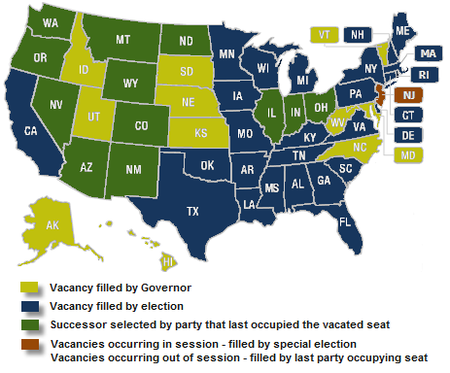 |
If there is a vacancy in the house, the vacant seat must be filled by a special election. An election is required if there are six months or more left in the unexpired term. The Speaker of the House must call for an election no later than 10 days following the vacancy. The Speaker of the House must determine the dates for the election along with all filing deadlines. The person elected to the seat serves for the remainder of the unexpired term.[38]
Term limits
- See also: State legislatures with term limits
The Louisiana legislature is one of 15 state legislatures with term limits. Of the 15 states, it is the only state where term limits were imposed by the state's legislators, rather than through the ballot initiative process. Under Louisiana's term limits, state representatives can serve no more than three 4-year terms in the house.[1]
The state's term limits law was enacted in 1995. 2007 was the first year that the term limits law impacted the ability of incumbents to run.
Redistricting
- See also: Redistricting in Louisiana
In Louisiana, the state legislature has control over the redistricting process. The redistricted maps are introduced as bills in the Senate and the House, and can be vetoed by the governor for any reason. Until 2013, Louisiana faced special scrutiny under the Voting Rights Act (VRA) as a state with a history of using district lines as tools of racial discrimination. As with several other states, mostly in the South, Louisiana's redistricting maps required pre-clearance by the U.S. Department of Justice. On June 25, 2013, the U.S. Supreme Court struck down the formula to determine pre-clearance jurisdictions, effectively excusing Louisiana from the requirement pending congressional action.[39][40]
According to the U.S. Census Bureau, Louisiana had the third-slowest growth rate of any state in the nation between 2000 and 2010. Only Rhode Island and Michigan experienced smaller positive population gains during this time period (notably, Michigan experienced an overall decrease in population). Louisiana grew 1.4 percent from 2000 to 2010, with a total population rise from 4.47 million in 2000 to 4.53 million in 2010. Notably the South as a region experienced overall growth of 14.29 percent.[41][42] Hurricane Katrina's impact caused enough people to move out of state to cost Louisiana a Congressional District. The population shifts also substantially affected state legislative districts, including the largely African-American city of New Orleans.[43]
During the redistricting process, Louisiana legislators faced a compressed timeline compared to other states. The odd year elections meant that the 2011 elections in the fall would need districts soon enough to get clearance from the Department of Justice per the Voting Rights Act, allow candidates to file in the appropriate districts, and leave time for the blanket primary and the general election to happen in early November 2011.
The new state House of Representatives map added two new majority-minority seats, which was one less than some lawmakers wanted. Many feared that the Justice Department would reject the plan without another majority-minority seat, but it ultimately accepted Louisiana's first map for the first time since the VRA came into enforcement.[44]
Representatives
Partisan composition
- See also: Partisan composition of state houses
| As of December 2025 | ||
|---|---|---|
| Party | Members | |
| Democratic | 31 | |
| Republican | 73 | |
| Other | 0 | |
| Vacancies | 1 | |
| Total | 105 | |
The chart below shows the partisan composition of the Louisiana House of Representatives from 1992 to 2013.

Leadership
The Speaker of the House is the presiding officer of the body. Duties of the Speaker include preserving order and decorum, deciding all points of order and appointing the membership of all House committees.[45][46]
Current leadership
| Current Leadership, Louisiana House of Representatives | ||
|---|---|---|
| Office | Representative | Party |
| State Speaker of the House | Taylor Barras |  Republican Republican
|
| State House Speaker Pro Tempore | Walt Leger, III |  Democratic Democratic
|
Salaries
- See also: Comparison of state legislative salaries
As of 2015, members of the Louisiana State Legislature were paid $16,800/year. Additionally, legislators receive $6,000/year for expenses and a $150/day per diem tied to the federal rate.[47]
Pensions
Louisiana does not provide pensions for legislators who took office after 1996. That year, voters passed a constitutional amendment banning state and local officials from collecting public retirement benefits.[48][49]
When sworn in
Louisiana legislators assume office at noon on the second Monday in January after their election.
Current members

Historical membership
A list of House members from 1812 to the present is maintained by the legislative library.[50]
Standing committees
The Louisiana House of Representatives has 16 standing committees:
- Administration of Criminal Justice
- Agriculture, Forestry, Aquaculture and Rural Development
- Appropriations
- Civil Law and Procedure
- Commerce
- Education
- Health and Welfare
- House and Governmental Affairs
- Insurance
- Judiciary
- Labor and Industrial Relations
- Municipal, Parochial and Cultural Affairs
- Natural Resources and Environment
- Retirement
- Transportation, Highways and Public Works
- Ways and Means
House Communications Office
The House Communications Office assists members of the House in public and media relations, and coordinates the chamber's own media operations.[51]
The House Communications Office is responsible for streaming video of floor and committee hearings, which is provided live and on-demand in the Windows Media format at no cost to the public. Live chamber video is also available for iOS devices. The Office's archive dates back to 1999, although some videos before 2003 are only available by request.[52]
House Legislative Services
House Legislative Services assists members of the House in "research, policy analysis, bill drafting, and support services." Several divisions operate under it, with jurisdictions ranging from legal and administrative matters to research and analysis.[53]
House Fiscal Division
| “ | The mission of the House Fiscal Division is to enhance the legislative process by serving as a consistent, professional, and nonpartisan resource to all House members through accurate and objective research, analysis, bill drafting, and quality committee staffing in order to foster informed decisions on fiscal matters.[54][14] | ” |
Poynter Library
The David R. Poynter Legislative Research Library assists members and staff of the Legislature in legislative research and information. The library also operates a telephone hotline for constituents.[55]
History
Partisan balance 1992-2013


From 1992 to 2013, the Democratic Party was the majority in the Louisiana House of Representatives for the first 19 years while the Republicans were the majority for the last three years. The Louisiana House of Representatives is one of 18 state houses that were Democratic for more than 80 percent of the years between 1992 and 2013. Louisiana was under Republican trifectas for the final three years of the study period.
Across the country, there were 577 Democratic and 483 Republican state Houses of Representatives from 1992 to 2013.
Over the course of the 22-year study, state governments became increasingly more partisan. At the outset of the study period (1992), 18 of the 49 states with partisan legislatures had single-party trifectas and 31 states had divided governments. In 2013, only 13 states had divided governments, while single-party trifectas held sway in 36 states, the most in the 22 years studied.
The chart below shows the partisan composition of the Office of the Governor of Louisiana, the Louisiana State Senate and the Louisiana House of Representatives from 1992 to 2013.
.PNG)
SQLI and partisanship
- To read the full report on the State Quality of Life Index (SQLI) in PDF form, click here.
The chart below depicts the partisanship of the Kentucky state government and the state's SQLI ranking for the years studied. For the SQLI, the states were ranked from 1-50, with 1 being the best and 50 the worst. Louisiana has had three periods of trifectas, two Democratic trifectas (1992-1995 and 2004-2007) and one Republican trifecta (2011-2013). Louisiana had its longest period of divided government between 1996 and 2003. For all but two years of the study, Louisiana has ranked in the bottom 10 in the SQLI ranking and only left the bottom 10 in the last two years of the study, 2011 and 2012. The state’s lowest ranking came in 1993 and 1994 under a Democratic trifecta. Its highest ranking came in 2012 under a Republican trifecta, when it ranked 36th.
- SQLI average with Democratic trifecta: 46.25
- SQLI average with Republican trifecta: 38.00
- SQLI average with divided government: 45.73

See also
- Louisiana
- Louisiana State Senate
- Governor of Louisiana
- Louisiana State Legislature
- Louisiana Constitution
External links
- Official website of the Louisiana House of Representatives
- Louisiana House of Representatives on Wikipedia
- Tulane University Law School - Louisiana Legislative History
Footnotes
- ↑ 1.0 1.1 legis.la.gov, "About the Legislature," accessed December 16, 2013
- ↑ U.S. Census Bureau, "Population Distribution and Change: 2000 to 2010," March 2011
- ↑ U.S. Census Bureau, "States Ranked by Population: 2000," April 2, 2001
- ↑ 4.0 4.1 The Times-Picayune, "Louisiana Republicans take first House majority since Reconstruction with latest party switch," December 17, 2010
- ↑ Washington Times, "Edwards officially calls special session on budget, taxes," accessed February 8, 2016
- ↑ The Times-Picayune, "2015 Louisiana Legislature: What to expect from Bobby Jindal, lawmakers," April 11, 2015
- ↑ American Press, "How different will session be?" April 12, 2015
- ↑ Bossier Press-Tribune, "Jindal taps budget, education, relgious freedom as major 2015 session issues," April 13, 2015
- ↑ Gannett Louisiana, "Marijuana fight returning to Legislature this session," April 12, 2015
- ↑ Associated Press, "Jindal pushes worker training as legislative session opens," March 10, 2014
- ↑ American Press, "Education, lawsuit key issues," March 9, 2014
- ↑ www.houmatoday.com, "Conservatives in state House forming new coalition," accessed February 20, 2014 (timed out)
- ↑ campaignmoney.com, "Louisiana Conservative Coalition," accessed April 21, 2014
- ↑ 14.0 14.1 14.2 Note: This text is quoted verbatim from the original source. Any inconsistencies are attributable to the original source.
- ↑ Louisiana House of Representatives, "2013 Regular Session Journals," accessed April 15, 2014
- ↑ wwltv.com, "A look at major issues at session's halfway point," April 24, 2013(dead link)
- ↑ Louisiana House of Representatives, "2012 Regular Session Journals," accessed April 15, 2014
- ↑ House Legislative Services, "2012 Regular Session of the Louisiana Legislature," June 2012
- ↑ Louisiana House of Representatives, "2011 Regular Session Journals," accessed April 15, 2014
- ↑ Louisiana House of Representatives, "2011 1st Extraordinary Session Journals," accessed April 15, 2014
- ↑ Louisiana House of Representatives, "2010 Regular Session Journals," accessed April 15, 2014
- ↑ House Legislative Services, "2010 Regular Session of the Louisiana Legislature," accessed April 15, 2014
- ↑ 23.0 23.1 23.2 National Association of State Budget Officers, "Budget Processes in the States, Spring 2021," accessed January 24, 2023
- ↑ For budgets with one-time money, two-thirds of elected House members must approve for it to pass.
- ↑ National Conference of State Legislatures, "Separation of Powers: Executive Veto Powers," accessed January 26, 2024
- ↑ Pew Charitable Trusts, "State Work," accessed June 6, 2014
- ↑ Pew Charitable Trusts, "States’ Use of Cost-Benefit Analysis," July 29, 2013
- ↑ 28.0 28.1 U.S. Public Interest Research Group, "Following the Money 2015 Report," accessed April 4, 2016
- ↑ Sunlight Foundation, "Ten Principles for Opening Up Government Information," accessed June 16, 2013
- ↑ The Thicket, "Why do Four States Have Odd-Year Elections?" August 25, 2011
- ↑ State of Louisiana, "Louisiana election code," accessed April 15, 2014 (Referenced RS 18:511-512)
- ↑ Louisiana Secretary of State, "2015 Elections," accessed January 2, 2015
- ↑ Follow the Money, "Louisiana 2011 - Candidates," accessed August 23, 2013
- ↑ Follow the Money, "Louisiana 2010 - Candidates," accessed April 15, 2014
- ↑ Follow the Money, "Louisiana 2003 - Candidates," accessed August 23, 2013
- ↑ Follow the Money, "Louisiana 1999 - Candidates," accessed August 23, 2013
- ↑ Louisiana Secretary of State, "Qualify for an Election," accessed December 16, 2013
- ↑ State of Louisiana, "Louisiana election code," accessed December 16, 2013 (Referenced Statute 18:601, Louisiana Statutes)
- ↑ Louisiana House of Representatives, "Frequently Asked Questions," accessed April 15, 2014
- ↑ The Huffington Post, "Voting Rights Act Section 4 Struck Down By Supreme Court," June 25, 2013
- ↑ Ruston Daily Leader, "Loss of one congressional seat a result of low population growth in state," accessed December 31, 2010
- ↑ U.S. Census Bureau, "Population Distribution and Change," March 2011
- ↑ New Orleans Times Picayune, "Redistricting is expected to cost New Orleans three districts in the Louisiana House of Representatives," January 19, 2011
- ↑ Newsstar, "Justice approves House redistricting proposal," June 21, 2011
- ↑ Louisiana House of Representatives, "House rules," accessed April 15, 2014 (Referenced House Rule 2.5)
- ↑ Louisiana House of Representatives, "Major Office Holders," accessed April 15, 2014
- ↑ NCSL.org, "2015 State Legislator Compensation and Per Diem Table," accessed July 13, 2015
- ↑ USA Today, "State-by-state: Benefits available to state legislators," September 23, 2011
- ↑ National Journal, "Nearly One in Five Members of Congress Gets Paid Twice," June 27, 2013
- ↑ House Legislative Services, "Membership in the Louisiana House of Representatives 1812-2016," March 19, 2014
- ↑ Louisiana House of Representatives, "House Communications Office," accessed April 15, 2014
- ↑ Louisiana House of Representatives, "House Live Video Streams," accessed April 15, 2014
- ↑ Louisiana House of Representatives, "House Legislative Services," accessed April 15, 2014
- ↑ House Fiscal Division, "About House Fiscal Division," accessed April 15, 2014
- ↑ House Legislative Services, "Poynter Library Home," accessed April 15, 2014

 |
State of Louisiana Baton Rouge (capital) |
|---|---|
| Elections |
What's on my ballot? | Elections in 2025 | How to vote | How to run for office | Ballot measures |
| Government |
Who represents me? | U.S. President | U.S. Congress | Federal courts | State executives | State legislature | State and local courts | Counties | Cities | School districts | Public policy |


