Illinois House of Representatives


| Illinois House of Representatives | |
 | |
| General information | |
| Type: | Lower house |
| Term limits: | None |
| Session start: | January 14, 2015 |
| Website: | Official House Page |
| Leadership | |
| House Speaker: | Michael Madigan (D) |
| Majority Leader: | Barbara Flynn Currie (D) |
| Minority Leader: | Jim Durkin (R) |
| Structure | |
| Members: | 118 |
| Democratic Party (77) Republican Party (39) Vacant (2) | |
| Length of term: | 2 years |
| Authority: | Art IV, Illinois Constitution |
| Salary: | $67,836/year + per diem |
| Elections | |
| Last election: | November 4, 2014 (118 seats) |
| Next election: | November 8, 2016 (118 seats) |
| Redistricting: | General Assembly First Draws, Commission Acts as Back-Up. |
The Illinois House of Representatives is the lower house of the Illinois General Assembly, the state legislature of Illinois. The body was created by the first Illinois Constitution adopted in 1818. The state House of Representatives is made up of 118 representatives elected from individual legislative districts for a two-year term with no limits. In contrast, the Illinois State Senate is made of 59 senators with staggered two- or four-year terms. Each member represents an average of 105,248 residents, as of the 2000 Census.[1]
Illinois Ballot Question 1 in 1980 altered Section 1 of Article IV of the Illinois Constitution to reduce the number of members of the Illinois House of Representatives from 177 members to 118 members beginning with the elections in 1982.
Illinois has a Democratic state government trifecta. A trifecta exists when one political party simultaneously holds the governor’s office and majorities in both state legislative chambers.
As of March 21, 2026, there are 23 Republican trifectas, 16 Democratic trifectas, and 11 divided governments where neither party holds trifecta control.
Sessions
Article IV of the Illinois Constitution establishes when the Illinois General Assembly, of which the House is a part, is to be in session. Section 5 of Article IV states that the General Assembly will convene its regular session on the second Wednesday of January.
Section 5 also creates rules for the convening of special sessions. The section allows the governor of Illinois to convene the General Assembly or the Senate alone. When the governor calls a special session, the General Assembly can generally only deal with matters related to the purpose of the session, as stated by the governor's proclamation of the session, but they can also deal with impeachments or confirmation of appointments. Section 5 also allows the presiding officers of both houses of the General Assembly to convene a special session through joint proclamation.
2015
- See also: Dates of 2015 state legislative sessions
In 2015, the Legislature is in session from January 14 through May 14.
Major issues
Major issues during the 2015 legislative session include a potential income tax increase, a statewide minimum wage and federal healthcare funding.[2]
2014
- See also: Dates of 2014 state legislative sessions
In 2014, the Legislature was in session from January 29 through June 2.
Major issues
Major issues during the 2014 legislative session included the pending expiration of a temporary income tax, corporate tax incentives, Chicago pension reform and capital construction.[3]
2013
- See also: Dates of 2013 state legislative sessions
In 2013, the Legislature was in session from January 9 through May 31.
Major issues
Major issues during the 2013 legislative session included regulation of horizontal hydraulic fracturing, concealed carry, same-sex marriage, and pension reform.[4][5][6][7]
2012
- See also: Dates of 2012 state legislative sessions
In 2012, the House was in session from January 11, meeting throughout the year.
2011
- See also: Dates of 2011 state legislative sessions
In 2011, the House was in session from January 12-June 1. A special session has been called by Governor Pat Quinn to settle disputes regarding Illinois construction projects. The session is slated to begin June 22, 2011.[8]
2010
- See also: Dates of 2010 state legislative sessions
In 2010, the House was in regular session from January 13th to May 7th.
Role in state budget
- See also: Illinois state budget and finances
Illinois on 
|
Illinois operates on an annual budget cycle. The sequence of key events in the budget process is:[9][10]
- In September and October of the year preceding the start of the new fiscal year, the governor sends budget instructions to state agencies.
- In October and November, agencies submit their budget requests to the governor.
- Budget hearings with the public are held from February through May.
- On the third Wednesday in February, the governor submits his or her proposed budget to the Illinois General Assembly.
- The General Assembly passes a budget in May.
Illinois is one of 44 states in which the governor has line item veto authority.[10][11]
The governor is constitutionally required to submit a balanced budget. In turn, the legislature must pass a balanced budget.[10]
Cost-benefit analyses
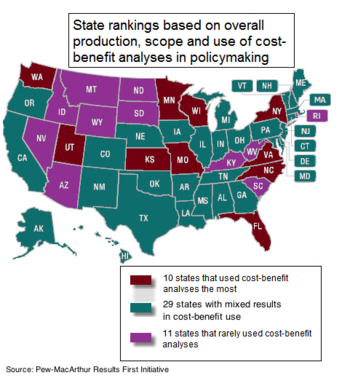
The Pew-MacArthur Results First Initiative is a joint project of the Pew Charitable Trusts and the John D. and Catherine T. MacArthur Foundation that works to partner with states in implementing cost-benefit analysis models.[12]. The initiative released a report in July 2013 concluding that cost-benefit analysis in policymaking led to more effective uses of public funds. Looking at data from 2008 through 2011, the study's authors found that some states were more likely to use cost-benefit analysis, while others were facing challenges and lagging behind the rest of the nation. The challenges states faced included a lack of time, money, and technical skills needed to conduct comprehensive cost-benefit analyses. Illinois was one of 29 states with mixed results regarding the frequency and effectiveness of its use of cost-benefit analysis.[13]
Ethics and transparency
Following the Money report
- See also: "Following the Money" report, 2014
The U.S. Public Interest Research Group, a consumer-focused nonprofit organization based in Washington, D.C., released its annual report on state transparency websites in April 2014. The report, entitled "Following the Money," measured the transparency and accountability of state websites with regard to state government spending.[14] According to the report, Illinois received a grade of B+ and a numerical score of 88, indicating that Illinois was advancing in terms of transparency regarding state spending.[14]
Open States Transparency
The Sunlight Foundation released an "Open Legislative Data Report Card" in March 2013. Illinois was given a grade of C in the report. The report card evaluated how adequate, complete, and accessible legislative data was to the general public. A total of 10 states received an A: Arkansas, Connecticut, Georgia, Kansas, New Hampshire, New York, North Carolina, Texas, Virginia, and Washington.[15]
Elections
2014
Elections for the Illinois House of Representatives took place in 2014. A primary election took place on March 18, 2014. The general election was held on November 4, 2014. The signature filing deadline for candidates wishing to run in this election was December 2, 2013.
2012
Elections for the office of Illinois House of Representatives were held in Illinois on November 6, 2012. All 118 seats were up for election.
The signature filing deadline for candidates wishing to run in these elections was December 5, 2011. Petitions can be circulated starting on September 6, 2011.[16] The primary election day was March 20, 2012.
The following table details the 10 districts with the smallest margin of victory in the November 6 general election.
| 2012 Margin of Victory, Illinois House of Representatives | ||||
|---|---|---|---|---|
| District | Winner | Margin of Victory | Total Votes | Top Opponent |
| District 79 |  Katherine Cloonen Katherine Cloonen |
0.2% | 42,483 | Glenn Nixon |
| District 112 |  Dwight D. Kay Dwight D. Kay |
0.7% | 48,733 | Marleen Suarez |
| District 71 | Mike Smiddy |
4.1% | 48,048 | Richard Morthland |
| District 77 | Kathleen Willis |
5.2% | 26,065 | Angelo Saviano |
| District 68 | John M. Cabello |
6.5% | 47,260 | Carl R. Wasco |
| District 55 | Martin J. Moylan |
6.5% | 40,032 | Susan Sweeney |
| District 62 | Sam Yingling |
10.6% | 37,972 | Sandy Cole |
| District 45 | Dennis Reboletti |
10.8% | 43,459 | JoAnn Franzen |
| District 57 | Elaine Nekritz |
11% | 36,263 | Jonathan L. Greenberg |
| District 91 | Michael D. Unes |
11.8% | 43,539 | Jennifer Groves Allison |
2010
Elections for the office of Illinois State House were held in Illinois on November 2, 2010. House seats in all 118 districts were up for election in 2010.
The signature-filing deadline for candidates wishing to run in these elections was November 2, 2009, and the primary Election Day was February 2, 2010.
In 2010, the total amount of contributions raised in state house elections was $50,734,623. The top 10 contributors were:[17]
| 2010 Donors, Illinois House of Representatives | |
|---|---|
| Donor | Amount |
| Illinois Democratic Party | $5,100,516 |
| House Republican Organization of Illinois | $1,304,567 |
| Illinois Republican Party | $1,302,517 |
| Illinois Education Association | $807,027 |
| Citizens to Elect Tom Cross | $769,486 |
| Illinois House Republican Organization | $700,651 |
| Illinois Health Care Association | $675,393 |
| Hoffman, Jay C | $543,711 |
| Associated Beer Distributors of Illinois | $520,270 |
| Illinois State Medical Society | $517,693 |
2008
Elections for the office of Illinois House of Representatives consisted of a primary election on February 5, 2008, and a general election on November 4, 2008.
During the 2008 election, the total value of contributions to House candidates was $42,866,912. The top 10 contributors were:[18]
| 2008 Donors, Illinois House of Representatives | ||
|---|---|---|
| Donor | Amount | |
| Illinois Democratic Party | $3,211,111 | |
| House Republican Organization of Illinois | $1,267,651 | |
| Illinois Education Association | $956,847 | |
| Illinois Republican Party | $906,754 | |
| Associated Beer Distributors of Illinois | $614,128 | |
| Illinois State Medical Society | $595,424 | |
| Illinois Federation of Teachers | $484,993 | |
| Afscme Illinois Council 31 | $465,724 | |
| Illinois Health Care Association | $431,593 | |
| Illinois Pro-Choice | $406,436 | |
2006
Elections for the office of Illinois House of Representatives consisted of a primary election on March 21, 2006, and a general election on November 7, 2006.
During the 2006 election, the total value of contributions to House candidates was $38,897,487. The top 10 contributors were:[19]
| 2006 Donors, Illinois House of Representatives | ||
|---|---|---|
| Donor | Amount | |
| Illinois Democratic Party | $2,714,136 | |
| House Republican Organization | $2,127,379 | |
| Illinois Education Association | $1,013,978 | |
| Illinois State Medical Society | $709,294 | |
| Illinois Republican Party | $508,701 | |
| Illinois Federation of Teachers | $501,815 | |
| Associated Beer Distributors of Illinois | $479,422 | |
| AT&T | $410,063 | |
| Citizens to Elect Tom Cross | $347,717 | |
| Illinois Hospital & Health Systems Association | $341,045 | |
2004
Elections for the office of Illinois House of Representatives consisted of a primary election on March 16, 2004, and a general election on November 2, 2004.
During the 2004 election, the total value of contributions to House candidates was $36,703,698. The top 10 contributors were:[20]
| 2004 Donors, Illinois House of Representatives | ||
|---|---|---|
| Donor | Amount | |
| Illinois Democratic Party | $2,906,011 | |
| House Republican Organization | $1,562,774 | |
| Illinois Education Association | $946,284 | |
| Citizens to Elect Tom Cross | $591,399 | |
| Illinois State Medical Society | $549,399 | |
| Associated Beer Distributors of Illinois | $375,400 | |
| Illinois Federation of Teachers | $358,443 | |
| Illinois Trial Lawyers Association | $321,122 | |
| Illinois Hospital & Health Systems Association | $308,935 | |
| Illinois Realtors Association | $296,421 | |
2002
Elections for the office of Illinois House of Representatives consisted of a primary election on March 19, 2002, and a general election on November 5, 2002.
During the 2002 election, the total value of contributions to House candidates was $35,823,142. The top 10 contributors were:[21]
| 2002 Donors, Illinois House of Representatives | ||
|---|---|---|
| Donor | Amount | |
| Illinois Democratic Party | $1,468,207 | |
| Illinois Education Association | $1,084,976 | |
| House Republican Campaign Cmte of Illinois | $662,308 | |
| Goldberg, Michael | $600,000 | |
| Illinois State Medical Society | $444,067 | |
| Leaders For A Republican Majority | $392,856 | |
| Illinois Trial Lawyers Association | $380,765 | |
| Associated Beer Distributors of Illinois | $336,204 | |
| Illinois Federation of Teachers | $315,027 | |
| Illinois Realtors Association | $277,721 | |
2000
Elections for the office of Illinois House of Representatives consisted of a primary election on March 21, 2000, and a general election on November 7, 2000.
During the 2000 election, the total value of contributions to House candidates was $35,659,714. The top 10 contributors were:[22]
| 2000 Donors, Illinois House of Representatives | ||
|---|---|---|
| Donor | Amount | |
| Illinois Democratic Party | $3,989,911 | |
| House Republican Campaign Cmte of Illinois | $2,492,649 | |
| Illinois Education Association | $896,830 | |
| Friends of Lee Daniels | $772,903 | |
| Illinois State Medical Society | $456,892 | |
| Associated Beer Distributors of Illinois | $447,285 | |
| Democratic Senatorial Campaign Cmte | $425,000 | |
| Illinois Trial Lawyers Association | $362,200 | |
| Illinois Federation of Teachers | $356,171 | |
| Illinois Hospital & Health Systems Association | $304,245 | |
Qualifications
Article IV of the Illinois Constitution states: To be eligible to serve as a member of the General Assembly, a person must be a United States citizen, at least 21 years old, and for the two years preceding his election or appointment a resident of the district which he is to represent.
Vacancies
| How vacancies are filled in state legislatures |
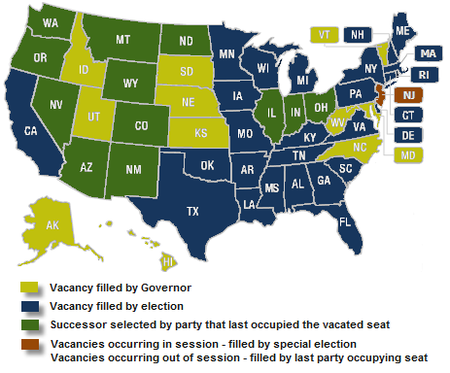 |
Whenever there is a vacancy in the House, the state constitution mandates that the seat must be filled by appointment when allowed by law. The appointment must be made within 30 days after the vacancy. All vacancies must be filled by a member of the same political party that last held the seat.[23]
The vacancy must be filled by the respective party organizations covering the legislative district.[24] This must be voted on by the respective committeemen and committeewomen representing the legislative district.[25]
Redistricting
- See also: Redistricting in Illinois
The Illinois General Assembly is responsible for redistricting. If the General Assembly fails to meet the deadlines to have a redistricting plan in place, an 8 member back-up commission is used. Illinois is one of a few states to enact a hybrid method of redistricting.
2010 census
Illinois received its 2010 local census data on February 14, 2011. The state population increased from about 12.4 million to 12.8 million residents, a 3.3 percent growth.[26] The state's Latino population grew by 33% from 2000 to 2010, reaching 2 million. Meanwhile, non-Latino population declined by 0.8%.[27]
2011 was the first time under the current state Constitution that one party -- namely the Democrats -- controlled the state House, Senate and governorship during redistricting. A number of Republicans expressed concern that Democrats would draw partisan maps to serve their own interests.[28]
Democrats released proposed maps of the 118 House districts on May 20, but initially offered few details. Democrats defended the new maps while being criticized from nearly all sides. Lack of data and the time to digest it angered transparency advocates, while Republicans were unhappy that the new districts would position over a dozen Republican incumbents against one another. Democrats were also criticized for creating a number of snaking districts that begin in Chicago and wind their way out into the suburbs.[29]
Republicans released their counter-proposal on May 26, saying their map was fairer than the Democrats.[30] The Democrats plan passed the House 64-52.[31] Gov. Pat Quinn signed the bill on June 3,[32][33] but GOP leaders filed a federal lawsuit on July 21 alleging the legislative maps unfairly targeted Republicans and discriminated against African-Americans and Hispanics. It was ultimately dismissed.[34]
Representatives
Salaries
- See also: Comparison of state legislative salaries
As of 2013, members of the Illinois House of Representatives are paid $67,836/year. Additionally, legislators receive $111/day per diem.[35]
When sworn in
Illinois legislators assume office the second Wednesday in January.
Majority control
- See also: Partisan composition of state houses
| As of March 2026 | ||
|---|---|---|
| Party | Members | |
| Democratic | 78 | |
| Republican | 40 | |
| Other | 0 | |
| Vacancies | 0 | |
| Total | 118 | |
The chart below shows the partisan composition of the Illinois State House of Representatives from 1992-2013.

Leadership
The Speaker of the House is the presiding officer of the body and is elected by its full membership. Duties of the Speaker include preserving order and decorum, deciding all points of order, signing all bills and acts of the House, and appointing all chairs, co-chairs, and vice chairs of committees, as well as appointing all majority caucus members of committees. The Minority Leader appoints all minority caucus members to committees.[36][37]
Current leadership


Current members
Standing committees
The Illinois House has 45 standing committees for the 2011-2012 session.[38]
- Accountability & Administrative Review
- Adoption Reform
- Agriculture & Conservation
- Appropriations-Elementary & Secondary Education
- Appropriations-General Service
- Appropriations-Higher Education
- Appropriations-Human Services
- Appropriations-Public Safety
- Bio-Technology
- Business Growth & Incentives
- Business & Occupational Licenses
- Cities & Villages
- Committee of the Whole
- Consumer Protection
- Counties & Townships
- Economic Development
- Elementary & Secondary Education
- Energy
- Environment
- Executive
- Financial Institutions
- Health & Healthcare Disparities
- Health Care Availability Access
- Health Care Licenses
- Higher Education
- Housing
- Human Services
- Insurance
- International Trade & Commerce
- Judiciary
- Labor & Commerce
- Mass Transit
- Museums, Arts, & Cultural Enhancement
- Personnel & Pensions
- Public Utilities
- Restorative Justice
- Revenue & Finance
- Rules
- Small Business Empowerment & Workforce Development
- State Government Administration
- Tollway Oversight
- Tourism & Conventions
- Transportation: Regulation, Roads & Bridges Committee
- Transportation: Vehicles & Safety
- Veterans' Affairs
History
Partisan balance 1992-2013


From 1992-2013, the Democratic Party was the majority in the Illinois State House of Representatives for 20 years while the Republicans were the majority for 2 years. The Illinois State House of Representatives is one of 18 state Houses that was Democratic for more than 80 percent of the years between 1992-2013. During the final 11 years of the study, Illinois was under Democratic trifectas.
Across the country, there were 577 Democratic and 483 Republican State Houses of Representatives from 1992 to 2013.
Over the course of the 22-year study, state governments became increasingly more partisan. At the outset of the study period (1992), 18 of the 49 states with partisan legislatures had single-party trifectas and 31 states had divided governments. In 2013, only 13 states had divided governments, while single-party trifectas held sway in 36 states, the most in the 22 years studied.
The chart below shows the partisan composition of the office of the governor of Illinois, the Illinois State Senate and the Illinois House of Representatives from 1992-2013.
.PNG)
SQLI and partisanship
Illinois was one of eight states to demonstrate a dramatic partisan shift in the 22 years studied. A dramatic shift was defined by a movement of 40 percent or more toward one party over the course of the study period.
The chart below depicts the partisanship of the Illinois state government and the state's SQLI ranking for the years studied. For the SQLI, the states were ranked from 1-50, with 1 being the best and 50 the worst. For a period of two years (1995 and 1996), Illinois had a Republican trifecta between two periods of divided government (1992-1995 and 1997-2002). Between 2003 and 2013, Illinois has had a Democratic trifecta. For four straight years, Illinois was in the top-10 in the SQLI ranking between 1997 and 2000 under divided government. Illinois slipped into the bottom-10 in the ranking in the year 2012 (41st) under a Democratic trifecta. The state had its most precipitous drop in the SQLI ranking between 2006 and 2007, dropping nine spots. Illinois had its biggest leap in the SQLI ranking between 1996 and 1997, rising eight spots in the ranking.
- SQLI average with Democratic trifecta: 27.10
- SQLI average with Republican trifecta: 11.50
- SQLI average with divided government: 11.78

External links
- Official website of the Illinois House of Representatives
- Illinois House Republicans official government site
- Illinois House Democrats official government site
References
- ↑ U.S. Census Bureau, "States Ranked by Population: 2000," April 2, 2001
- ↑ Chicago Tribune, "Rauner-Madigan showdown looms in 2015," December 4, 2014
- ↑ dailyjournal.net, "Illinois lawmakers focus on budget issues with election-year legislative session set to begin," January 19, 2014
- ↑ Chicago Sun-Times, "Lame-duck session ends with no pension reform," January 8, 2013
- ↑ mymoinfo.com, "MAY 31, 2013 ILLINOIS LEGISLATORS PASS OIL FRACKING BILL," May 31, 2013
- ↑ [http://www.foxnews.com/politics/2013/06/01/illinois-passes-bill-to-allow-concealed-firearms-last-us-state-to-have-such-ban/ foxnews.com, " Illinois passes bill to allow concealed firearms; last U.S. state to have such a ban," June 1, 2013]
- ↑ npr.org, "Will Ill. Legalize Gay Marriage Before Legislature Adjourns?," May 30, 2013
- ↑ ABC.com, General Assembly to hold special session next week, June 15, 2011
- ↑ National Conference of State Legislatures, "State Experiences with Annual and Biennial Budgeting," accessed February 4, 2021
- ↑ 10.0 10.1 10.2 National Association of State Budget Officers, "Budget Processes in the States, Spring 2021," accessed January 24, 2023
- ↑ National Conference of State Legislatures, "Separation of Powers: Executive Veto Powers," accessed January 26, 2024
- ↑ Pew Charitable Trusts, "State Work," accessed June 6, 2014
- ↑ Pew Charitable Trusts, "States’ Use of Cost-Benefit Analysis," July 29, 2013
- ↑ 14.0 14.1 U.S. Public Interest Research Group, "Following the Money 2014 Report," accessed April 15, 2014
- ↑ Sunlight Foundation, "Ten Principles for Opening Up Government Information," accessed June 16, 2013
- ↑ Confirmed via email with Illinois Board of Elections, February 28, 2011
- ↑ Follow the Money: "Illinois House 2010 Campaign Contributions"
- ↑ Follow the Money, "Illinois 2008 Candidates," accessed July 18, 2013
- ↑ Follow the Money, "Illinois 2006 Candidates," accessed July 18, 2013
- ↑ Follow the Money, "Illinois 2004 Candidates," accessed July 18, 2013
- ↑ Follow the Money, "Illinois 2002 Candidates," accessed July 18, 2013
- ↑ Follow the Money, "Illinois 2000 Candidates," accessed July 18, 2013
- ↑ Illinois General Assembly, "Illinois Constitution," accessed December 16, 2013(Referenced Section Article IV, Section 2(d))
- ↑ Illinois General Assembly, "Illinois Election Code," accessed December 16, 2013(Referenced Statute 10 ILCS 5/25 6 (a), (c))
- ↑ Illinois General Assembly, "Illinois Election Code," accessed December 16, 2013(Referenced Statute 10 ILCS 5/25 6 (d))
- ↑ The Daily Journal, "Census: Cook County losses slow Illinois population growth ," February 15, 2011 (dead link)
- ↑ PR-USA.net, "Latinos Fuel Illinois Population Growth," February 17, 2011
- ↑ Illinois Statehouse News, "Minorities could have more influence in new political map," March 7, 2011
- ↑ Chicago Tribune, "Democrats defend House redistricting plan," May 22, 2011
- ↑ Quad-City Times, "Republicans unveil their own redistricting plan," May 26, 2011 (dead link)
- ↑ Chicago Tribune, "Senate Dems send new legislative map to governor," May 27, 2011
- ↑ The News-Gazette, "Map awaits Quinn's signature, may face Republican court challenge," May 29, 2011
- ↑ My FOX Chicago, "Gov. Pat Quinn Signs Off on New Illinois Legislative Maps," June 3, 2011
- ↑ Chicago Tribune, "Assembly GOP leaders sue over Democrats' redistricting map," July 21, 2011
- ↑ NCSL.org, "2012 State Legislator Compensation and Per Diem Table," accessed March 18, 2013
- ↑ Rules of the House of the Illinois 9gth General Assembly
- ↑ Illinois Republican House Leaders
- ↑ Illinois General Assembly, "House Committees," accessed March 21, 2011